Neutron Delayed to 2027 After Voids Found in Carbon Dome
The short version
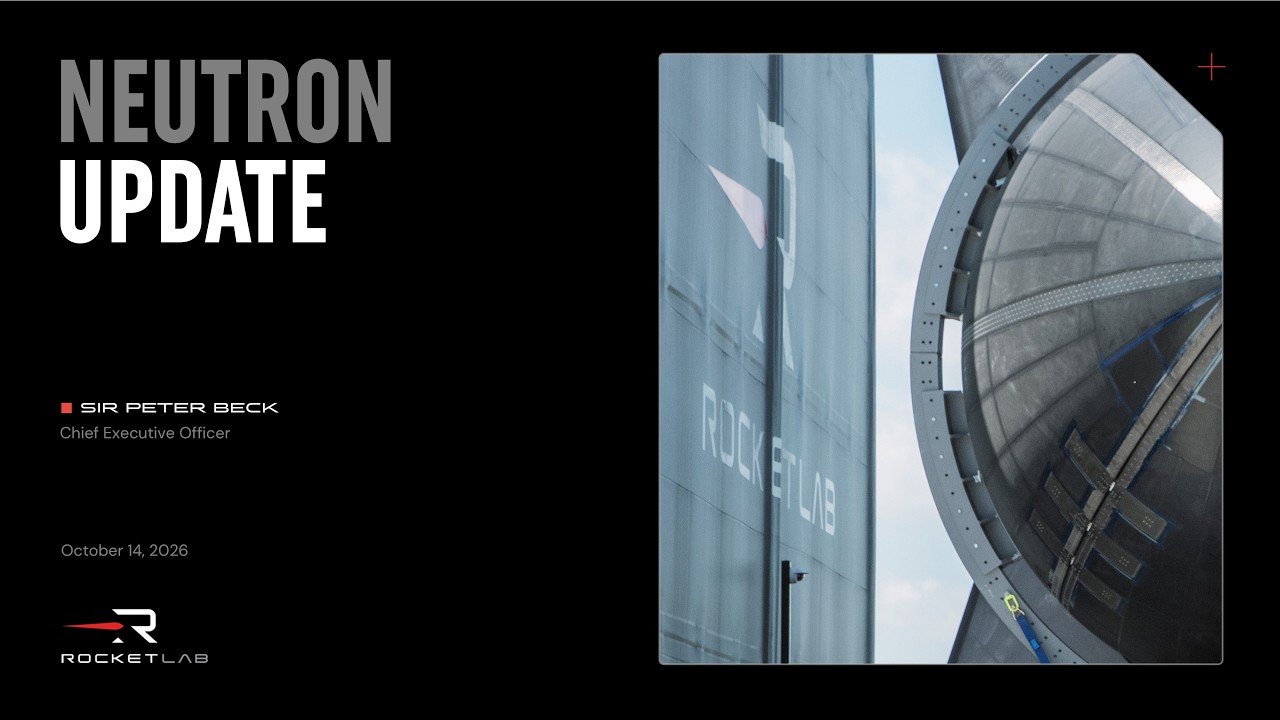
Rocket Lab CEO Sir Peter Beck explains why Neutron's first flight has moved into 2027. Voids were found in the newly cured forward dome of the first stage, and the company has identified a cause and added mitigations. He lists the steps needed before a new target launch date can be given.
Full written account
Rocket Lab has moved the first flight of its Neutron rocket into 2027. In an update led by CEO Sir Peter Beck, the company said a manufacturing problem with the first stage propellant domes pushed the schedule. During an inspection of the newly cured forward dome, engineers found voids, tiny air pockets, within the carbon composite layers.
How the first stage reached this point
Earlier this year, the first stage tank Rocket Lab built failed qualification due to a third-party manual hand-lay process. The company then moved to its long-term production process using the automated fiber placement (AFP) machine, which lays down carbon with speed and accuracy. The change also allowed design improvements: eliminating the insert and thickening the sections for the propellant aft and forward domes to increase strength.
Many parts have since been made on the AFP machine, including the first stage barrels and the propellant domes.
The voids
Carbon composite sections are cured through a heat-activated chemical reaction that turns epoxy into a solid cross-linked polymer binding the fibers. This is typically done in an autoclave, but autoclaves have a size limit. Beck described Neutron as the largest pressurized structure ever made from carbon composite, so Rocket Lab developed out-of-autoclave processes, including custom cure cycles for the large forward and aft domes.
If the process is not perfect, voids can form between the layers and compromise strength, durability and reliability. Beck said the voids do not necessarily mean the dome would fail in flight, but that the company proceeds only when it believes the system has appropriate margins: "Possible success isn't our standard."
Cause and fix
Analysis and testing showed the process was already very close to right when the forward dome was built. After stage one qualification, however, a design change deleted joints and thickened the carbon composite in some areas, and the voids formed in those thicker sections. Rocket Lab replicated the issue in testing and added mitigations to the manufacturing process.
The after dome was then run through the new process and produced the highest quality carbon composite dome to date. Beck said this gave complete confidence to proceed with a new forward dome. Building that dome, together with the time spent investigating and resolving the issue, pushed the first launch to next year. Rocket Lab is also using the time to bring forward upgrades to other parts of the vehicle planned for future flights.
What happens next
No new date was given. The steps are:
- Build the forward dome on the AFP machine, which is already underway.
- Cure it and analyze it with ultrasonic testing and other inspection methods to confirm there are no voids or further issues.
- Assemble the forward and aft half domes and other components into the entire first stage, then run the hydrostatic test campaign followed by the cryo test campaign.
Rocket Lab expects the first two steps to be completed before Q1, with the third wrapped up within that quarter, after which it expects to share a new target launch date. Beck said he would rather show real-time progress than give a date that might have to be walked back, and promised updates on the website and social media.
Why the company is not rushing
Beck said Rocket Lab is not rushing to the pad with a minimum viable product that may need re-qualification repeatedly. He said the new techniques take time now but bring scaling benefits later, and that a second and third rocket are already being built before flight one. He also pointed to earlier firsts: Electron as the world's first carbon composite orbital rocket, Rutherford as the first 3D printed orbital rocket engine, and launch complex one as the world's first private orbital launch site. He said some new contracts will be announced soon.
Questions this video answers
When is Neutron's first flight now planned?
The first launch of Neutron has moved into 2027.
What caused the delay?
Voids, or tiny air pockets between carbon fiber layers, were found in the newly cured forward dome during inspection. They formed in thicker sections created by a design change made after stage one qualification.
Has the problem been fixed?
Rocket Lab says it has added mitigations to the manufacturing process. An after dome run through the new process was the highest quality carbon composite dome to date.
Is there a new launch date?
Not yet. Rocket Lab expects the first two steps to be done before Q1 and the third within that quarter, and then to share a new target date.
Why did the company switch to the automated fiber placement machine?
The first stage tank built earlier this year failed qualification due to a third-party manual hand-lay process.