Electron’s 93rd Launch Puts iQPS Radar Satellite in 575 km Orbit
The short version
Rocket Lab launched Electron on The Lightning God Defends mission for iQPS from Launch Complex 1 in Mahia, New Zealand, on 20 August 2026. The kickstage deployed a QPS-SAR satellite into a 575 km low Earth orbit, and payload deployment was confirmed about 48 minutes into the mission, the broadcast said.
Full written account
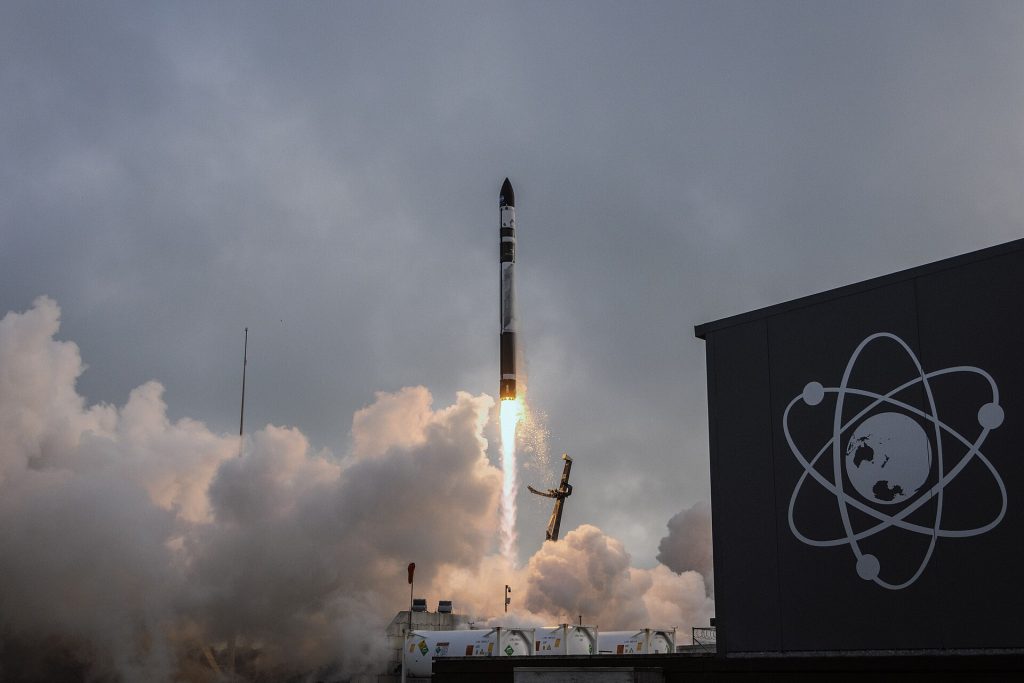
Rocket Lab's Electron lifted off from Launch Complex 1 on the Mahia Peninsula, New Zealand, on 20 August 2026 at 13:04 UTC (1:04 a.m. local time) and delivered a radar-imaging satellite to a 575 km circular orbit. The mission, named The Lightning God Defends, was the 93rd Electron launch and the 14th of 2026. It carried the ninth QPS-SAR satellite for the Japanese company iQPS, nicknamed SUSANOO-II. It was the first time the constellation's lightning god had been flown a second time.
A naming tradition
Every iQPS mission so far has been named for a Japanese deity chosen to represent the role of the next satellite in the constellation. Earlier launches were named after gods and goddesses of wisdom, the ocean and the mountains. Rocket Lab had flown eight missions for iQPS before this one, all from Launch Complex 1. In the month before the launch, Rocket Lab announced a deal for three more iQPS launches, the third multi-launch booking the customer had made on Electron in less than a year.
What the satellite does
QPS-SAR satellites use synthetic aperture radar. Radio waves bounce off terrain and objects below, producing high-resolution images regardless of weather or time of day. Optical satellites cannot see through clouds or at night. iQPS, founded in Fukuoka, marked its 20th anniversary in 2025. It works with more than 25 partner companies, mainly in northern Kyushu, and is working toward a 36-satellite constellation aimed at near real-time observation almost anywhere on Earth. Its first satellite launched in December 2019. A new R&D hub, established in March 2025, integrates manufacturing, testing and shipping on one floor and can produce up to 10 satellites per year. The data is used for inspecting large infrastructure and monitoring wildfires, earthquakes and eruptions.
The vehicle
Electron flew in its standard configuration: two stages plus a kickstage, an in-space maneuvering platform. It is about 18 m tall and can deliver up to 320 kg to orbit. Nine Rutherford engines power the first stage and one vacuum-modified Rutherford powers the second. These are described as the first engines to use an electric pump-fed cycle powered by lithium polymer batteries, and are almost entirely 3D printed, with main components manufactured in 24 hours. Engines ignite at T-minus 2 seconds.
Countdown and flight
The launch status check began at T-minus 12 minutes, with stations including stage, avionics, GNC, range safety and weather all reporting go. Launch director Julia Vbaka ran the poll. The auto sequence began at T-minus 2 minutes, the vehicle went to internal power, and the flight termination system was reported green and enabled. Weather carried only a 20% chance of exceeding constraints.
After liftoff, the broadcast reported passing max Q, the point of greatest structural stress, then traveling at more than 2,000 km/h. Main engine cutoff, stage separation and second stage ignition came at about T+2:30, and the vehicle was then moving at over 8,000 km/h. Fairing jettison was confirmed with just over four minutes elapsed.
Because the second stage burns about three times longer than the first, it needs fresh batteries. In the battery hot swap, a depleted pack disconnects and falls away while the engine keeps running; mission control confirmed battery jettison and a successful hot swap. Just past eight minutes the vehicle was above 263 km and moving at more than 22,000 km/h. Second engine cutoff and stage separation followed, leaving the kickstage in a nominal transfer orbit.
Orbit and deployment
The kickstage coasted for about 40 minutes in an elliptical transfer orbit. Its Curie engine then fired to circularize the orbit at 575 km, targeting a 42-degree inclination. Curie cutoff was confirmed and the satellite deployment was confirmed, after which iQPS began commissioning.
Ghost and what comes next
The broadcast also covered Rocket Lab's new deployable launch system, Ghost (global hypersonic and orbital spaceport technology), which packs launch infrastructure, ground support and range control into standard shipping containers. It will anchor a new Launch Complex 4 in Kodiak, Alaska, and the company's largest launch contract, for up to 18 suborbital launches for the Space Force's Space Systems Command. Electron and HASTE use the same infrastructure. The hosts said the 100th Electron launch was a few launches away.
Questions this video answers
When and where did The Lightning God Defends launch?
20 August 2026 at 13:04 UTC (1:04 a.m. local time), from Launch Complex 1 on the Mahia Peninsula, New Zealand.
What did Electron carry?
The QPS-SAR satellite nicknamed SUSANOO-II for iQPS, delivered to a 575 km circular low Earth orbit.
Did the mission succeed?
Payload deployment was confirmed after the kickstage's Curie engine circularized the orbit, and the broadcast called it another successful mission.
Which Electron launch was this?
It was Electron's 93rd launch and Rocket Lab's 14th launch of 2026.
Explore related missions
Connected by the topic: Electron