Four Satellites That Came Back: LES-1, AO-7, IMAGE and BeeSat 1
The short version
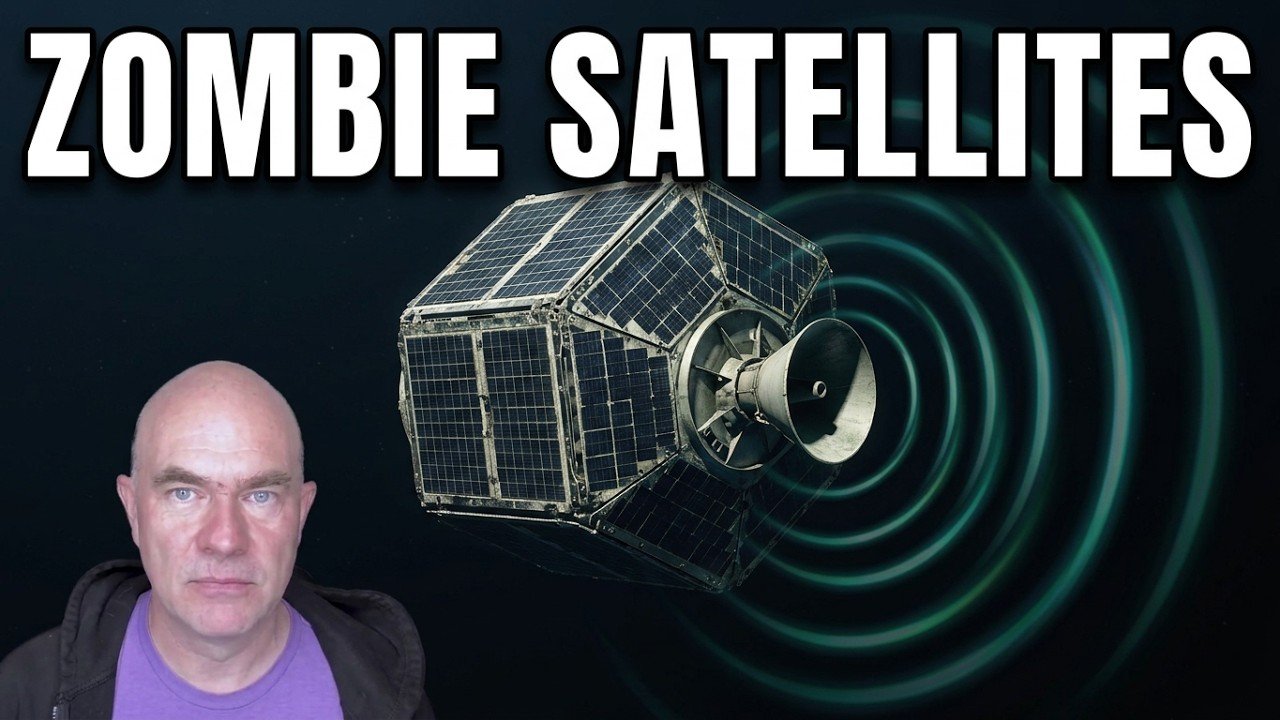
Scott Manley tells the stories of four satellites that went silent and later transmitted again: LES-1, AMSAT-OSCAR 7, IMAGE and BeeSat 1. For the first three he gives a likely battery or power-system explanation. BeeSat 1 was revived deliberately by a student, who built a test satellite from salvaged parts to do it.
Full written account
Four satellites that had gone quiet were heard transmitting again, one of them silent for 21 years. Scott Manley's tour of these "undead" spacecraft starts with a battery fault that can reverse itself and ends with a student who rebuilt a satellite's software four bytes at a time.
LES-1: a signal after 45 years
LES-1, the first Lincoln Experimental Satellite, was built by MIT's Lincoln Laboratory for the US Air Force to test military satellite communications. It launched on February 11th, 1965 from Cape Canaveral on a Titan 3A. A wiring error in the ordnance system stopped the solid kick motor from firing, so it stayed in a roughly circular orbit about 2,800 km high. It still transmitted for about two years before going silent in 1967.
On December 18th, 2012, a British amateur radio operator in Cornwall picked up a signal on 237 MHz. Amateurs in Brazil and Germany confirmed it within days. The signal faded and strengthened on a 4-second cycle, which suggested the satellite might be tumbling.
The most plausible explanation involves the nickel-cadmium batteries. Cadmium can pass through the membrane between the plates and form a bridge, and the resulting short circuit pulls solar power away from the electronics. If heating or chemical change later breaks that bridge, the circuit opens again and the power can reach the transmitter, but only in sunlight. Lincoln Lab set up an automated rooftop antenna at its Lexington campus to detect LES-1 whenever it passes overhead.
AMSAT-OSCAR 7: back after 21 years
AO-7 was an amateur radio satellite built by AMSAT with linear transponders. It launched in November 1974 on a Delta as a secondary payload with NOAA-4, into a near-polar sun-synchronous orbit about 1,450 km up. It worked for nearly seven years, until mid-1981, when its nickel-cadmium batteries shorted and took down the power system.
In June 2002 a British amateur scanning the 2-metre band heard slow Morse code on 145.97 MHz, Doppler shifted as a satellite's signal would be. It began and ended with "hi hi", the old Amsat identifier, and held groups of three-digit numbers. These matched the Morse telemetry format of the early Oscar satellites: 24 channels of battery voltages, currents and temperatures. Jan King, the original project manager, said the only explanation was that a shorted battery cell had gone open-circuit.
AO-7 still works for voice and other contacts whenever the sun lights it, and goes silent in eclipse. Amsat lists it as operational as of 2026, and the video calls it the oldest satellite still performing its original function. A claim that the Polish Solidarity movement used it in 1982 has no real evidence behind it, according to Manley.
IMAGE: a brief return in 2018
IMAGE, the Imager for Magnetopause Aurora Global Explorer, was the first spacecraft dedicated to imaging Earth's magnetosphere. It launched in March 2000 on a Delta II from Vandenberg into a highly elliptical polar orbit reaching 46,000 km, and was designed for a 2-year mission. Contact was lost during a routine pass in December 2005. The failure review board concluded the most likely cause was a single event upset that tripped the solid-state power controller feeding the transponder. A deep eclipse that drained the battery was meant to reset the computer, but the 2007 opportunity did not revive it.
In January 2018 Canadian amateur Scott Tilley, searching for the Zuma satellite, picked up a strong signal matching IMAGE's known orbit. NASA's Deep Space Network and Johns Hopkins Applied Physics Laboratory locked on, and on 30 January decoded the spacecraft ID and basic housekeeping. The battery was fully charged and temperatures were normal. The craft had rebooted into the A-side power distribution unit, thought dead since a glitch in 2004.
The signal then became intermittent, and in May only a fraction of commands were acknowledged. By August NASA decided IMAGE had returned to its quiet death. Manley's explanation for the revival is a later deep eclipse, probably between 2014 and 2016, that forced the reset. NASA noted the signal strength matched the spin period, which raised the possibility of a drifted spin axis. The ground systems needed to command the payload no longer existed.
BeeSat 1: revived on purpose
BeeSat 1 was a 1U CubeSat from Technische Universität Berlin, launched in September 2009 on a PSLV. After a couple of years it returned invalid telemetry. The backup computer fixed this temporarily, but in 2013 the same problem hit the backup, and the satellite sent only frames of zeros.
In 2024 a student known as Piston Miner took it on as his bachelor's thesis and presented it at the 38th Chaos Communication Congress in Hamburg. The zeros were valid frames. The routine assembling telemetry ran too infrequently, because a reboot counter written to memory could, when a watchdog timer interrupted a NAND flash write, wipe the stored interval. Shortening the interval by command restored real telemetry.
Questions this video answers
Why might LES-1 and AO-7 have started transmitting again?
The likely explanation given is that a short circuit inside a nickel-cadmium battery, formed by a cadmium bridge, later broke. The circuit then became open again and solar power could reach the transmitters.
How long was AO-7 silent?
It was silent for about 21 years after its batteries shorted in mid-1981, until a British amateur heard it in June 2002.
Is AO-7 still working?
Yes. The video says it works for voice and other contacts whenever the sun lights it, goes silent in eclipse, and is listed by Amsat as operational as of 2026.
Why did NASA stop working with IMAGE after 2018?
The signal became intermittent and commands were only partly acknowledged. By August 2018 NASA decided the spacecraft had returned to its quiet death.
How was BeeSat 1 brought back?
A student called Piston Miner sent patches four bytes at a time during 15-minute passes. He first tested the update sequence on a test satellite assembled from salvaged parts.