How the Vandenberg Range Decides Launch Weather, Zones and Destruct
The short version
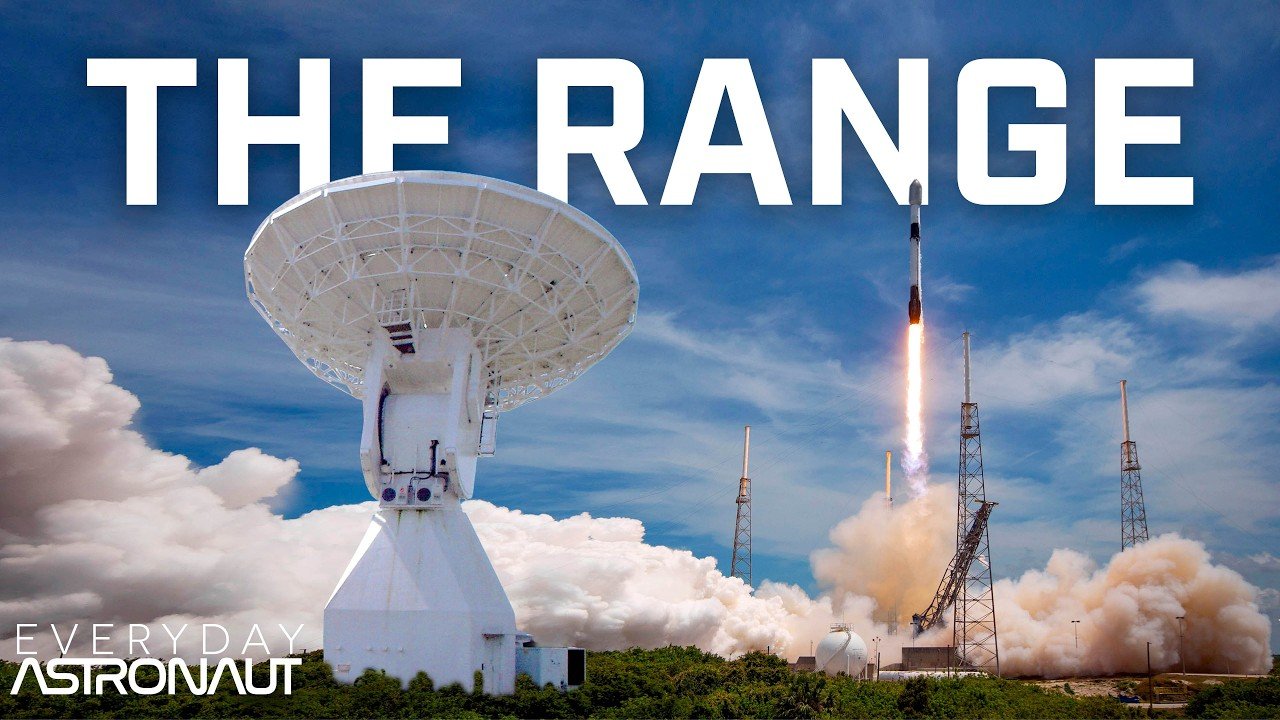
A tour of the range at Vandenberg Space Force Base, produced with the U.S. Space Force, explaining how range teams handle launch weather constraints, exclusion zones for aircraft, ships and trains, and flight termination. It covers lightning launch commit criteria, weather balloons, the launch decision authority, the mission flight control officer's destruct button, and tracking through ascent.
Full written account
Range teams at Vandenberg Space Force Base in California decide on launch day whether a rocket is safe to fly. Tim Dodd of Everyday Astronaut visited with the U.S. Space Force, which sponsored the video, and was shown how weather, exclusion zones and flight termination fit together. Some rooms were so classified that cameras were not allowed in.
What the range is
The range is both a physical location and the teams who make the safety decisions. Vandenberg is served by Space Launch Delta 30, and Kennedy Space Center and Cape Canaveral Space Force Station by Space Launch Delta 45. Wallops, the Pacific Spaceport in Alaska and SpaceX's Starbase each have their own range operations. The primary goal is public safety, and the next goal is mission success.
A Space Force risk engineer explained that risk is a number. It accounts for planes, trains, automobiles and boats near the launch, and for the history of the vehicle: a first launch is assessed differently from a 400th. The aim is as many nines after the decimal as possible, since zero risk is mathematically impossible. The trajectory sets a corridor the rocket must stay within, and that corridor helps define the exclusion zones. As Falcon 9 built up flight history, the hazard areas around launches and landings could shrink, and that cadence is one reason SpaceX is allowed to fly polar orbits out of Florida, which requires overflying Cuba.
Weather and lightning
Launch weather officer Addison Nichols said the work centres on lightning launch commit criteria. A rocket's exhaust plume connects it to the ground and, in the wrong atmospheric conditions, can trigger lightning.
Apollo 12 was struck twice on November 14, 1969. Ground controller John Aaron recognised the data pattern from simulations and recommended moving the signal conditioning equipment switch to auxiliary; Alan Bean flipped it and the signal issues cleared. NASA then adopted stricter criteria, including not launching within 8 kilometres of thunderstorms. In 1987 an Atlas Centaur 67 carrying a Navy communication satellite was struck 49 seconds into flight, causing a guidance and navigation error and the loss of the vehicle, and new criteria followed. They include no lightning within 16 km of the pad, a minimum 6.4 km visibility, a 1.8 km ceiling for radar tracking and ground winds up to around 55 km an hour at the pad.
Wind data comes from towers, Doppler wind profilers and balloons. Balloons feed toxic-plume and blast assessments, and let providers check whether wind shear at max Q could exceed what a vehicle can handle. Vandenberg launches balloons twice a day, with extras during launch campaigns; they typically reach about 100,000 ft before bursting.
Exclusion zones
In the area control center, an airspace safety officer watches air traffic and a marine safety officer monitors ships, coordinating with the Coast Guard. Pilots are told of temporary flight restrictions through a NOTAM, and mariners through notices to mariners. Ground safety officers keep people out of the zone on the ground. Trains at Vandenberg have priority over a launch, because they were there before the base.
All range safety officers report to a range operations commander in the range control center, who passes information to the launch decision authority. Range staff cannot press a pause button on an automated countdown; a red range is called over the countdown net and an engineer cancels the sequence. Inside 45 seconds from launch, all constraints are removed except the mandatory safety ones. After the go/no-go poll, a "hold hold hold" over the nets cancels the countdown.
Flight termination
The mission flight control officer, or MIFCO, can terminate a rocket that veers off course. Their station has video feeds, infrared cameras that see through clouds, a foot switch for communications, and a screen plotting the trajectory, the termination line and the debris impact zone, with buttons marked arm and destruct.
The main goal of termination is to stop thrust. Methods include engine shutdown, as with Astra's Rocket 3; thrust termination ports on solid motors; linear shaped charges, triggered on the Falcon 9 CRS-7 mission in 2015; and high explosive charges. On Starship's first launch the charges blew holes in the rocket, which continued to spiral intact, and the system was strengthened for flight 2.
A delay before terminating is intentional: more data reaches the ground, and waiting can shrink the debris field. Since 2017 rockets have been moving toward an automated flight termination system.
The MIFCO replayed Firefly Alpha's first launch, on September 2, 2021. About 15 seconds in, an engine's power connector came loose and shut down one of four engines. The vehicle kept climbing for about 2 and a half minutes before losing control, and was terminated close to the termination line.
Tracking
Questions this video answers
What is the range?
It is the physical location supporting a launch and, more importantly, the teams who decide on launch day whether it is safe to launch. Each launch site has a dedicated range.
Who has the final say on launching?
The launch decision authority (LDA) is in charge of the launch. They rely on information passed up by range operations commanders.
What does a flight termination system do?
Its main goal is to stop thrust so the rocket follows a ballistic trajectory and lands within the debris impact zone. Methods include engine shutdown, thrust termination ports, linear shaped charges and high explosive charges.
Why does the mission flight control officer sometimes wait before terminating?
As long as the rocket has not crossed the termination line, more data can be sent to the ground to help find the root cause, and delaying can reduce the debris field.
How high do Vandenberg weather balloons go?
They typically rise to about 100,000 ft before bursting, and are released twice a day.
Explore related missions
Connected by the topic: Electron