Inside Stoke Space: Nova’s Zenith and Andromeda Engines
The short version
Everyday Astronaut's Tim Dodd tours Stoke Space in Washington and at its Moses Lake test site with CEO Andy Lapsa. The tour covers the Hopper test vehicle, the Nova rocket's Zenith first-stage engine and Andromeda upper-stage engine with its actively cooled heat shield, manufacturing and test infrastructure, and ends with an Andromeda hot fire. Nova has not yet flown.
Full written account
Stoke Space is building Nova, a fully reusable rocket with a hydrogen upper stage whose engine is fitted into an actively cooled heat shield and a first stage powered by seven full flow staged combustion engines. In a tour with CEO Andy Lapsa, Everyday Astronaut visited the company's facility and its Moses Lake test site, where the Andromeda upper-stage engine was hot fired on camera.
Hopper and the heat shield
Hopper, structure number two, flew at Moses Lake. FAA limits meant it flew almost with empty tanks, so the flight was modest in altitude. Its objectives included measuring the thrust vector control impulse and validating a rolling variance in the GNC algorithm. The vehicle has 30 thrust chambers but flew with 15, at minimum throttle. The same engine had seen thousands of seconds of test time.
A single set of turbopumps, one for oxygen and one for fuel, feeds all the thrusters in an expander bleed cycle. Fuel flows through the heat shield, which feeds the chambers, so it is integral to the system. The shield is effectively steel, and Hopper's slanted shape gives some cross range.
Andromeda's upgraded design
The new Andromeda heat shield drops the steep side walls, giving a larger surface area for re-entry stability and slightly better vacuum performance. Thruster expansion ratio is around 50, and a special dual bell implementation lets the nozzles attach differently at sea level. Hydrogen's heat capacity means four to seven times less coolant mass is needed than with other propellants, and Lapsa says it can take much higher heat fluxes than an uncooled shield, including returns from the Moon or Mars.
The second stage lights during the end of the first stage burn in a hot separation. Its thrusters sit just outside the first stage ring, so there is no direct impingement. Lapsa says Andromeda produces just under 30,000 lb of thrust, with ISP a little north of 420. Each thrust pod uses one valve to control fuel and oxidizer to two chambers, reducing the count to 24 thrusters. Propellant leaves the pumps as liquid, cools the thrusters first, then flows through the heat shield, the hot gas throttle valve and the turbines before leaving through the exhaust manifold.
Zenith and full flow
Zenith is full flow staged combustion, a decision made less than two weeks before it was first mentioned publicly. The oxygen preburner chambers are printed in an in-house alloy and run at about 5,000 PSI (about 300 bar), while the main chamber is over 2,000 PSI. Turbines run cool, which Lapsa ties to long life. Nozzles are made of 3D-printed copper panels joined together, with no liner.
Each engine produces about 100,000 lbs, designed for at least double, with chamber pressure about 2,200 PSI and minimum throttle about 45%. The first engine fired about 18 months after the full flow decision, in April. Lapsa called the start sequence the biggest risk of the program and said it worked with the first test article.
First mission
The first flight aims for a high energy orbit. Lapsa said it would be the first time an entity reached orbit on its first try with its first rocket. There will be no booster landing legs and no upper stage re-entry on flight one. Later landings follow a Falcon 9-like progression, either returning to launch site or downrange.
Manufacturing and tooling
The avionics lab runs a flat rocket hardware-in-the-loop setup with nightly Monte Carlo simulations. The in-house Bolt Line software handles procurement, inventory, build and test procedures, and ties each part's serial number to its test history. Tanks start as sheet metal in a fabrication area called the strip mall, with common domes and slosh baffles that damp propellant motion. Welding is not friction stir; Lapsa mentioned laser welding as effective. The Florida pad got environmental approval on October 20 and dirt was moving the next day; Lapsa said it should be an active launch pad by about the end of the year.
Moses Lake
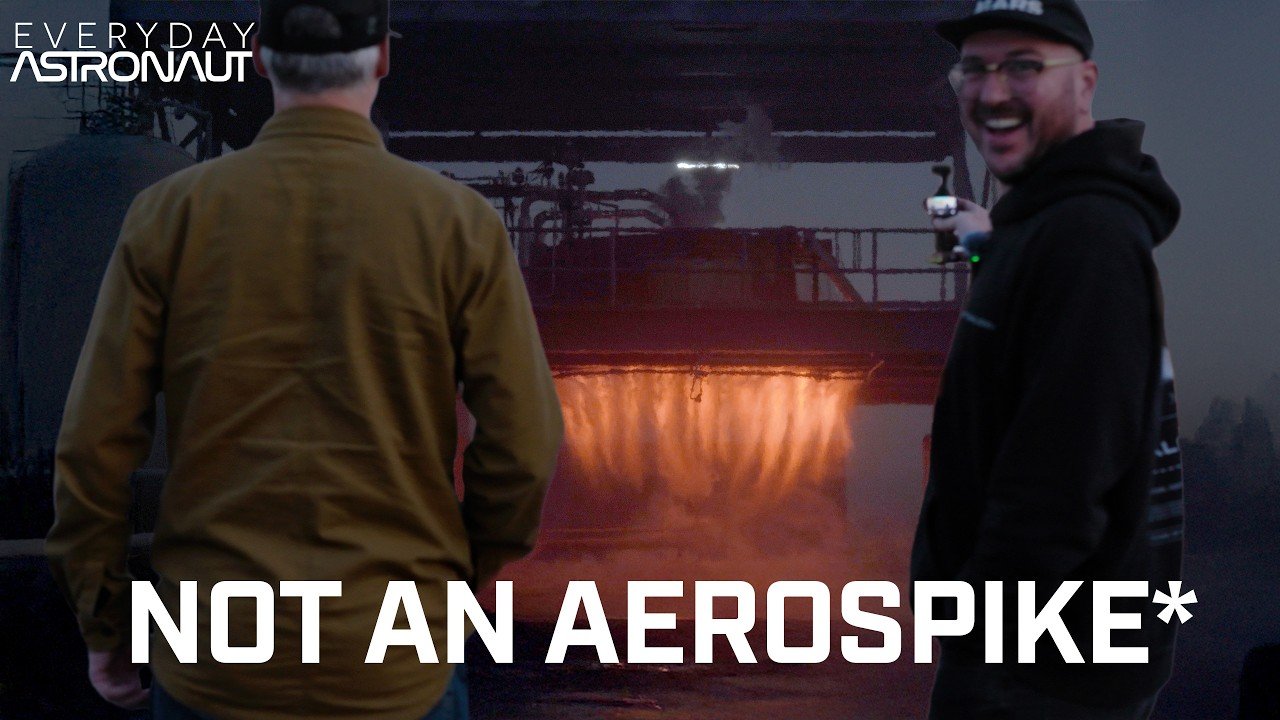
A sprayer system on the Andromeda test stand sprays water on the heat shield to vary the heat input, because heat flux in space differs from on the ground. An ejector built as an intern project creates a vacuum for testing thrust modules with nozzle extensions. The Zenith stand has six degrees of freedom thrust measurement and a flame bucket about 60 to 65 ft deep. The visit ends with an Andromeda hot fire running a mission duty cycle slice with power and mixture ratio sweeps. Tim Dodd called it the coolest engine he had seen fire.
Questions this video answers
What is special about Nova's upper stage?
Its Andromeda engine is aerospike-like, hydrogen-fueled and built into an actively cooled heat shield, with regenerative cooling channels that carry fuel through the shield.
What engine cycle does the first stage use?
The Zenith engines use full flow staged combustion, which Lapsa says the team chose for rapid, long-life reuse.
What is the goal of Nova's first flight?
To reach a high energy orbit on the first try. There will be no landing legs on the booster and no upper stage re-entry on flight one.
How much thrust does a Zenith engine produce?
About 100,000 lbs, designed for at least double that, with chamber pressure around 2,200 PSI and minimum throttle about 45%.
What is Bolt Line?
In-house software that tracks procurement, inventory, build, test and launch procedures, and the full configuration and test history of each part.