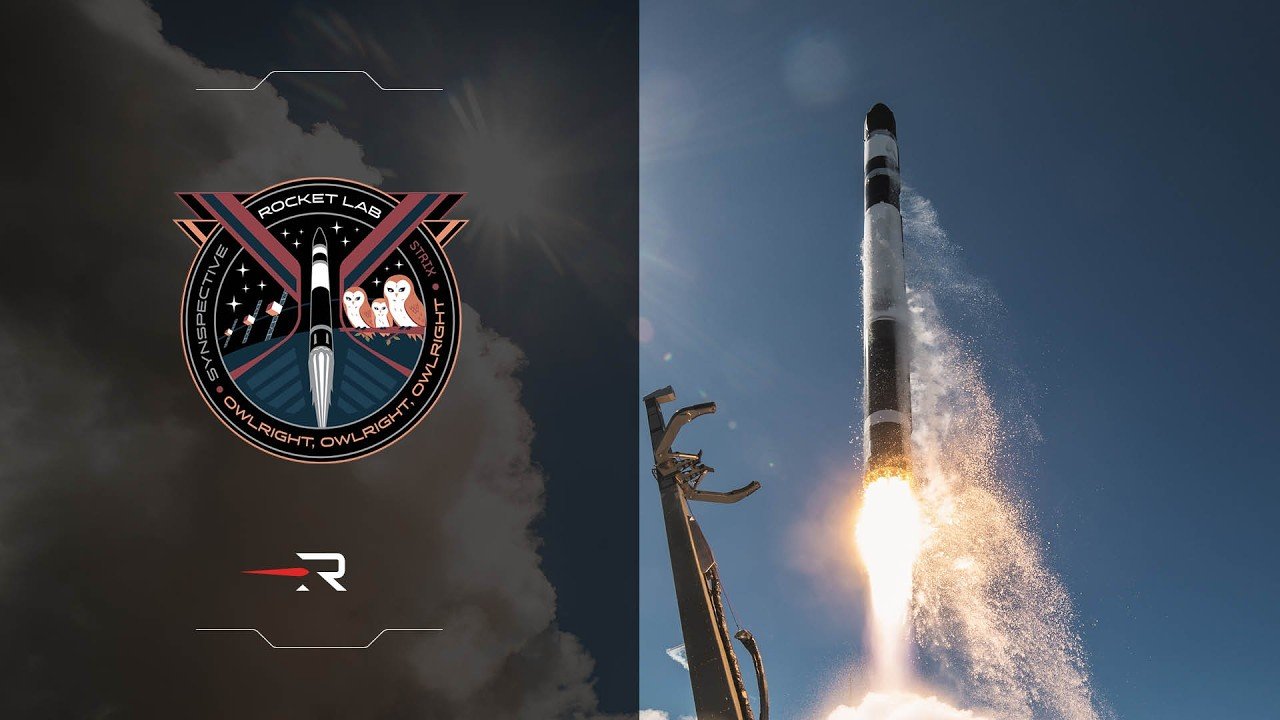
Owl By The Dozen: Electron Deploys a 12th StriX Radar Satellite
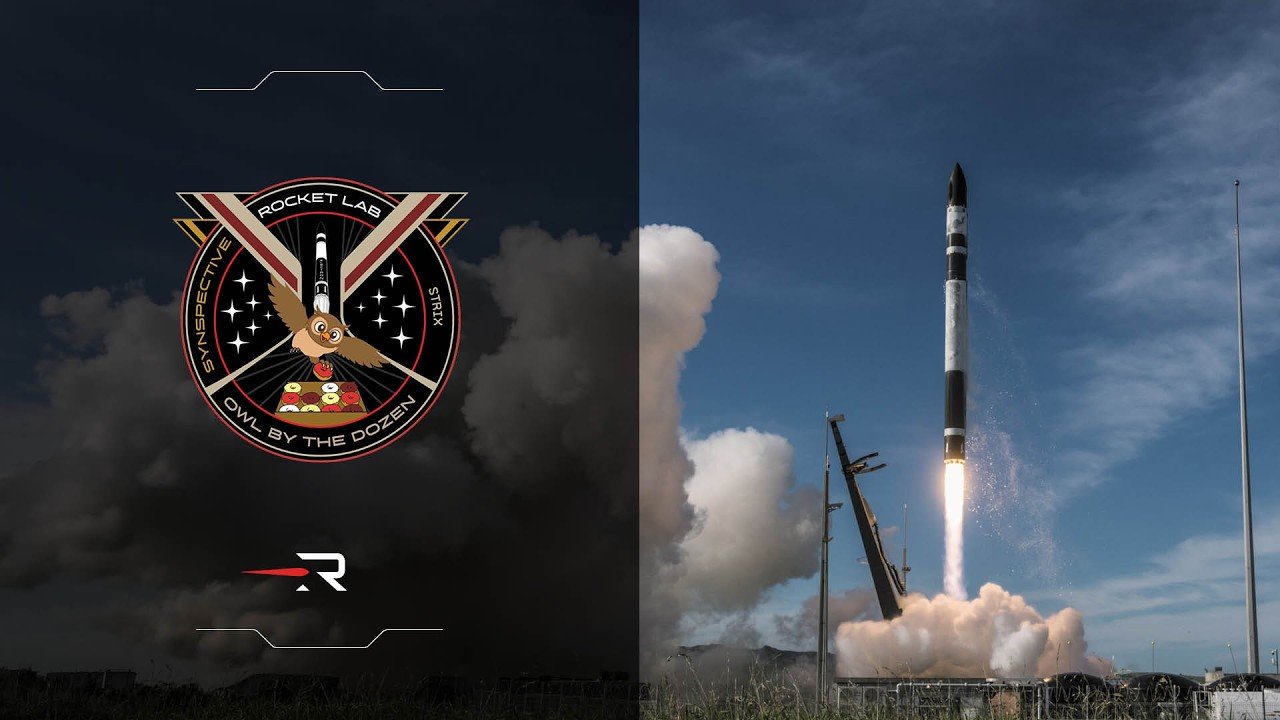
The short version
Rocket Lab launched Electron from Launch Complex 1 in New Zealand on 19 September 2026 with a StriX radar satellite for Synspective. The mission, named Owl By The Dozen, was the 12th dedicated launch for Synspective and Rocket Lab's 96th Electron launch. The broadcast confirms payload separation in a 572 km orbit.
Full written account
Rocket Lab's Electron lifted off from Launch Complex 1 on the Mahia Peninsula, New Zealand, on 19 September 2026 at 03:22 UTC, carrying a single StriX synthetic aperture radar satellite for Japan-based Synspective. The mission, named "Owl By The Dozen", was Rocket Lab's 12th dedicated launch for Synspective and the 96th Electron launch overall. It ended with the satellite deployed to a 572 km orbit and, in the broadcast's words, 12 launches with 100% mission success for the customer.
The mission and its orbit
The launch was the 17th Electron of the year. It flew from pad B at Launch Complex 1 on a 38° inclination, heading southeast. The target was a mostly circular orbit at 572 km with a slightly lower perigee of 536 km. The 3:22 p.m. local New Zealand liftoff time was 12:22 p.m. in Japan, where Synspective's satellite operators were standing by.
The mission name marks the 12th dedicated launch for Synspective. Rocket Lab has been the sole launch provider for the constellation for the past six years, and another 15 StriX satellites are booked to fly on Electron to complete it before 2030. Rocket Lab's presenters said dedicated launches let the customer dictate exactly where and when each satellite slots into place, which would not be possible on a rideshare.
StriX satellites use synthetic aperture radar, measuring the bounce of radio waves between Earth and the satellite. This lets Synspective capture imagery at any time of day, at night and through clouds, for urban development, construction and infrastructure monitoring, and disaster response.
The vehicle
Electron is a two-stage rocket, 18 m tall and 1.2 m in diameter, built from lightweight carbon composite. It is light enough to be rolled out by hand from its hangar to the pad. Without propellant it weighs about 1,000 kg, rising to 13 times that once liquid oxygen and kerosene are loaded.
- Rutherford engines: 3D printed and named after Sir Ernest Rutherford. They use batteries to power electric motors that drive the fuel pumps. Nine sit at the base of the first stage and a single one powers the second stage.
- Stage timing: the nine first-stage engines drain the tanks in about two and a half minutes, while the second-stage engine has just over six and a half minutes of runtime, bringing the vehicle to more than 27,000 km an hour.
- Kickstage: the platform that holds the payload under the fairing. Its Curie engine, named after Marie Curie, is 3D printed and can restart multiple times in space for precise payload placement.
Countdown and launch
At T-minus 12 minutes launch director Paz Serongia ran the final go/no-go poll, and every station reported go. The terminal count began at T-minus 10 minutes. At T-minus 2 minutes the auto sequence started, the vehicle switched to internal power, and the autonomous flight termination system (AFTS) was green and enabled for flight. Both stage tanks were pressed for flight before the final count from 10 seconds.
- T+1:08: Electron passed through max Q, the point of maximum aerodynamic pressure, at more than 17 km altitude and above 1,900 km an hour.
- Main engine cutoff and stage separation: confirmed, followed by stage two ignition.
- Fairing jettison: shown on the onboard cameras, with the vehicle past 8,000 km an hour.
- About 3 minutes 50 seconds: speed above 8,700 km an hour.
- Battery hot swap: an action used only on Electron, in which the batteries powering the second-stage Rutherford are ejected and a fresh set takes over. It was confirmed successful.
- Second engine cutoff: confirmed, with a nominal transfer orbit achieved and the kickstage separated.
Reaching the final orbit
After separation the kickstage coasted in an elliptical transfer orbit. About 40 minutes after second engine cutoff, the Curie engine performed a correction burn to circularize. Curie cutoff was confirmed, and shortly afterward payload separation was confirmed. The 12th StriX satellite was in orbit at 572 km, completing the 96th Electron mission.
The broadcast noted that the launch came about two weeks after the previous Synspective mission and one week before the next, with another Electron flight planned about the same time the following week. Synspective's team moved on to commissioning the new satellite.
Questions this video answers
When did Owl By The Dozen launch?
19 September 2026 at 03:22 UTC, which was 3:22 p.m. local New Zealand time.
Where did it launch from?
Pad B at Launch Complex 1 on the Mahia Peninsula, New Zealand.
What did Electron carry?
A single StriX synthetic aperture radar Earth-imaging satellite for Synspective, deployed to a 572 km orbit.
Why is it called Owl By The Dozen?
It was Rocket Lab's 12th dedicated launch for Synspective and the 96th Electron mission overall.
Was the mission successful?
Yes. The broadcast reports payload separation confirmed and the satellite deployed to its 572 km orbit.
Explore related missions
Connected by the topic: Electron