Smile: How ESA and China Built a Satellite in Two Years
The short version
ESA's documentary covers two years of the Smile mission, a 50–50 collaboration between ESA and the Chinese Academy of Sciences. It follows the payload module and platform arriving at ESTEC in the Netherlands, their integration, testing, shipment to French Guiana and launch preparations. The film ends with the announcement that a signal was received from the satellite and its solar panels were deployed.
Full written account
How do a European payload module and a Chinese platform become one working satellite? ESA's Smile mission, a 50–50 collaboration between ESA and the Chinese Academy of Sciences, went from separate pieces to a satellite that deployed its solar panels in space, with the film covering June 2024 to May 2026.
What Smile is meant to see
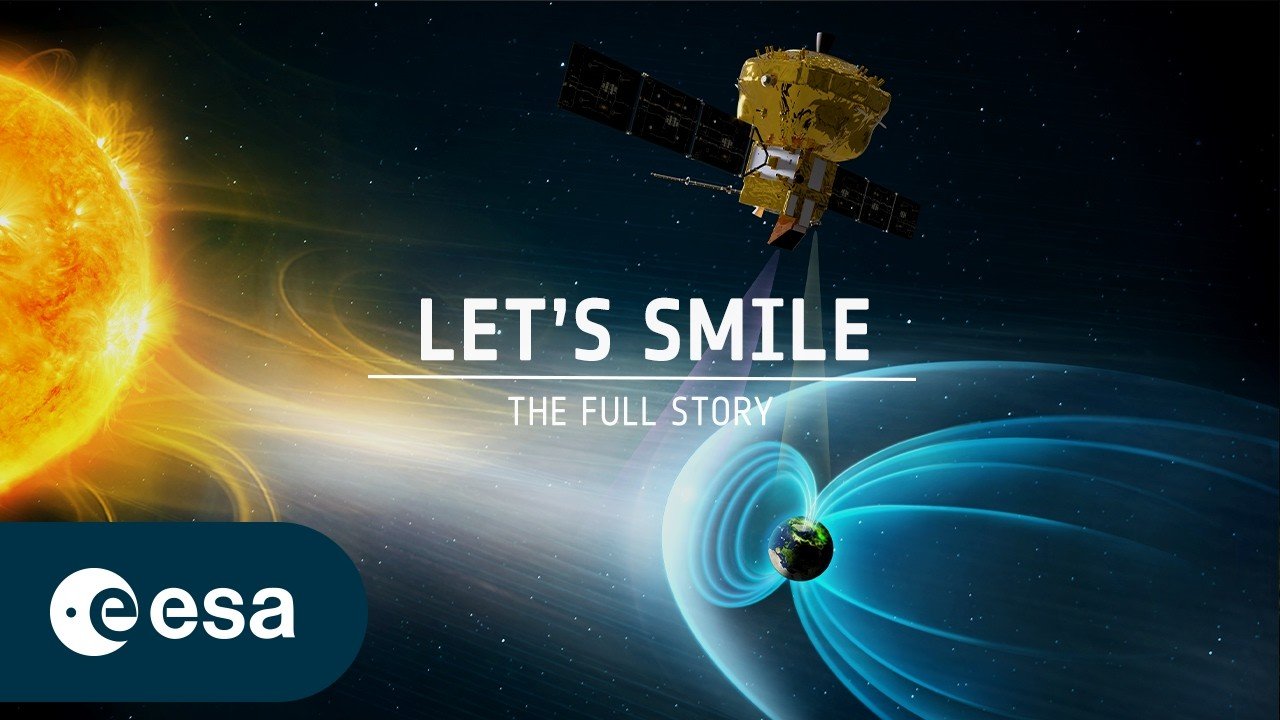
Smile aims to make the invisible visible: clouds of dense plasma leave the Sun toward Earth and are seen for a few hours but then not seen interacting with Earth. Europe is responsible for the payload module on top of the spacecraft, which holds three instruments; another sits on the platform below, which is China's responsibility. The four instruments are a light ion analyzer, a magnetometer on a 3 m boom, a soft X-ray imager and an ultraviolet imager. Imaging in X-rays is a first for this kind of mission, and the ultraviolet band removes the dayglow so aurora can be seen on the day side.
The name came from a Chinese colleague's simulation of Earth's magnetosphere as an X-ray instrument would see it; the image looked like a smile.
Building the payload module
The soft X-ray imager was unpacked and integrated onto the payload module base plate. A thermal interfiller under the front end electronics needed time to creep, so the team waited a rest day and re-checked the torque before installing the telescope. An ionized flow was set up to reduce the risk of electrostatic damage to the CCDs.
The flight model of the payload module arrived at ESTEC from Airbus in Madrid. Electronics there had a hiccup, the unit was dismounted and repaired within a month. During boom testing, the magnetometer boom released but did not lock because a harness was too stiff and incorrectly mounted; the fix was quick and the release succeeded the next day.
Joining the two halves
The Chinese platform arrived by Air China Cargo shortly before Christmas. When the payload module and platform were integrated for the first time, the whole satellite could be seen. Engineers noted that ESA and Chinese standards could not always be fully followed together, so interfaces were defined with both sides agreeing.
Testing
Electromagnetic compatibility testing checked for unintended cross-talk between systems. Flight procedures were run from the ground segment in China to the satellite at ESTEC, and telemetry was received back. A vibration test simulated launch loads, and a deployment took less than 11 seconds as designed. The thermal balance, thermal vacuum test ran day and night for about a week; problems, mostly needing a software update, led to a likely new software release.
Shipping and launch
A qualification and flight readiness review released the satellite for transport. A launch window opened 8 April, with the launcher being Vega. The satellite crossed the Atlantic by boat with 12 containers and four colleagues. In Kourou, the campaign had three phases: checks, fueling and combined operations with the launcher, including encapsulation in the fairing. One or two working days before launch, an issue on the launcher delayed the launch, with a tentative date of 19 May. The film ends with the announcement that a signal was received from the satellite and the solar panels were deployed.
Questions this video answers
What is Smile?
Smile (Solar wind Magnetosphere Ionosphere Link Explorer) is a 50–50 collaboration between ESA and the Chinese Academy of Sciences.
What instruments does Smile carry?
Four scientific instruments: a light ion analyzer, a magnetometer on a 3 m boom, a soft X-ray imager and an ultraviolet imager.
How did Smile get its name?
A Chinese colleague simulated Earth's magnetosphere as an X-ray instrument would see it, and the image looked like a smile.
Why was the launch delayed?
One or two working days before launch, an issue on the launcher was discovered; the tentative new date was 19 May.
Did the satellite work in orbit?
The film reports a signal was received from the satellite and its solar panels were deployed.