Starliner Crew Flight Test: Why Five Thrusters Failed at 260 m
The short version
On June 6, 2024, Boeing's Starliner, carrying Butch Wilmore and Suni Williams, lost five small thrusters while approaching the International Space Station and docked after 3.5 hours. NASA decided to return the capsule empty, and the crew came home on a SpaceX Dragon 286 days after launch. NASA's February 2026 investigation report classified the flight as a Type A mishap and named three root causes.
Full written account
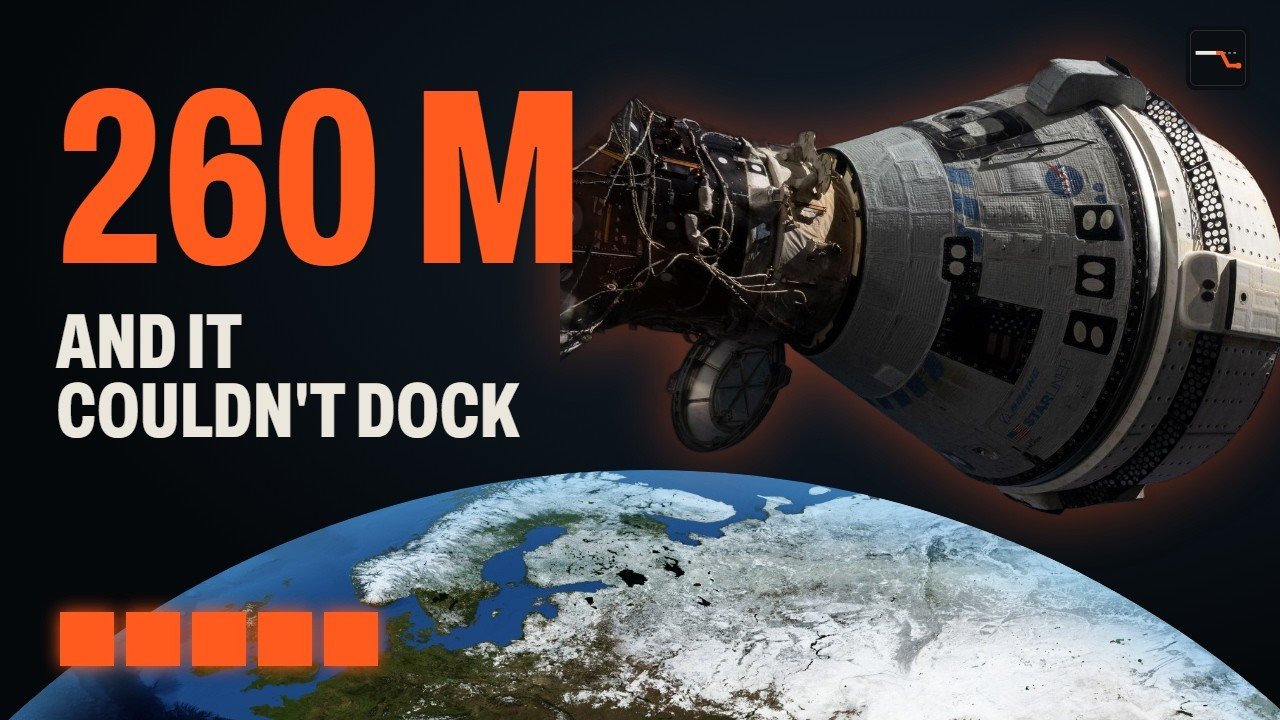
On June 6, 2024, Boeing's Starliner was closing on the International Space Station with Butch Wilmore and Suni Williams aboard when its small steering thrusters began shutting themselves off. Five went out in all, and at 260 m from the station the capsule could no longer move forward. An eight-day test flight became 286 days for its crew.
A gap and two contracts
In 2014 no American spacecraft could carry its own astronauts to the station. NASA chose to buy rides rather than own a spacecraft. Boeing received $4.2 billion and SpaceX $2.6 billion, under fixed-price contracts. SpaceX flew its first astronauts in 2020, after Dragon spent nearly a decade flying cargo. Starliner had no such apprenticeship: its December 2019 uncrewed test went wrong when a clock error made it miss its burn, and an independent review found two critical software defects. In May 2022 two service module thrusters failed off before docking; they were later test fired and put back into use. The report called this a pattern of unexplained problems carried into the next flight.
Five thrusters in 3.5 hours
Starliner launched on an Atlas V on June 5, 2024, after attempts on May 6 and June 1 were called off. Interviewees told investigators known hardware issues were accepted before launch, and a design flaw was found only in the run-up. The propulsion system lacked the backup the rules required for the burn that brings a crew home.
On June 6 at 1400 GMT, 9 km out, thruster S2 A2 reported low pressure and software switched it off. At 14:57, 526 m out, B1 A3 failed, and Wilmore took manual control, holding at 260 m. B2 A2 failed at 15:28, and S101 three minutes later. Test fires returned weak results: 51%, 11%, 91% and 29% of expected thrust. The team re-enabled the thrusters with the automatic failure check switched off, which removed a safety barrier. At 16:12 a fifth, T2 A2, failed. Starliner docked at 17:34 GMT.
Why they failed
The thrusters sit in insulated pods called doghouses. Heat soaks back into the metal and propellant lines. The oxidizer NTO can boil in the line, giving bubbles and lower chamber pressure. A Teflon seal in the valve, the poppet, swelled and extruded under heat and pressure, partly blocking the oxidizer path. A ground test at NASA White Sands in summer 2024 reproduced the degradation. Qualification tests had been run without the insulation and with active cooling between firings. Pressure data reached the ground too rarely to meet the Nyquist criterion, and the capsule stored nothing on board. Seven of eight helium manifolds leaked. The report calls its cause the most probable, not definitive.
The decision to send it home empty
Interviewees described yelling in meetings and one person who stopped speaking up. Some felt data was presented to support bringing the crew home in Starliner. The report found a goal that NASA wanted its two providers to succeed, which pushed the team toward accepting risk. On August 24 NASA decided Starliner would return without a crew. It undocked on September 6 and landed in New Mexico, where one crew module thruster failed to fire. Wilmore and Williams returned on Dragon on March 18, 2025.
The report
Questions this video answers
How many thrusters failed during the rendezvous?
Five of the small steering thrusters shut themselves off during the approach on June 6, 2024.
How long did Starliner take to dock after the first failure?
It docked at 17:34 GMT, three and a half hours after the first failure.
How long were Wilmore and Williams in space?
They splashed down on March 18, 2025, 286 days after launch, on a SpaceX Dragon.
What caused the thruster failures?
The report calls overheating, with boiling NTO oxidizer and a swollen Teflon poppet seal, the most probable cause, not a definitive one. The failures have not been recreated on the ground.
What did NASA's investigation conclude?
It classified the flight as a Type A mishap, named three root causes and made 61 recommendations.