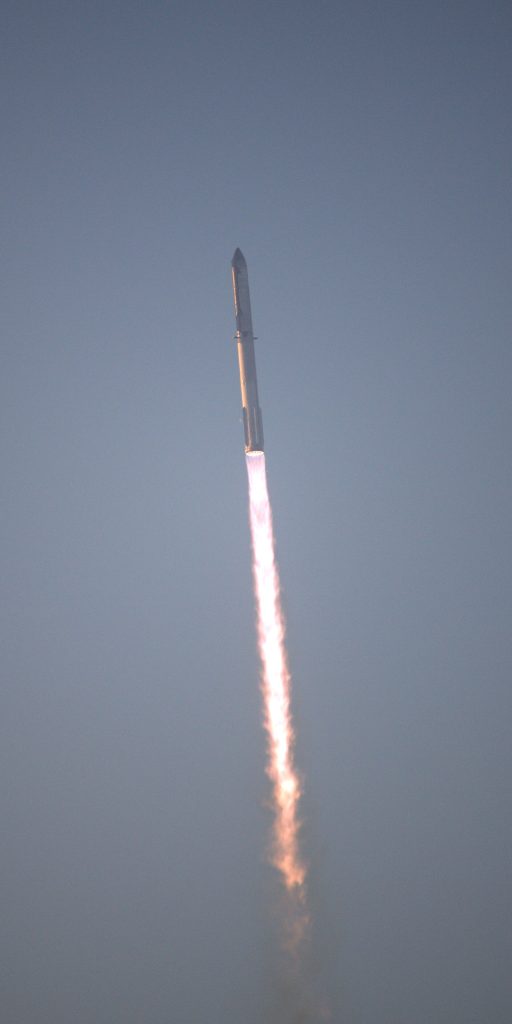
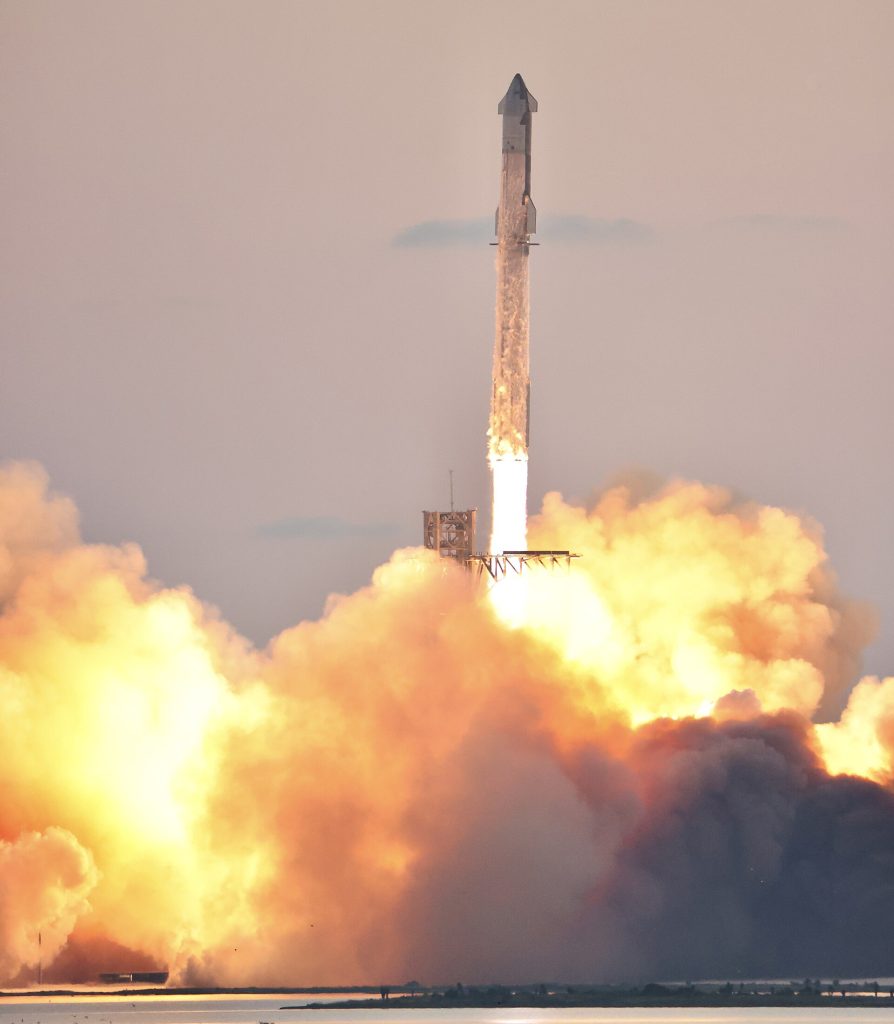
Starship Flight 13 Scrub: Booster Abort at Startup on Pad 2
The short version
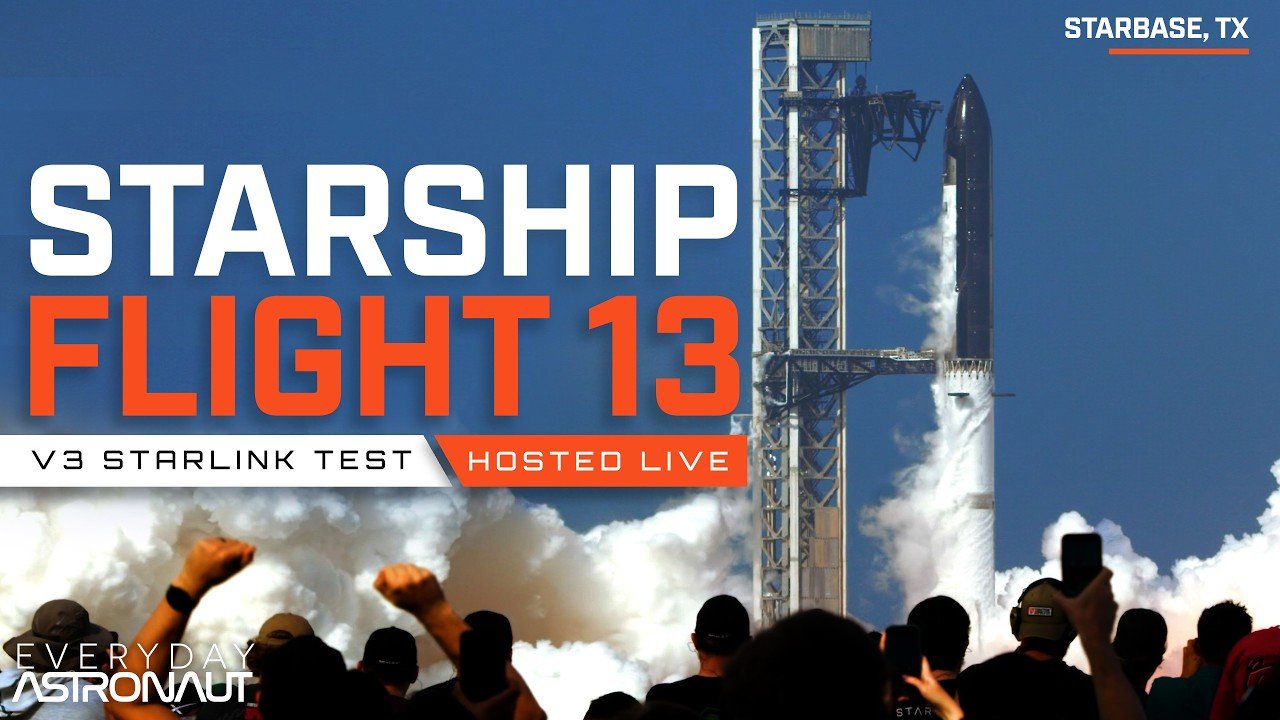
Everyday Astronaut's livestream of Starship Flight 13, the second flight of Starship V3, which was to carry 20 Starlink V3 satellites on a suborbital trajectory. The stream includes SpaceX's broadcast and viewer Q&A. At the end of the countdown the booster triggered an abort at engine startup and the launch was scrubbed for the day.
Full written account
Starship Flight 13, the second launch of a version 3 Starship, went through a full countdown from Pad 2 at Starbase, Texas, and then scrubbed in the last seconds. Engines on the Super Heavy booster began lighting, a hold was triggered at startup, and the engines shut down. The planned payload was 20 Starlink V3 satellites, six of them fitted with cameras to film the ship in space. No one was aboard, and the flight was meant to be suborbital.
What Flight 13 was meant to do
The flight repeated the goals of Flight 12, which flew in May. SpaceX described it as a developmental test: the most important payload was data. Everyday Astronaut host Tim Dodd said the launch came 55 days after Flight 12.
The plan SpaceX presented was:
- Liftoff of the full stack from Pad 2, with 33 Raptor 3 engines on Super Heavy.
- Hot staging, in which the booster shuts down all but five engines while the ship lights its own.
- A directional flip of the booster, a boostback burn, and a landing burn ending in a splashdown. Dodd put the target about 20 miles (30 km) off the coast in the Gulf, due east of the pad.
- A ship ascent to a suborbital trajectory, deployment of 20 Starlink V3 satellites, and a relight of a single Raptor in space.
- Re-entry, a landing flip and landing burn, and a splashdown in the Indian Ocean.
There was to be no booster catch. Dodd said the booster had not completed its boostback on Flight 12, so that test objective had to be repeated before the booster is sent back toward the tower. He added that the ship's in-space Raptor relight had not yet been done on a V3 vehicle, and that an orbital launch is out of the question until it has.
What Flight 12 left unfinished
SpaceX's Dan Huitt reviewed the earlier flight. It was the first launch of a new ship, a new booster and a new Raptor engine, and the first from Pad 2.
- During hot staging the booster flip was off by about 90 degrees because of differences in engine startup. SpaceX said it modified the startup sequence.
- Five engines had problems when the booster tried to relight for its boostback burn, which ended early. SpaceX made hardware changes to improve relight reliability and updated its alarms and aborts.
- The landing burn was unsuccessful, and the booster ended with a hard splashdown in the hazard area.
- About 40 seconds after stage separation the ship lost one of its three Raptor vacuum engines. It still reached the planned suborbital trajectory.
- The ship deployed all 20 Starlink simulators. Two were modified satellites that returned brief views of Starship in space.
- The in-space burn was skipped because of engine issues. The ship did a flap stressing test and a maneuver mimicking the trajectory of future missions returning to Starbase, then splashed down in the Indian Ocean.
The vehicle and the satellites
SpaceX gave the fully stacked height as just over 407 ft. The booster has 33 Raptor 3 engines and three grid fins, 50% larger than on the previous booster version. The ship has six Raptors, three optimized for sea level and three for vacuum.
Dodd explained the three grid fins. On re-entry the top fin sits in the wake of the rocket and gets little air. One fin handles yaw. Two fins handle pitch, and a symmetric pair is needed so drag does not induce roll. He said two fins alone would make flight control a harder way to hit a pinpoint landing.
SpaceX's Tyler Lionquist described the Starlink V3 satellites as built in Redmond, Washington. Each Starship mission would add around 20 times the capacity of the V2 satellites launched on Falcon. The stated design figures are:
- 1 Tbps of downlink, about ten times V2.
- 160 Gbps of uplink, about 22 times V2.
- Six 400-gigabit space lasers.
- Solar arrays generating about twice the power of V2's.
The satellites were loaded into the ship the day before the attempt. After deployment the Starlink team would have about 20 minutes to run tests, such as extending solar arrays and antennas and connecting with ground stations, before the satellites burn up in the atmosphere. Dodd added that Starlink thrusters are too weak to raise a satellite's orbit within that time, so the satellites follow the same suborbital path and demise as the ship's earlier deployments.
He also explained why real satellites were carried rather than mockups. In his view the deployment data is worth more than the few million dollars each satellite costs.
The countdown
Huitt reported weather at about a 90% probability of go, with blue skies and scattered clouds, and a green range in both the Gulf and the Indian Ocean. The launch window was 90 minutes long and opened at 5:45 p.m. Central time. The flight director's go/no-go poll came at about T-minus one hour, and SpaceX called the vehicle go for propellant load.
Propellant loading closed out on the ship at about 2 minutes 10 seconds and on the booster at about 2 minutes 50 seconds before launch, with a little over 11.5 million pounds of propellant on board. Dodd noted that a rocket more than 120 m tall was being filled in roughly 37 minutes.
The final built-in hold moved to T-minus 60 seconds, a new time that SpaceX said it had adjusted by moving some final checks earlier. The count hit a brief hold there, was reset, and continued. Huitt had said that a flame diverter on Pad 2 activates at T-minus 17 seconds, and that a hold triggered after that results in a scrub for the day.
The abort at engine start
As the booster's Raptors began to light, a hold was triggered and the engines shut down. SpaceX said the hold on the booster aborted liftoff, and because the diverter was already on, it was a scrub for the day. Teams began offloading the methane and oxygen from both vehicles.
Dodd later relayed Elon Musk's statement that some of the engines did not start, triggering an automatic launch abort, with the next attempt hopefully in a few days rather than as soon as the next day. Dodd's own view from the footage was that about four engines had not lit. He said the computer aborts automatically, with no human in the loop. He did not know SpaceX's internal limits on how many engines may be out, and said he did not know whether the booster would have to be rolled back to replace engines.
He noted that Starship had needed a day reset on only three of its 13 flights.
Why the booster aims short
Answering viewer questions during the delay, Dodd explained the booster's return profile. Once the ship separates, the booster is moving away from the pad at thousands of kilometers an hour. Lighting engines for the flip and boostback burn brakes that horizontal velocity. The booster is aimed short of the pad and glides back on its grid fins, which lets drag absorb energy. Dodd said that if there were an engine problem or a flight termination during the boostback burn, aiming short keeps debris in the Gulf and away from the launch site and populated areas.
What comes next, in Dodd's reading
Dodd said he would not predict dates in spaceflight, only milestones. Next would be a clean V3 flight with soft splashdowns. Then probably a booster catch, which could come on Flight 14 or Flight 15. After that, with permission, would come a true orbital flight deploying real V3 satellites, possibly followed by a ship catch. He guessed a docking test of two ships would come within three to four orbital missions. He described all of this as his own expectation, not a SpaceX schedule.
Florida and Artemis III
The SpaceX broadcast also covered work beyond Texas. Starship launches from Florida would begin at Launch Complex 39A at NASA's Kennedy Space Center, which was going through tower chopstick motion tests and integrated tests of the propellant farms, water farm, diverter and launch mount. At Space Launch Complex 37, Pad 37A is targeted to be ready for flight operations early next year. Construction began in November, and stacking of its launch and catch tower began in June.
Huitt also relayed NASA's Artemis III crew announcement: Randy Bresnik, Luca Parmitano, Frank Rubio and Andre Douglas, three from NASA and one from the European Space Agency. The mission is slated for 2027 as a crewed demonstration flight in low Earth orbit. SpaceX will launch a Starship with a docking port on the nose to practice rendezvous and docking with the crew in Orion, and to test the maneuverability of the two docked vehicles.
Questions this video answers
Did Starship Flight 13 launch?
No. The launch was scrubbed after the booster triggered an automatic abort at engine startup, and propellant was offloaded from both vehicles.
Why was Flight 13 scrubbed?
A hold on the booster aborted liftoff as the Raptor engines were lighting. Elon Musk said some engines didn't start, triggering an automatic launch abort.
Was a booster catch planned?
No. The stream says there was no booster catch attempt on Flight 13 because the boost-back test objective from Flight 12 had to be redone.
What payload was Starship carrying?
Twenty Starlink V3 satellites, which were real V3s. Six were to carry cameras, and they were to demise after about 20 minutes.
What was the flight plan?
A suborbital flight with a Raptor relight in space, then re-entry and a splashdown in the Indian Ocean, while the booster splashed down in the Gulf.
Where was it launching from?
Pad 2 at Starbase, Texas.
Explore related missions
Connected by the topic: Starship