Tiangong vs ISS: Why China’s Smaller Station Carries More Payload
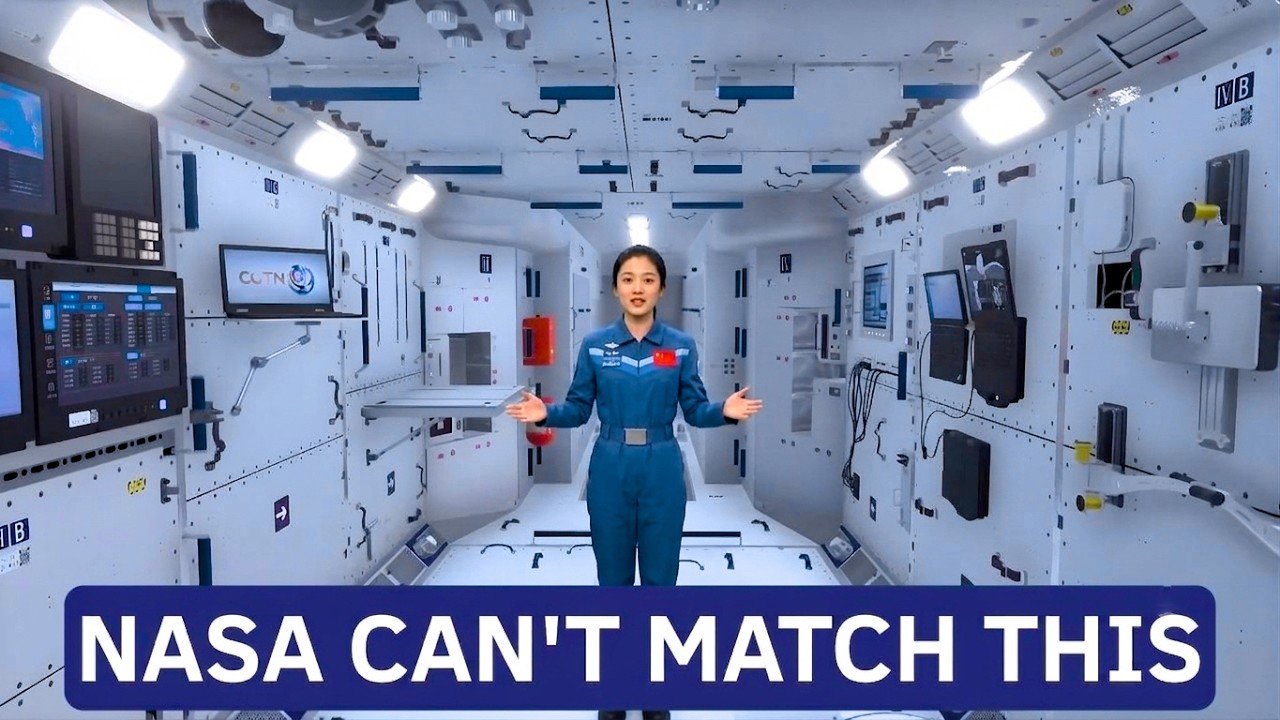
The short version
An analysis of China's Tiangong space station, which the video says is about a sixteenth the mass of the ISS yet carries 25 experiment cabinets against the ISS's 31 and 67 exposed payload slots against 12. It gives a payload share of 30.6% against 7.93% for the ISS, and covers Hall-effect thrusters, crawling robotic arms, a record spacewalk, the planned expansion to six modules and the Xuntian telescope.
Full written account
China's Tiangong space station weighs about a sixteenth of the International Space Station, has three modules where the ISS has 16, and carries three people where the ISS carries seven. By one measure the video highlights, the smaller station comes out ahead: the share of its mass that is payload is 30.6%, against 7.93% for the ISS and 17.5% for Mir.
Why the station exists
In 2007 China formally asked to join the ISS program, and Roscosmos and the European Space Agency supported it. In 2011 the US Congress passed the Wolf Amendment, which prohibits NASA from cooperating directly with Chinese space agencies. No Chinese astronaut has boarded the ISS. The same year, China launched Tiangong 1, a single-module lab, and began learning to rendezvous and dock. Tiangong 2 later tested longer-duration life support and automatic refueling. Both labs were deliberately brought down over the Pacific.
Built in two years
Mir took about 10 years to assemble in orbit and the ISS more than 12. Tiangong took two years from the first module reaching orbit to the station being declared finished. Its modules arrived preassembled and docked to the front of the core module automatically, then used an indexing arm beside their own hatch to swing 90° onto a side port. While the first lab module sat at the front the station was briefly L-shaped, which costs power and propellant to hold in orientation. For the final swing the station was turned to an attitude where Earth's gravity helped steady the operation.
Tiangong carries 12 control moment gyroscopes, six in the core module and six in the first lab, which hold it steady to better than a tenth of a degree without burning propellant.
The numbers against the ISS
- Internal experiment cabinets: 25 against 31.
- Exposed payload slots: 67 against 12.
- Power: about 27 kW generated, 17 kW reaching science (63%), against about 110 kW and 50 kW (roughly 45%) on the ISS.
- Science power per ton: 0.41 kW against 0.26.
- Supplies: about 12 tons a year for three people, against 30 to 40 tons for six on the ISS.
The chief designer, Yang Hong, calls this the late mover advantage. Every item aboard carries a QR code scanned with tablets, and internal communication is wireless. The ISS, by contrast, was built by different countries to different standards: Russian and European vehicles use different propellant, and the Russian glycol and American water cooling loops cannot be connected. Tiangong was specified as one system, with more than 80% of parts common between modules, and if the core module's control system fails the station hands control to the first laboratory module.
Electric thrusters and robot arms
Four Hall effect thrusters on the core module produce 80 millinewtons each. With them off, the orbit decays about 30 kilometers every 100 days; running continuously, about 7. They save at least 800 kg of chemical propellant a year, and ground testing ran the system for 8,240 hours without a fault. The xenon bottles are external and can be swapped by robotic arm or by astronauts.
A 10-meter arm on the core module and a 5-meter arm on the first lab can join into a 15-meter arm, and both can crawl across the hull. On 17 December 2024, Cai Xuzhe went outside with Song Lingdong and stayed out 9 hours and 6 minutes, described as the longest spacewalk in history.
A port for a telescope and a larger station
A forward hatch has been reserved since the design stage for the Xuntian telescope, which has a 2-meter primary mirror and is scheduled to launch in 2027. It will fly in the same orbit and dock for servicing. The plan is to grow Tiangong from three modules to six, roughly 90 tons to 180, with at least 15 years of operation beginning in 2027. A second core module has already been built on the ground.
In 2025 the Shenzhou 20 crew's spacecraft was suspected of damage by space debris. The crew returned on 14 November aboard the spacecraft their replacements had flown up on, and Shenzhou 22 was launched early so the crew left aboard still had a ride home.
Questions this video answers
Why did China build its own station?
The video says the US Wolf Amendment of 2011 prohibits NASA from cooperating directly with Chinese space agencies, and no Chinese astronaut has boarded the ISS.
How does Tiangong compare with the ISS in payload share?
The video gives Tiangong 30.6% payload against 7.93% for the ISS and 17.5% for Mir.
How long was the longest spacewalk?
Cai Xuzhe went outside with Song Lingdong on 17 December 2024 and stayed out 9 hours and 6 minutes, described as the longest in history.
What is planned for Tiangong?
Expansion from three modules to six, roughly 90 tons to 180, with at least 15 years of operation beginning in 2027.