Mir Space Station: Building and Ending a 15-Year Orbital Outpost

The short version
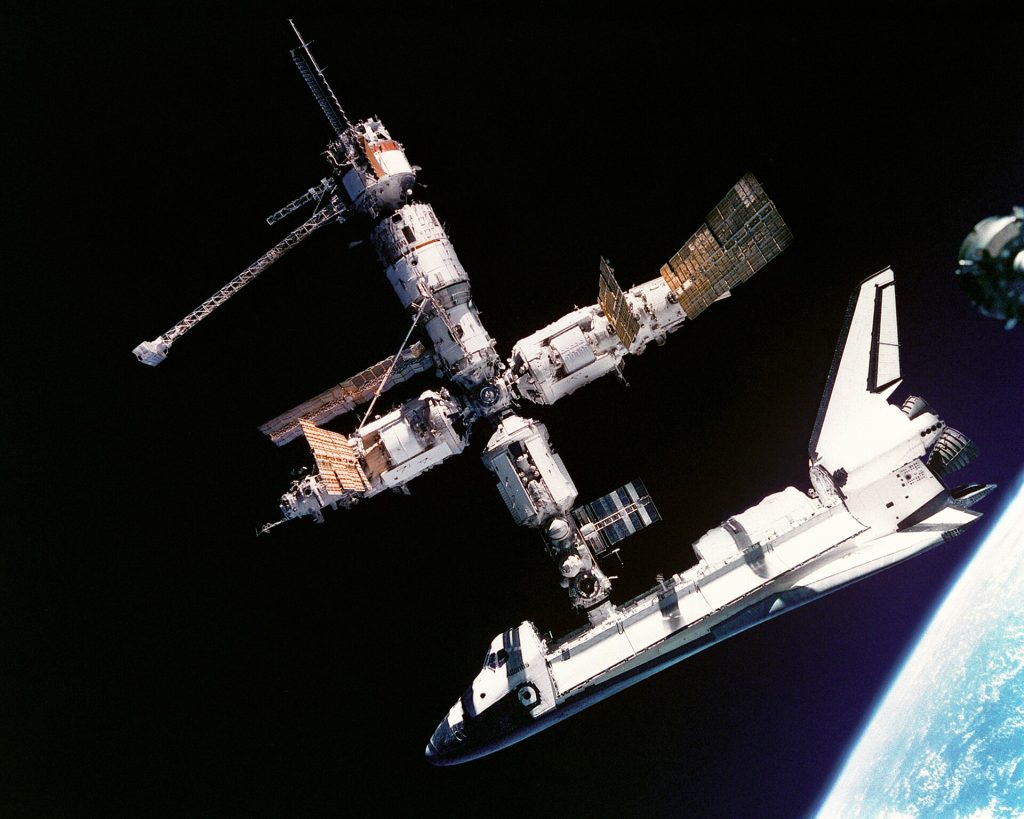
A history of the Mir space station, whose core module launched on a Proton-K from Baikonur on 19 February 1986. Six further modules were added over ten years, 104 people visited, and more than 23,000 experiments were conducted. The video covers the Shuttle-Mir cooperation, the 1997 fire and the Progress M-34 collision with Spektr, and the station's deorbit on 23 March 2001.
Full written account
How did a station planned for a short life stay in orbit three times longer?
The Mir space station was in orbit between 1986 and 2001, three times longer than first planned. Its core module launched on a Proton-K rocket from the Baikonur Cosmodrome on 19 February 1986, six days before the 27th Communist Party Congress, after a manic effort to meet a political deadline. The launch came three days after a failed launch.
From Salyut to Mir
Mir was authorized in 1976 to improve on the Salyut stations, the first of which launched in 1971. Salyut was 15.8 meters long. Early plans gave the core module, DOS-7, four docking points, with four more via a docking sphere. By 1978 the design had one aft port and five in a spherical compartment at the front. Work stopped in 1984 as resources went to the Buran program. The core module reached Baikonur on 6 May 1985 and was altered to be ready by the end of the year.
The core module and its additions
The core module was 13.13 meters long and 4.15 meters in diameter, with a habitable volume of 90 cubic meters. It had a lavatory, two sleeping cabins, exercise and medical equipment, and entertainment.
- Kvant-1: launched 31 March 1987, docked 9 April, with X-ray and ultraviolet telescopes for studying active galaxies, quasars and neutron stars.
- Kvant-2: docked 6 December 1989, with an airlock for spacewalks and a system to regenerate water from urine.
- Kristall: launched 31 May 1990, docked 10 June, a laboratory for materials and biological experiments.
- Spektr: docked 1 June 1995, completed with American help in return for 600 kilograms of US experiments.
- Mir Docking Module: launched on the Space Shuttle Atlantis on 12 November 1995, attached to Kristall.
- Priroda: docked 26 April 1996 for Earth remote-sensing, completing the station.
A new owner and an American partner
On Christmas Day 1991 the Soviet flag was lowered over the Kremlin, and the station had a new owner in financial trouble. Two planned missions and two modules were canceled. On 17 June 1992 Boris Yeltsin and George H.W. Bush announced a collaboration that became the Shuttle-Mir program, with 11 missions between 1993 and 1998, costing about 1.5 billion dollars.
Life on board
In total 104 people visited over 39 crewed missions, including 30 Soyuz flights and nine Shuttle flights. Valeri Polyakov's stay of 14 months from January 1994 remains a record. Crews woke at 8, exercised, cycling 10 kilometers and running 5 kilometers daily on two treadmills and a stationary bicycle, and worked in two periods.
Accidents and the end
In January 1994 the Kristall module collided with Soyuz TM-17. On 23 February 1997 a malfunctioning chemical oxygen generator started a fire that officially lasted 90 seconds; a man on board said 14 minutes. Smoke filled Mir for around 45 minutes, some gas masks were broken and some extinguishers could not be removed from the walls. Progress M-34 later hit Spektr and punctured it during a docking maneuver, and the module was sealed off, sharply cutting power.
Russia confirmed it would not fund Mir past June 1999. The final crew left on 28 August 1999. Re-entry came on 23 March 2001 at 5:44 am UTC near Nadi, Fiji, with remnants crashing into the South Pacific around 6 am. More than 23,000 experiments were conducted on Mir.
Questions this video answers
When did Mir launch and from where?
The core module launched on 19 February 1986 on a Proton-K rocket from the Baikonur Cosmodrome.
How many modules did Mir have?
Six modules were added to the core module over ten years, and it reached its final size when Priroda docked on 26 April 1996.
How many people visited Mir?
104 people visited over 39 crewed missions, including 30 Soyuz flights and nine Space Shuttle flights.
How did Mir end?
After Russia would not fund it past June 1999, it was deorbited and re-entered on 23 March 2001, with remnants falling into the South Pacific.
What went wrong on Mir in 1997?
A malfunctioning chemical oxygen generator caused a fire on 23 February 1997, and the Progress M-34 cargo craft later hit the Spektr module and punctured it.
Explore related missions
Connected by the topic: Mir