Starship Flight 14: Orbit, 26 Starlink V3 Satellites, Early Deorbit

The short version
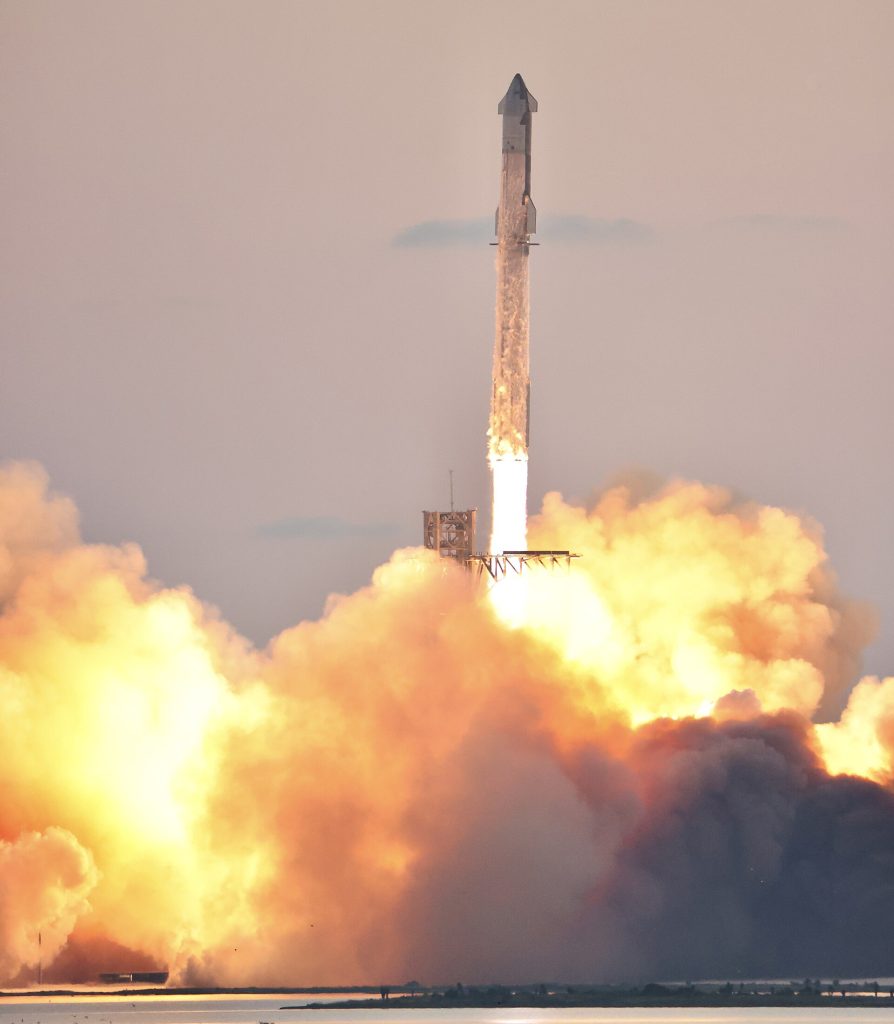
Starship Flight 14 lifted off at 7:49 a.m. Central Time with Booster 21 and Ship 41, which reached orbit and deployed all 26 Starlink V3 satellites. After an engine shut down during ascent, SpaceX chose an early deorbit rather than the planned full 10-hour mission. Both the booster and the ship made soft splashdowns, the ship in the Pacific north of Hawaii.
Full written account
Starship Flight 14 put a ship into orbit for the first time in this program's coverage, deploying 26 Starlink version 3 satellites before Ship 41 came home early after an engine shut down on ascent. Liftoff came one second before 7:49 a.m. Central Time, and both Booster 21 and Ship 41 made soft splashdowns.
Approvals before launch
SpaceX rolled Booster 21 out early and used the wait for regulatory approval to run a full stack wet dress rehearsal on the Thursday before launch. The Federal Communications Commission granted authority on Friday for the Starlink V3 satellites to communicate with gateways in American territory using the 42 to 42.5 GHz band. On Saturday the FAA modified the launch license. The previous license had not authorized reentry from orbit or splashdowns in the proposed Pacific locations, west of Chile and north of Hawaii. The new license splits launch and reentry into orders A1 and A2, and the reentry section currently applies only to Flight 14. A ship catch would require a further change.
The booster
All 33 engines ignited at liftoff. About 75 seconds in, one middle-ring engine shut down and Booster 21 continued on 32 engines through hot staging. During the boostback burn, two of the 33 engines failed to relight, including the one that had already shut down. The burn was still completed. SpaceX said it had been planned to use up the remaining liquid oxygen in the main tank, since the landing burn has its own reserve.
For the landing burn the booster relit 11 engines, then went to five and then three before splashing down. It used a swing like the one needed for a catch on Pad 2, aligning with a simulated tower. Frost was visible on a pipe in the engine section, which did not appear on Flights 12 or 13. After splashdown the booster exploded near the common dome area. SpaceX confirmed that triggering the flight termination system after splashdown was planned as a demonstration, which is why the usual callout that the system was safed was not heard.
The ship and the orbit decision
With less than a minute left in the planned ascent burn, Raptor vacuum engine six shut down early. The burn was extended by around 20 seconds, compared with more than a minute on Flight 12. The ascent left the ship on a suborbital trajectory that would have allowed reentry over the Indian Ocean. Concern about effects on the sea level engines led to an initial call to end the mission early, but the team reviewed the data before the orbital insertion burn, scheduled around 25 minutes after launch. The burn was approved and added around 92 m/s. Ship 41 became one of the heaviest single vehicles placed in orbit, at more than 200 metric tons including dry mass, propellant and the remaining satellites.
The satellites were deployed between T+34 and T+64 minutes into a 262 by 275 km orbit at 30.5 degrees. Operational altitude is expected around 470 to 480 km. The dispenser can hold up to 60 satellites; Flight 14 carried 26. SpaceX said the flight delivered the equivalent capacity of around 10 Falcon 9 launches carrying Starlink V2 mini satellites.
Early return and splashdown
The planned mission was a coast of more than 7 hours and six orbits. After an early checkout about an hour and a half after liftoff, SpaceX chose the contingency early return, making it fewer than two orbits. The deorbit burn came around 2 hours 12 minutes after launch over South Africa, producing an 81 by 267 km orbit according to Jonathan McDowell. Peak reentry speed was only 38 m/s above the previous flight, and Ship 41 took nearly 22 minutes to descend from 120 km to 50 km, against 16.5 minutes for Ship 40. It landed in the Pacific next to the pre-placed buoys, then tipped over and exploded, as happened on six of the previous seven splashdowns.
Looking ahead
Booster 22 and Ship 42 are in work, and a slide associated with the Kadena air traffic management system suggested Flight 15 no earlier than 19 October, though its age is unknown. A booster catch is already reflected in the launch license; a ship catch is not. A first launch from Florida's LC-39A was listed for no earlier than 30 October, which is considered tight given vehicle readiness.
Questions this video answers
Did Starship Flight 14 reach orbit?
Yes. Ship 41 completed an orbital insertion burn that added around 92 m/s and deployed 26 Starlink V3 satellites.
Why did Ship 41 return early?
SpaceX said the early return was made out of an abundance of caution following the engine out during ascent.
Where did the satellites go?
Tracking data showed a 262 by 275 km orbit at 30.5 degrees inclination.
Was the booster blown up on purpose?
SpaceX confirmed that triggering the flight termination system after splashdown was part of the plan, to demonstrate the system.
When might Flight 15 happen?
A presentation slide suggested no earlier than 19 October, but the age of that information is unknown.
Explore related missions
Connected by the topic: Starship