China’s Many New Rockets: Private Firms and New Long Marches
The short version
A survey of China's expanding family of launch vehicles since a 2014 State Council directive allowed private companies to build civil space infrastructure. It covers government-derived solid rockets, private liquid-fuelled designs modelled on Falcon 9, and new Long March variants such as the 10, 10A, 10B and 12A. It describes each rocket's size, payload and launch record, and notes how many share stages with missiles and with each other.
Full written account
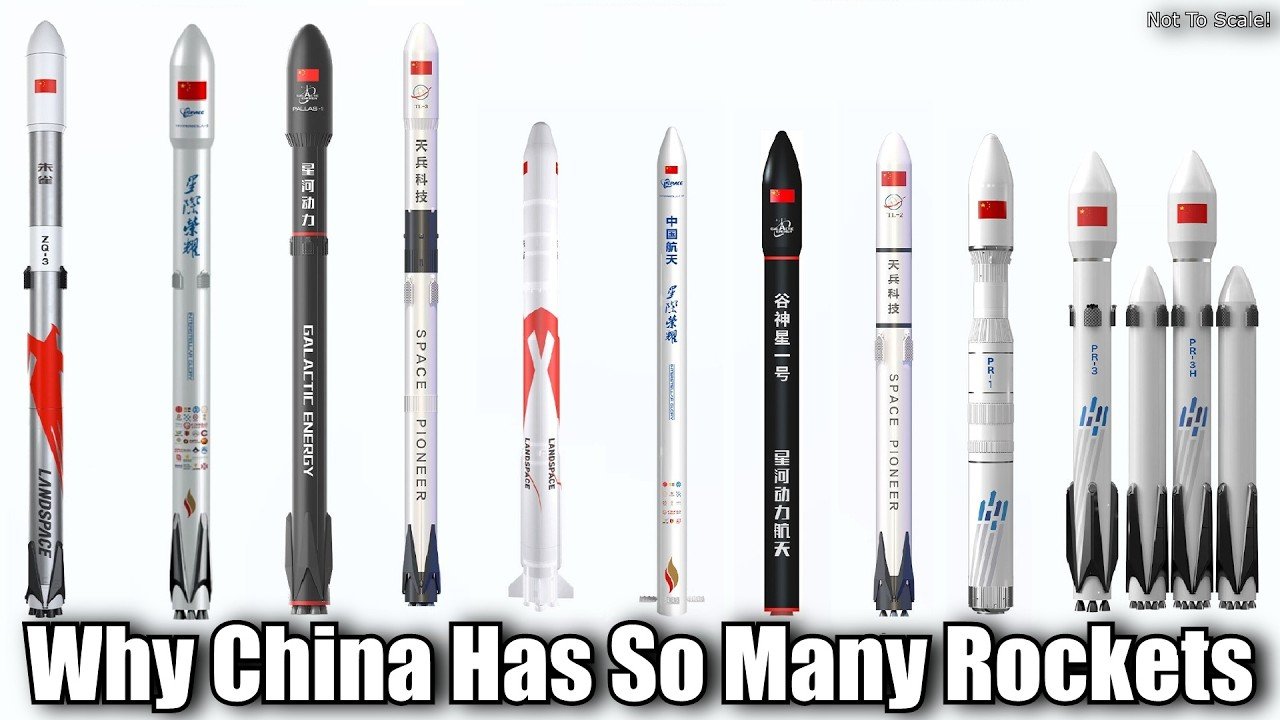
China now flies a far larger family of rockets than it did six years ago, and most of the new designs come from private companies. The surge traces to a 2014 State Council directive allowing private firms to build civil space infrastructure, which drew investors hoping to create a Chinese SpaceX. Many of the resulting rockets share stages with each other and with missiles.
Missile-derived solid rockets
The government-built Kuaizhou 1, whose name means speedy boat, first flew in 2013 and comes from CASIC, the missile maker. Its first two stages match the size, mass and performance of the first two stages of the Dongfang 25 missile. Two more stages are added to reach orbit, along with grid fins on the first stage. The 1A launched 27 times with three failures. The larger Kuaizhou 11 is 25 m tall, masses 78 tons and carries one ton to orbit; its first launch failed, and it has flown six times in total.
Galactic Energy's Ceres-1 is a close relation: about 20 m tall, 30 tons, 300 kg to orbit. The Ceres-1 family has launched 23 times with two failures, including a first launch from a ship in 2023. iSpace's Hyperbola-1 reached orbit in July 2019, the first successful orbital launch by a private Chinese company. Its upgraded version then failed three times in a row, and a successful flight in April 2023 carried no payload.
Methane and kerosene rockets
LandSpace's Zhuque-2 was the first rocket in the world to reach orbit on methane. Its first launch in December 2022 lost the second stage; the second flight in July 2023 succeeded. The Zhuque-3 resembles a stainless-steel, methane-fuelled Falcon 9. It has flown twice and reached orbit both times. One booster landed on a downrange pad, but a fire later toppled it, so reuse is not yet proven.
Space Pioneer built its Tianlong rockets on YF-100 engines bought from the government. Tianlong-2 launched successfully in April 2023, the first successful launch of a liquid-fuelled rocket developed outside the government. Tianlong-3 famously lifted off during what was meant to be a static fire, and nobody was hurt. Its one full launch, in April 2026, had a first-stage anomaly.
Larger solid and liquid designs
Jielong 3, Kinetica-1 and Gravity-1 use similar 2.65 m first-stage casings. Jielong 3 launches from a barge in the Yellow Sea and has had 12 successes in 12 launches since 2022. Kinetica-1 has flown 15 times with one failure. Gravity-1 clusters four more boosters around its core, making it the most powerful all-solid launch vehicle operating, and has three successful launches. Kinetica-2 debuted successfully in March 2026, carrying the Qingzhou cargo spacecraft.
New Long March rockets
The Long March 10 combines three boosters into a 2,200-ton vehicle intended to launch China's astronauts to the Moon. The 10A flew once, as a suborbital max Q abort test for the Mengzhou capsule. The 10B demonstrated booster recovery in July 2026 using a wire and hook capture system. The Long March 12 has launched seven times, all carrying Guowang internet satellites. The 12A reached orbit in December 2025 but its booster crashed about a mile from the landing site, and the 12B reached orbit in June 2026 without a recovery attempt.
Questions this video answers
Why did China get so many new rockets?
A 2014 State Council directive allowed private companies to build civil space infrastructure, which brought in investment from Chinese investors wanting a Chinese SpaceX.
Which Chinese private company launched first successfully?
iSpace's Hyperbola-1 made the first successful orbital launch by a private Chinese company in July 2019.
Which rocket was the first to reach orbit on methane?
LandSpace's Zhuque-2.
What is the Long March 10 for?
It is to be used to launch China's astronauts on their Moon mission at the end of the decade, if not sooner.
Which rockets use the same first stage?
Jielong 3 and Kinetica-1 very likely share a first stage, and Gravity-1 uses the same 2.65 m core.
Explore related missions
Connected by the topic: Long March