Stoke Space Nova Block 2: Billion-Dollar Reusable Rocket Redesign
The short version
Scott Manley explains Stoke Space's new funding round of another billion dollars, bringing its total to $2.3 billion, and the Block 2 version of its Nova fully reusable rocket. He describes the Andromeda upper-stage engine redesign and the removal of the upper stage's taper, and offers his own ideas about how that stage might survive reentry. Stoke has not said how it will do this.
Full written account
Stoke Space has announced another billion dollars of funding, bringing its total to $2.3 billion, before its Nova rocket has made a first launch. The money is meant to carry the company through to flying Block 2, a larger Nova whose upper stage drops the conical taper of the original design and raises questions about how it will survive reentry.
The original Nova
Stoke is building a fully reusable launch vehicle that is much smaller than SpaceX's Starship. Its upper stage is cone-shaped, with a heat shield on the base that is integrated with the engine. Propellant would flow through the base of the heat shield to cool it, in the way propellant cools a rocket engine's combustion chamber. The engines built into the heat shield would also steer and land the stage.
The Andromeda engine has 24 nozzles around the outside, fed by a pair of power heads, and the thrust of each nozzle can be controlled individually for thrust vector control. Stoke flew a small hopper test vehicle with the rough geometry of the intended upper stage. It showed control by varying the thrust of the nozzles, and it lifted off and landed gently.
The first stage uses Zenith engines, which are full-flow staged combustion methalox engines. Seven of them are planned for the first Nova test flight, and they were test-fired in 2024. The original Nova has now become the Pathfinder, the vehicle meant to demonstrate the technology.
Why the taper mattered
A reentering vehicle has to steer to correct for trajectory changes and atmospheric variation. The original design used a slightly skewed heat shield to create asymmetric lift. The taper widened the control envelope without making it harder to keep the vehicle from melting, because the cooling could sit in the heat shield area. If the vehicle changes its angle to the airflow and air hits the side too hard, heating runs all the way up the side, which is why many capsules are tapered behind the heat shield.
What Block 2 changes
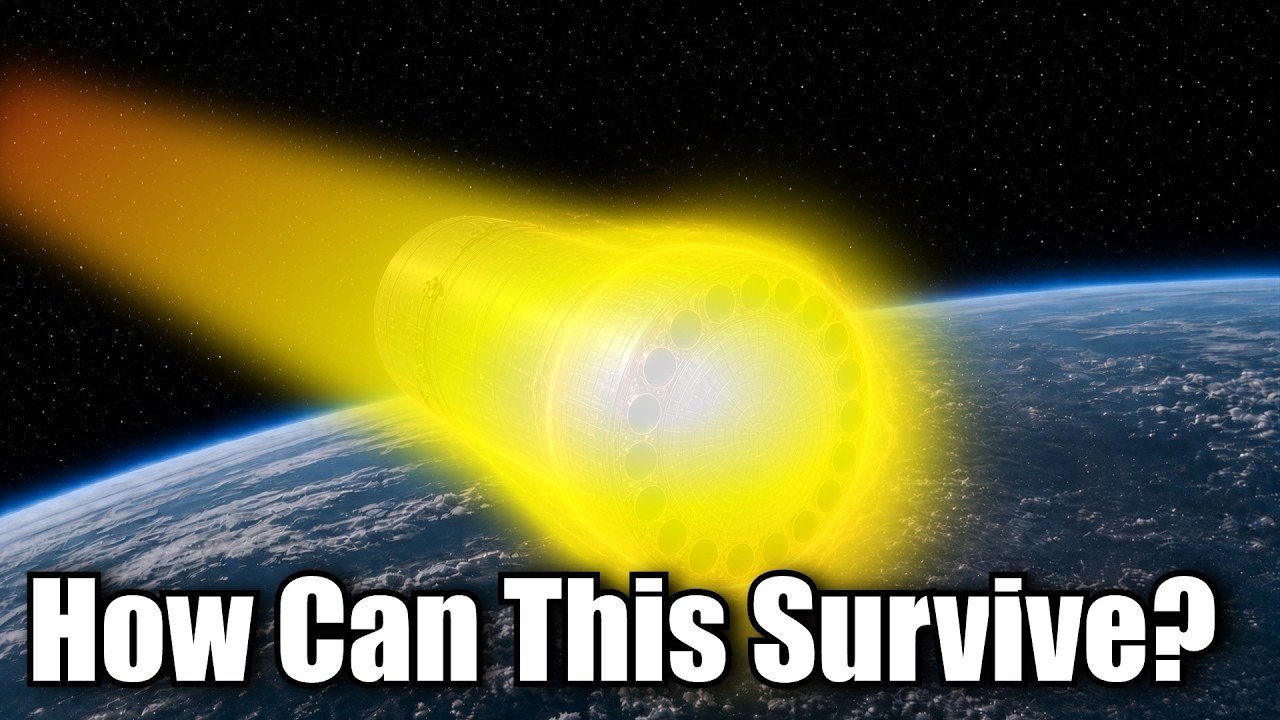
Block 2 raises the payload to 15 tons, with 4 tons to GTO, which implies landing the upper stage after a return from GTO. The first stage grows to 14 engines, twice the thrust, and is fatter and taller. The upper stage keeps no taper. Stoke's blog post cites a launch market crunch, and the video says the rocket would have capabilities very similar to Falcon 9. Stoke says customers want the large fairing space on top, and scaling the Pathfinder shape would mean either a very fat rocket or a tiny payload space.
The new Andromeda keeps the 24 small nozzles but uses 12 independent engines, each running two thrust chambers, in place of two sets of turbopumps and gas generators. That gives more redundancy and a wider thrust range, though Scott Manley notes that twelve times the engines is also twelve times the chance something fails. A separate pump would circulate liquid hydrogen through the liquid-cooled surfaces during reentry, so the engines would not need to fire while cooling runs.
Stoke says the distributed mini-engine design lets it close the hydrogen expander cycle, raising specific impulse to more than 440 seconds. In an expander cycle, hydrogen cools the engine, vaporizes and drives a turbine that powers the pumps. In a closed cycle the turbine output is then burned in the engine. Large engines have to bleed some hydrogen overboard instead. Manley infers that the original Andromeda must have been an expander bleed cycle.
The reentry question
Blue Origin has patented the idea of a non-tapered reentry vehicle with a plug nozzle type heat shield. A patent covers the idea and does not explain how such a vehicle would survive reentry or be controlled. The Block 2 render appears to be a placeholder, with no landing legs, so it should not be treated as set in stone. Stoke has been coy about how it will work.
Manley offers several possibilities, which are his own speculation:
- A pure ballistic reentry at zero angle of attack that keeps the sides from heating, at the cost of aerodynamic control, possibly paired with a very steep profile like the OSIRIS-REx capsule's.
- Added heat shielding up the sides, which adds mass, possibly only on one dominant side if the stage flies like a wing.
- Firing the engines during reentry, so the exhaust slows the incoming air and protects the sides while inducing a turn. This is the one he thinks might be used.
Manley says there is not enough information to know. He hopes to see the Nova Pathfinder launch for the first time next year and be recovered successfully.
Questions this video answers
How much funding has Stoke Space raised?
Stoke announced another billion dollars of funding, which the video puts at $2.3 billion in total. Before this round the company had already had about $1.3 billion.
What is Nova Block 2?
A larger version of the Nova rocket with a 15-ton payload and 4 tons to GTO. Its first stage has 14 engines instead of seven, and its second stage has a new engine and a non-tapered shape.
Why is the missing taper a concern?
A taper protects the side of a vehicle from heating when air hits it at an angle during reentry. Without it, Stoke has not explained how it will steer and protect the stage.
When will Nova Pathfinder fly?
The video says it hopes to see the Nova Pathfinder launch for the first time next year.