Bandwagon-5: Falcon 9 Rideshare Launch With Starfall Capsule
The short version
NASASpaceflight's live webcast of the Falcon 9 launch of Bandwagon-5, SpaceX's 23rd Smallsat Rideshare mission, from SLC-40 at Cape Canaveral. The launch was targeted for 6:30 a.m. EDT but lifted off from a 7:04 a.m. T0 within the window. The booster landed on the droneship A Shortfall Of Gravitas, and the hosts discuss the payloads, including the second Starfall capsule, and the rocket's jellyfish effect in the sunrise sky.
Full written account
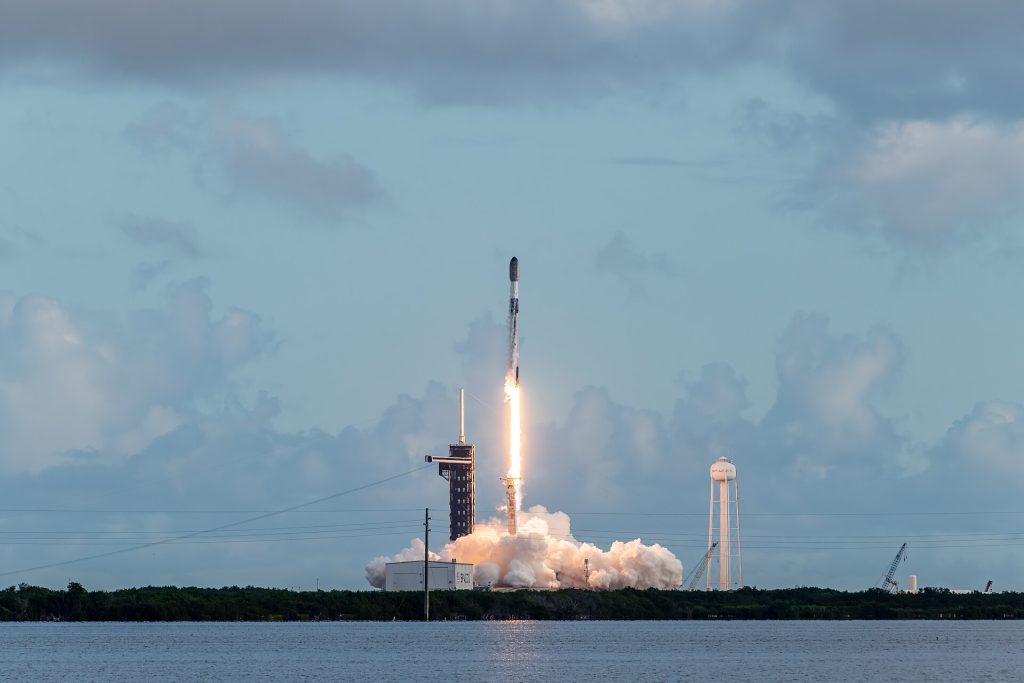
SpaceX launched its Falcon 9 on the Bandwagon-5 rideshare mission from Space Launch Complex 40 at Cape Canaveral Space Force Station on 20 October 2026. The rocket carried 32 payloads, including the second Starfall capsule on top of the stack. The launch window ran from 6:30 to 7:30 a.m. EDT, and liftoff came at 7:04 a.m. EDT, 34 minutes into the window. It was SpaceX's 730th launch overall and its 121st of the year.
What Bandwagon is
SpaceX began its Smallsat Rideshare Program several years ago. Transporter missions carry many payloads to polar or sun-synchronous orbit, and Bandwagon missions go to mid-inclination orbits. Eighteen Transporter missions have flown, and Bandwagon-5 was the program's 23rd dedicated launch. Clustering many satellites on one rocket is cheaper for each customer.
The payload stack uses standardised hardware, with a user's guide for rideshare customers. Satellites attach to ports of different sizes and spacings on gold plates. A larger satellite of one or two tonnes can ride on top as a "cake topper". On this flight that position held Starfall, with 31 other payloads on the sides. Stacks have sometimes carried more than 100 payloads.
Commentary on the stream said SpaceX may not be taking rideshare contracts beyond 2028, with about two Bandwagons and three Transporters a year until then. The same commentary said Starlink launches from the Florida coast are moving to Starship, leaving Falcon 9 on customer, commercial, military and NASA missions.
Starfall and the long second-stage mission
Starfall is SpaceX's own capsule for carrying materials such as pharmaceuticals into microgravity and returning them. It is cheaper than Dragon but still recoverable. It has no propulsion of its own, so it depends on the Falcon 9 second stage to perform its deorbit burn.
That shaped the whole flight profile:
- The second stage burned once to reach a preliminary low orbit, then relit about 53 minutes 48 seconds after launch for a burn of about 4 seconds to circularise. The target was roughly 600 km, with commentary giving 585 by 597 km.
- The 31 non-Starfall payloads were due to be deployed by about 1 hour 10 minutes into the mission.
- The stage then coasts for about an hour before the deorbit burn. Starfall separates afterwards, at 2 hours 48 minutes in the timeline.
- Starfall is to re-enter and splash down off the coast of California, where a SpaceX recovery vessel waits.
A stage normally lasts about an hour and a half in space. For this mission it carried a gray band, a mission extension kit, to keep the kerosene from freezing or turning to slush. The broadcast was not expected to show the Starfall deployment live.
Booster, fairings and weather
The booster was B1085, on its 19th flight, with a 68-day turnaround. It was to land on the droneship A Shortfall Of Gravitas, with fairing recovery handled by the vessel Bob. The mission was the 169th landing on that droneship out of 170 attempts. Commentary noted that one of the two fairing halves was flying for the 40th time, and the other was on about its 20th flight. Fairings were described as costing millions of dollars each, and the hosts recalled Elon Musk calling them pallets of cash falling from the sky.
The pad weather was 90% go. The booster landing was a moderate concern, compared with moderate to high the day before.
The countdown
The broadcast had no mission control audio, so the only sign that propellant loading had begun was frost on the vehicle. Loading of RP-1 kerosene on both stages and liquid oxygen on the first stage was due at T-minus 35 minutes, with frost visible around T-minus 32. Once loading started, the launch was committed to the 7:04 a.m. time.
The other steps they described:
- At about T-minus 20 minutes a vent appears as the line for the second stage's liquid oxygen is chilled, so the extremely cold liquid doesn't cause overpressure or cracking in a line at ambient temperature.
- Around T-minus 7 minutes liquid oxygen flows through the pumps of the nine Merlin engines to chill them. First-stage RP-1 loading finishes around T-minus 6.5 minutes.
- The tanks pressurise at T-minus 5 minutes. The strongback retracts between T-minus 4 and 4.5 minutes, only partway, so the umbilicals stay connected. A launch pad on the West Coast, by contrast, pulls out about 20 degrees.
- At T-minus 1 minute Falcon 9 enters startup and the onboard computers take over. The launch director's "go for launch" came at about 45 seconds.
The four towers at SLC-40 hold the catenary wires of the lightning protection system, which act like a Faraday cage around the rocket and ground systems.
The jellyfish and the landing
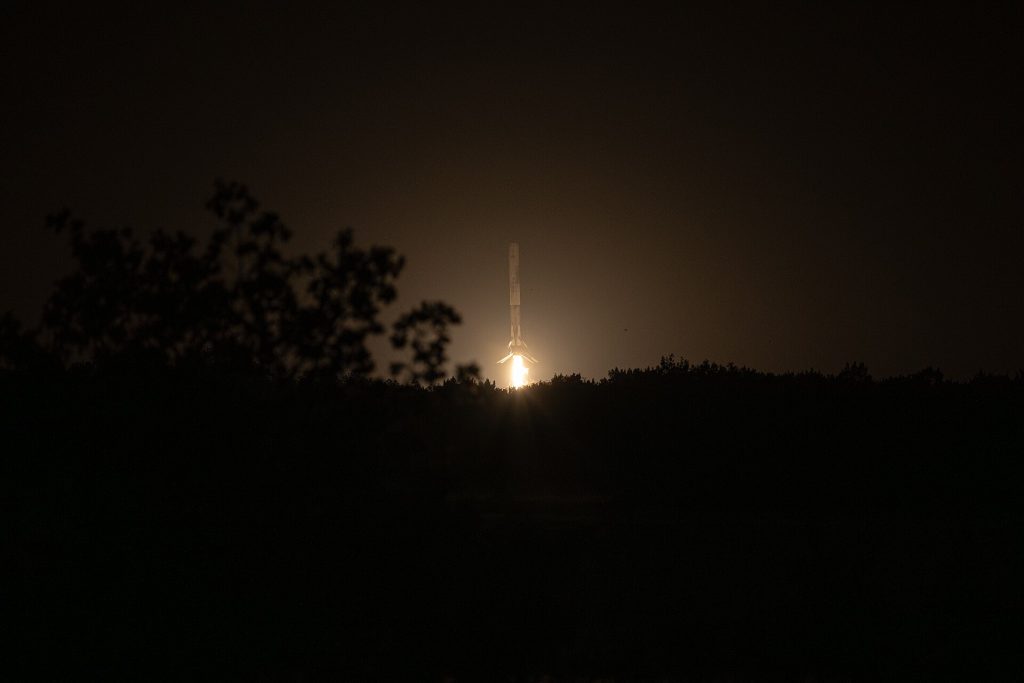
The launch headed southeast, passing north of the Bahamas. It was still dark on the ground, but sunlight reached the rocket and plume as it climbed, producing the jellyfish effect, an optical effect of viewing conditions rather than anything about the launch itself. Fairing separation was confirmed and the second stage's Merlin vacuum engine ignited. Clouds near the horizon blocked some viewers, and the hosts noted that the farther west the viewer, the lower the rocket sits and the clearer the horizon must be. Those who did see it posted replies to the channel's jellyfish clip.
The first stage dove through the cloud deck, relit a single engine for the landing burn, and the landing was confirmed. It was the 554th droneship landing of a Falcon booster in 565 attempts. The hosts also noted a velocity readout of 27,500 km/h, the orbital velocity, on the second stage's telemetry.
Questions this video answers
What was Bandwagon-5?
A Falcon 9 launch from Space Launch Complex 40 at Cape Canaveral as part of SpaceX's Smallsat Rideshare Program, the fifth Bandwagon mission.
When did it launch?
On October 20 with a T0 of 7:04 a.m. EDT, inside a window that opened at 6:30 a.m. EDT.
What was the Starfall capsule?
A SpaceX capsule on top of the payload stack that carries materials into microgravity and returns them; it was to splash down off California.
How many payloads were on board?
32 in total, with 31 non-Starfall payloads deployed into an orbit of about 600 km.
Where did the booster land?
On the droneship A Shortfall Of Gravitas; a landing was confirmed during the webcast.
Explore related missions
Connected by the topic: Falcon 9