Cassini’s Grand Finale: Final Dive Into Saturn After 20 Years
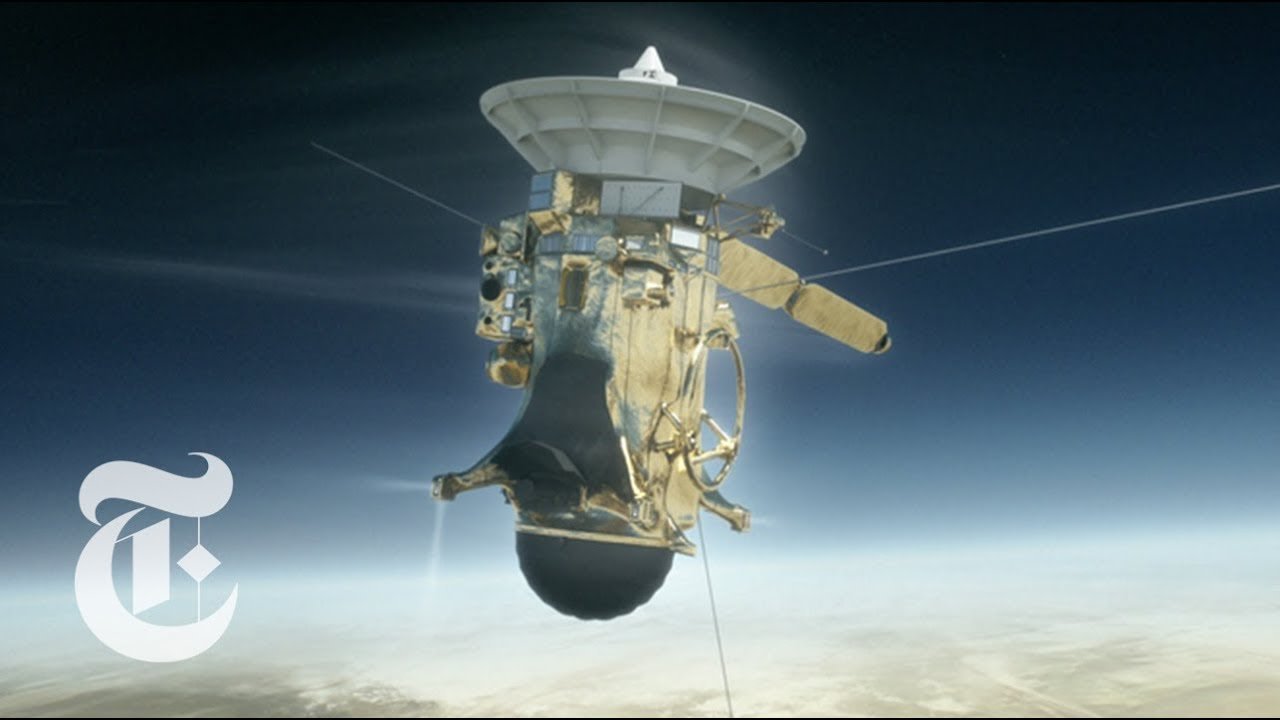
The short version
A New York Times short film on the end of NASA's Cassini spacecraft, which was to dive into Saturn on September 15, 2017. It recounts the arrival in 2004, the Huygens landing on Titan, the flybys of moons including Enceladus, and the 22 dives of the grand finale. Cassini was to be destroyed because its fuel was almost gone.
Full written account
Cassini was scheduled to end its mission on September 15, 2017, by diving into Saturn at over 70,000 miles an hour, after 20 years in space. The spacecraft arrived at Saturn in 2004 after a seven-year journey, and its tour of the ringed planet lasted 13 years.
Titan and the Huygens probe
Cassini's first port of call was Titan, Saturn's largest moon, described as a frigid world of nitrogen smog and dark hydrocarbon lakes. Cassini released the Huygens probe, which parachuted through the smog and sent back images of riverbeds carved in methane and water ice. This was the first touchdown on an alien moon. Cassini returned to Titan over a hundred times, using the moon's gravity as a slingshot to shift its orbit.
Saturn's moons
Cassini's cameras resolved Saturn's rings into grooves, gaps, bands and braids. It observed Saturn's 62 moons, including Pan, Prometheus, Hyperion and Iapetus. Enceladus was called the most surprising: its crinkled shell hides an ocean of water that might be hospitable to life, and geysers of salt water shoot from its south pole. Cassini flew through the plumes several times and detected promising molecules, but its sensors were not designed to look for life. A future spacecraft will be needed to answer that question.
Saturn itself
Cassini arrived in northern winter, with the north pole in darkness. As the seasons changed, it could study the north polar hurricane, a six-sided storm. Some orbits took it behind Saturn, and from there it saw the distant Earth as a pinprick of blue light.
The grand finale
In April, Cassini passed Titan for the last time, and the moon's gravity pulled it inward for the first of 22 dives inside Saturn's rings. These gave 22 chances to look at the cloud tops, study the pole and view the rings from the inside. The fuel was almost gone. To keep Titan's lakes and Enceladus's snows untouched by any earthly microbes, the spacecraft had to be destroyed. On the final dive it would pierce Saturn's clouds while sending its last data to Earth.
Questions this video answers
When did Cassini dive into Saturn?
On September 15, 2017, according to the video.
Why was Cassini destroyed?
Its fuel was almost gone, and the spacecraft had to be destroyed to keep the lakes of Titan and the snows of Enceladus untouched by any earthly microbes.
How fast was Cassini going on its final dive?
Cassini would pierce Saturn's clouds at over 70,000 miles an hour.
When did Cassini arrive at Saturn?
The video says Cassini arrived at Saturn in 2004 after a seven-year journey.
What was the grand finale?
It carried out 22 dives inside Saturn's rings, called the grand finale, after a last close pass by Titan in April.