Falcon Heavy Launches ViaSat-3 F3 and Lands Both Side Boosters
The short version
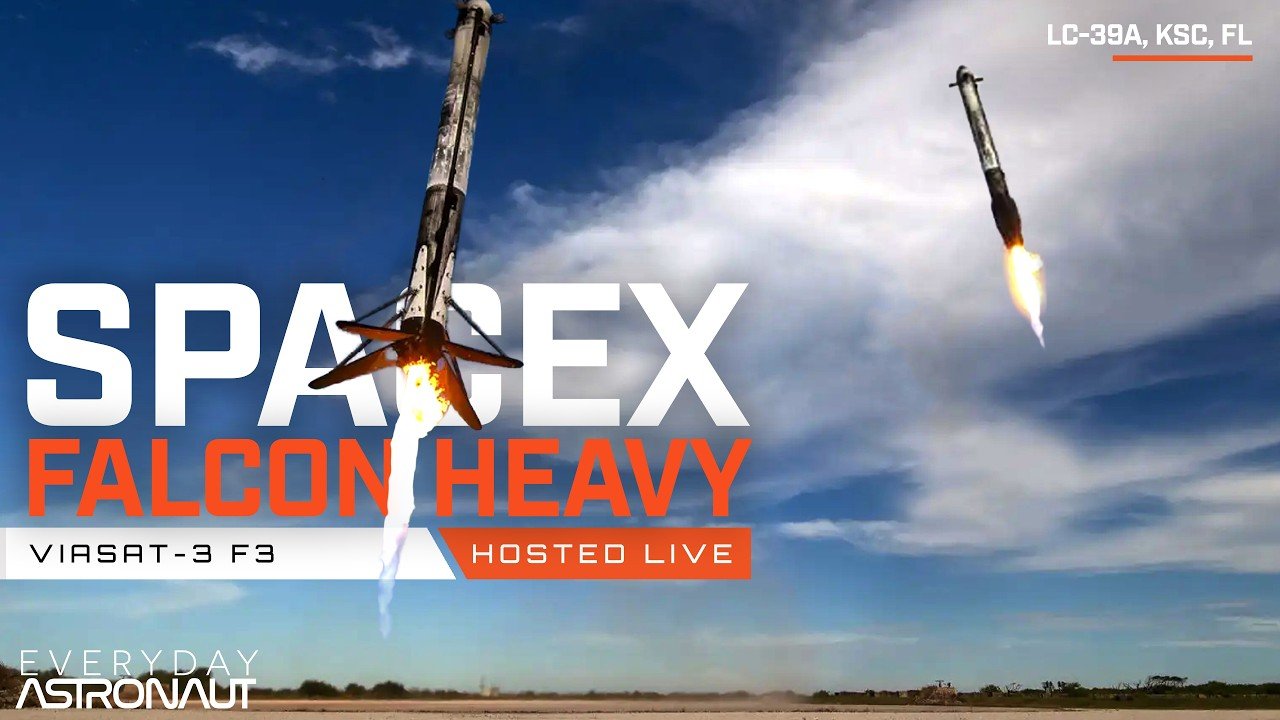
SpaceX launched a Falcon Heavy from Launch Complex 39A with the Boeing-built ViaSat-3 F3 satellite, the 12th Falcon Heavy flight and the first since October 2024. Both side boosters landed at Landing Zones 2 and 40, and the second stage made a nominal orbit insertion before a later burn. The stream pairs SpaceX's official webcast with live commentary from Tim Dodd.
Full written account
Falcon Heavy lifted off from Launch Complex 39A at Kennedy Space Center on April 29, 2026, at 10:13 a.m. Eastern time, carrying the Boeing-built ViaSat-3 F3 satellite. It was the 12th Falcon Heavy flight and the first since October 2024, when the vehicle launched NASA's Europa Clipper. Both reused side boosters returned to land at Cape Canaveral Space Force Station within minutes of liftoff.
The mission and its payload
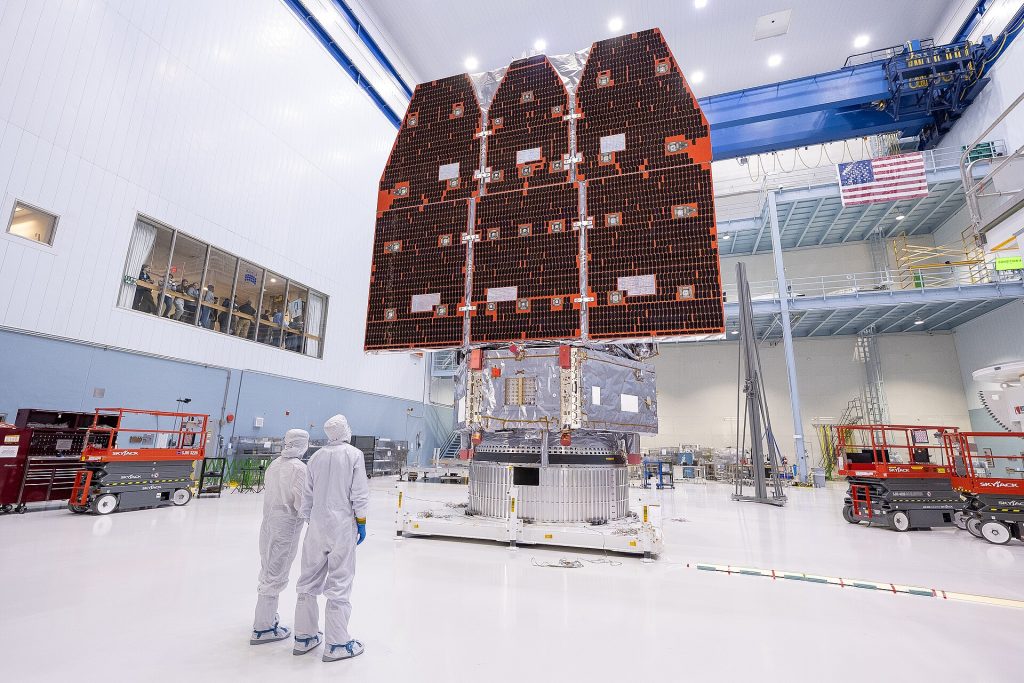
ViaSat-3 F3 is the third of three ultra high-capacity satellites for Viasat, and its launch completes the ViaSat-3 constellation. The payload weighs about 6 metric tons. Its solar array has a wingspan of 144 ft and is expected to generate more than 25 kW of power, and the satellite itself is about 24 ft long. Viasat designed and manufactured the payload.
Once in service, it is expected to provide more than 1 Tbps of broadband capacity over the Asia-Pacific region, more than doubling the bandwidth capacity of Viasat's entire fleet. Each ViaSat-3 satellite can steer capacity between beams, which matters for aviation, maritime, defense and home internet customers whose demand hotspots shift during the day.
This was a paid commercial launch, not a test flight. Falcon Heavy is described as having flown 11 times before with 100% mission success, from its debut on February 6, 2018, which carried a Tesla Roadster and Starman into a heliocentric orbit, through USSF 44 in November 2022, ViaSat-3 Americas in 2023, Psyche later that year, and Europa Clipper in October 2024.
An unusual orbit choice
The satellite was headed for a geostationary transfer orbit, and at 6,500 kg or so that puzzled Tim Dodd, the Everyday Astronaut, who noted that a Falcon 9 had launched similar masses. During the broadcast, the next second-stage burn was announced for about 4 hours and 46 minutes after the T+26 minute burn. Dodd concluded that the stage was doing much of the orbit-raising itself, going out toward geostationary altitude rather than leaving the satellite to do all the work. This was his reasoning from the broadcast, not a stated mission plan.
He offered a possible trade-off: a satellite operator with contracts worth, in his hypothetical, $30 million a month would lose revenue during a months-long orbit raise with slow burns, so paying more for Falcon Heavy to get the satellite into service sooner could make sense. He gave those figures as illustrations, not actual contract values. The gray stripe on the upper stage, he explained, helps warm the RP-1 so it does not freeze into a slush during a long coast in contact with the liquid oxygen.
Countdown and ascent
Propellant loading finished on schedule, leaving Falcon Heavy with nearly 3 million pounds of propellant. The strongback retracted after the clamp arms around the second stage opened, a process of about 15 seconds. Weather was forecast at 85% favorable on launch day, up from roughly 50% on the earlier attempt that scrubbed. Dodd said clouds matter chiefly because of lightning risk, which can damage electronics, and that a rocket's exhaust plume can act like a conductor from ground to cloud.
At liftoff, the side boosters lit first, followed by the center core. About 30 seconds into flight the engines throttled down for max Q, the point of maximum aerodynamic pressure, and the vehicle was called supersonic shortly after. Before separation, one engine on each side booster was throttled down to manage loads between the side boosters and the center core.
Booster separation and landings
Booster engine cutoff came roughly two and a half minutes into flight. The side boosters separated, flipped, and started a boost back burn, the first of three burns on the way back. The center core then cut off, stage separation was confirmed, the second-stage MVac ignited, and the fairing separated.
The entry burn was planned for just after T+6:30 and lasted about 15 seconds, slowing the boosters before the denser atmosphere. A landing burn followed, and the boosters touched down at Landing Zones 2 and 40. Sonic booms were heard on the way down. One side booster was flying for the 22nd time and the other for the second time. The side boosters pass through the exhaust of their own engines during re-entry, depositing soot from RP-1 that builds up with each flight.
The center core was expended; Dodd said Falcon Heavy center cores are purpose-built and fly once. He added that SpaceX has talked about landing Falcon Heavy cores downrange, and speculated that an obstacle could be the risk of one booster's plume damaging its neighbor on a shared landing platform.
Second stage burns
The second-stage MVac cut off nominally, and orbit insertion was confirmed. The second burn, SES-2, started at about T+26 minutes, lasted a little over a minute, and was the second of three burns to deliver the payload to its required orbit. Ice crystals seen forming near the vents were described as solid oxygen from venting liquid oxygen, ripped away by acceleration. Dodd explained that liquid oxygen expands about a thousand times when it becomes gas, so tanks must vent.
The broadcast also noted upcoming Falcon Heavy missions: NASA's Griffin lunar lander and the Nancy Grace Roman Space Telescope, both manifested for late 2026, and Rosalind Franklin, targeted for 2028 and announced earlier that month.
Questions this video answers
When and where did Falcon Heavy launch ViaSat-3 F3?
Liftoff was at 10:13 a.m. Eastern time from Launch Complex 39A at Kennedy Space Center, Florida. The description gives the date as April 29, 2026.
Did the boosters land?
Both side boosters landed at Landing Zones 2 and 40 at Cape Canaveral Space Force Station. The center core was expended.
How big is the satellite?
The payload weighs about 6 metric tons and has a solar array with a 144 ft wingspan. The arrays are expected to generate more than 25 kW.
What will ViaSat-3 F3 do?
It is expected to provide more than 1 Tbps of broadband capacity over the Asia-Pacific region, more than doubling the bandwidth capacity of Viasat's entire fleet and completing the ViaSat-3 constellation.
How often does Falcon Heavy fly?
It was the 12th Falcon Heavy launch and the first since October 2024, when it launched Europa Clipper.
Explore related missions
Connected by the topic: Falcon Heavy