Mir: 15 Years of Modules, Mold, Fire and a Progress Collision
The short version
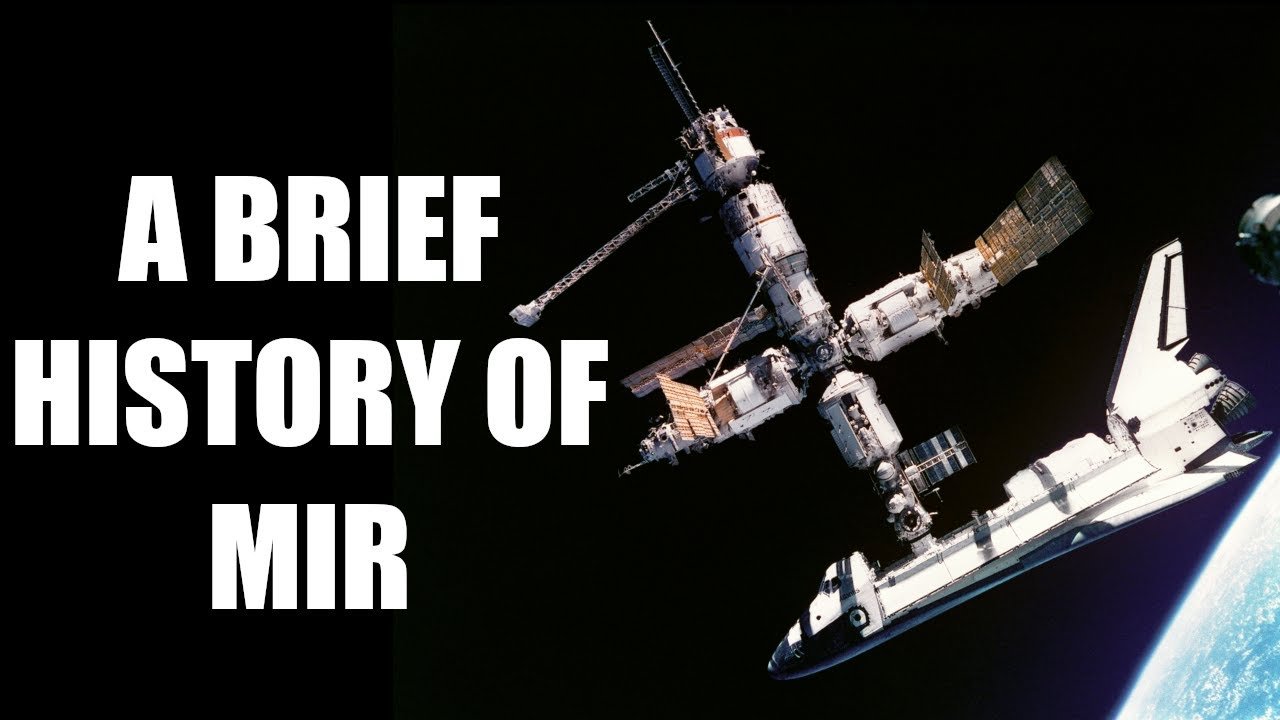
A history of the Mir space station from its 1986 core module launch on a Proton rocket to its 2001 deorbit. It covers the Salyut precursors, the module additions, the mold infestation, the Shuttle-Mir program, the 1997 fire and the Progress collision, and the end of the station over the South Pacific.
Full written account
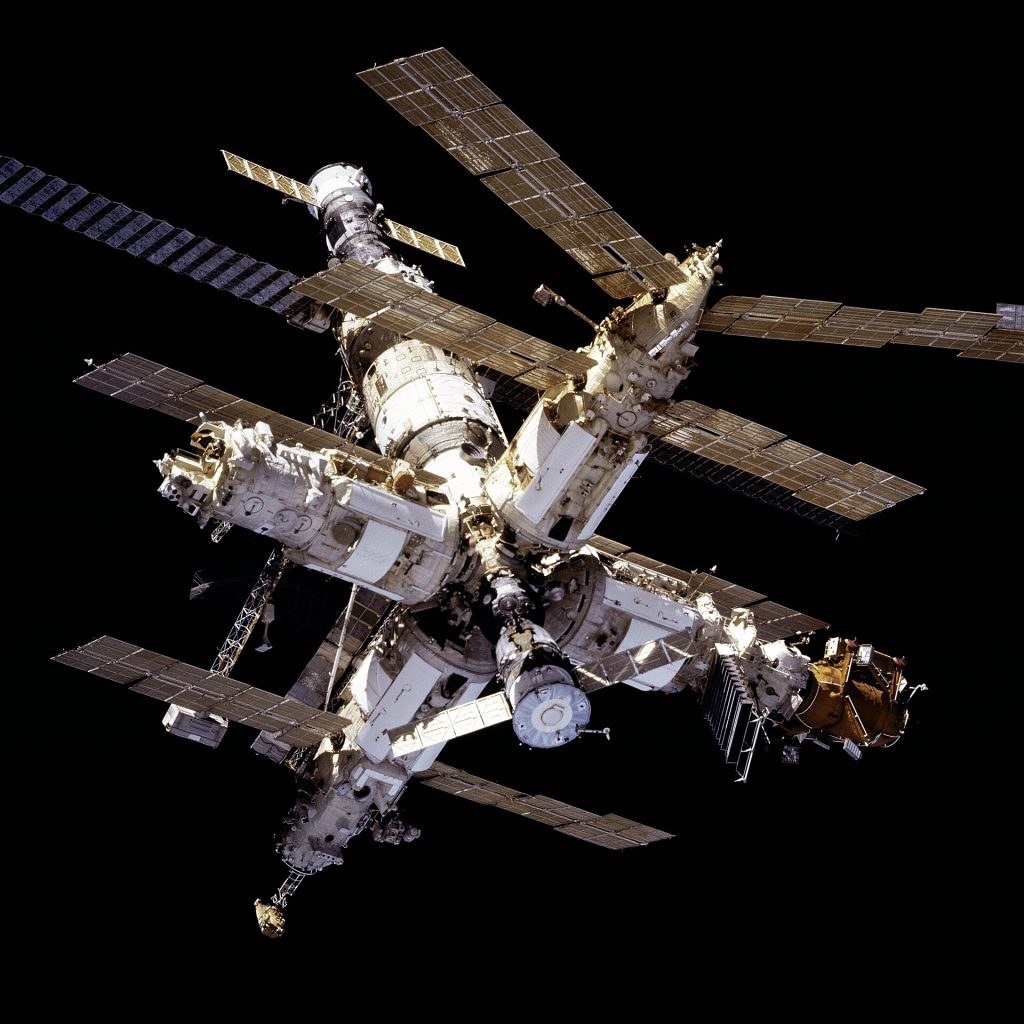
Mir, launched without a crew on a Proton rocket on February 19, 1986, was inhabited for 3,644 days between 1986 and 2001. It was the first space station made of more than one part, and it pioneered modular assembly. Over those years it was also hit by a cargo ship, set on fire and infested with fungus.
From Salyut to a modular station
Mir was approved in 1976. Its core came from the DOS-7 module, which was meant to give two cosmonauts private sleeping cabins, a toilet, an entertainment area, exercise and medical equipment, and a command center. The core had six docking ports. Work slowed in the early 1980s while the Soviet program concentrated on Buran, and it had all but halted by early 1984. When the base block reached Baikonur in May 1985, 1,100 of its 2,500 cables needed reworking.
Early expansion
The first crew, Leonid Kizim and Vladimir Solovyov on Soyuz T-15, launched on March 15, 1986. They then flew to Salyut 7, a trip of 2,500 km that took 29 hours. Salyut 7 had been empty for seven months and was frozen and without power. It remains the only time two stations have been visited on a single mission, as far as the narrator knows. The crew landed on July 16 after a 125-day flight.
Kvant-1 launched on March 30, 1987 and reached only a soft dock, with no seal between the ports. The EO-2 crew made an emergency spacewalk lasting 3 hours 40 minutes and found a trash bag pinned between the docking ports. Kvant-2 followed on November 26, 1989, after a 40-day delay caused by faulty computer chips. One of its solar arrays had not deployed, and rolling the craft while rotating the array freed it. At 20 m the Kurs system ended the docking approach because it sensed the module was moving too fast. The cosmonauts took manual control and docked on the second attempt. Kvant-2 carried an airlock and the SPK maneuvering unit, which was tested tethered to the station. Kristall arrived in May 1990 with two APAS docking ports intended for the Buran program.
The end of the Soviet Union
Soyuz TM-13 launched on October 2, 1991, and the country it left from no longer existed when its crew returned. Sergei Krikalev's stay on board is often described as being stranded, but the narration calls that slightly exaggerated: his return was delayed by a few months. His relief craft, Soyuz TM-14, launched on March 17, 1992. In the meantime the Sofora girder, a 14 m mast, had been installed on Kvant-1 in 1991, and cosmonauts mounted a Soviet flag on it. It was reduced to shreds and removed in late 1992.
Funding was short. Tracking ships operated by Ukraine were withdrawn, some Progress cargoes arrived with items missing, and mission control staff worked second jobs as taxi drivers and interpreters.
Znamya mirrors
The Znamya satellite, designed by Vladimir Syromyatnikov, was first proposed as a solar sail. It found support only once it was pitched as a space mirror. Znamya 2 was a 20 m mirror deployed from Progress M-15 in October 1992. It produced a bright spot 5 km wide that crossed from southern France to western Russia at 8 km/s, but cloud cover hid it from most observers. Znamya 2.5 was deployed on February 5, 1999. It caught on the Progress antenna and tore, and a third, larger mirror was cancelled.
The mold
From 1988 cosmonauts saw fungus at the windows, and it later spread inside. By the mid-1990s about 90 microorganism species were found aboard. They fed on control panels, cable insulation, window seals and parts of the Orlan suits. Visiting shuttle crews reported a smell of mold. In 1998 cosmonauts found basketball-sized globules of murky water behind an instrument panel, and the water held microorganisms including dust mites.
Shuttle-Mir
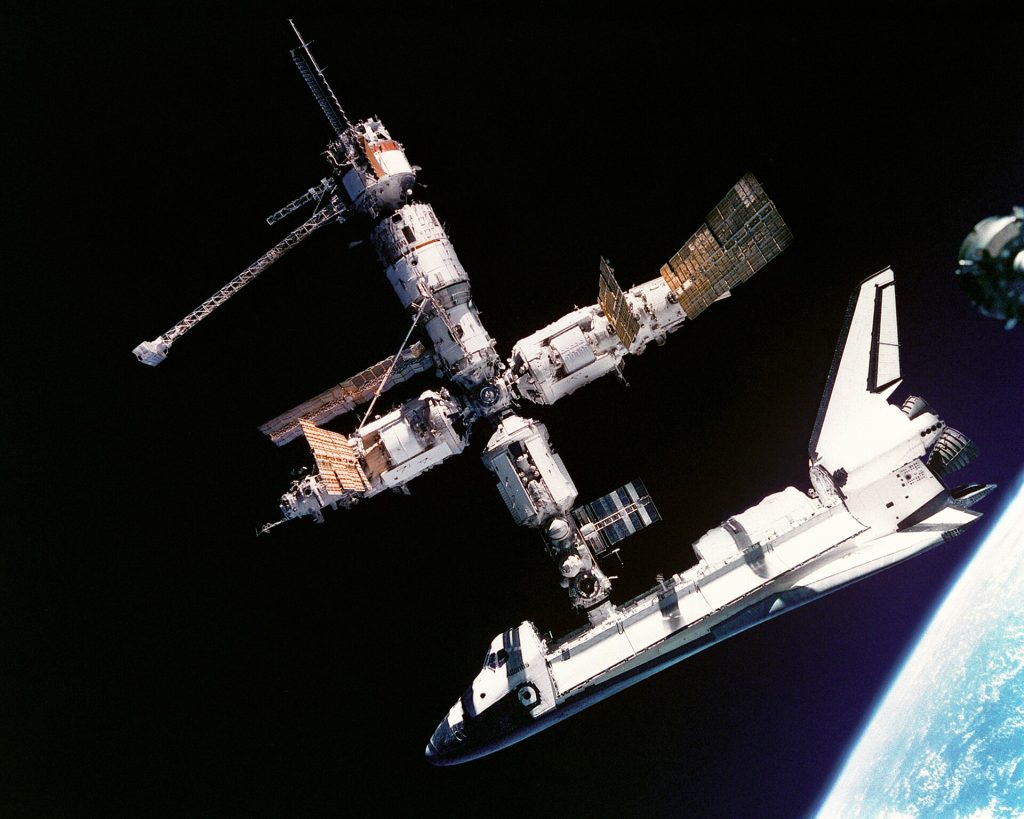
Krikalev flew on Discovery on STS-60 in February 1994. STS-63 in February 1995 came within 37 ft of Mir. On the approach, James Wetherbee said the next time they would "shake your hand". Spektr arrived in June 1995, and NASA paid part of its cost in exchange for installing 600 to 700 kg of experiments. STS-71 launched on June 27, 1995 and made the first docking of American and Russian spacecraft since Apollo-Soyuz. The linked pair was the largest and heaviest spacecraft in history. Priroda, launched in April 1996, had only enough battery power after an electrical failure for one docking attempt, and it docked on the first.
1997: fire and collision
On February 24, 1997, a solid-fuel oxygen canister caught fire in Kvant-1 and sent out meter-high flames and molten metal. The fire burned for 14 minutes, the crew used three extinguishers, and they wore filter masks for several days.
On June 25, 1997, Vasily Tsibliyev tried to dock Progress M-34 by the manual TORU system. The Kurs radar had been switched off, he had no telemetry, and the monitor image was hard to read against clouds. Laser range finders misjudged range and speed. Aleksandr Lazutkin told Michael Foale to get to the Soyuz. The Progress hit the core module, then Spektr twice. Pressure fell and the station began to spin. The crew disconnected the power cables running through Spektr and closed its hatch, which left the station without power and cut radio contact. They used Soyuz TM-25 to stabilize the station and reorient the working solar panels, and they worked by flashlight for days while the temperature rose. Tsibliyev developed a heart arrhythmia and was put on medication until a relief crew arrived.
NASA weighed ending the program early but kept it, since only three flights remained. A later crew entered the depressurized Spektr to restore power cables. Foale and Anatoly Solovyov made a 6-hour spacewalk to inspect the damage. Shuttle-Mir ended with the departure of Discovery on STS-91, June 8, 1998.
Deorbit
Questions this video answers
When was the Mir core module launched?
On February 19th, 1986, on a Proton rocket.
How long was Mir inhabited?
3,644 days, from 1986 to 2001.
What happened in the 1997 collision?
During a manual docking test, Progress M-34 hit the Spektr module, which was then sealed off, and the station lost pressure and power.
How did Mir end?
It was deorbited in three phases, with a final burn bringing it down on March 23rd, 2001, and it broke apart over the South Pacific.
Explore related missions
Connected by the topic: Mir