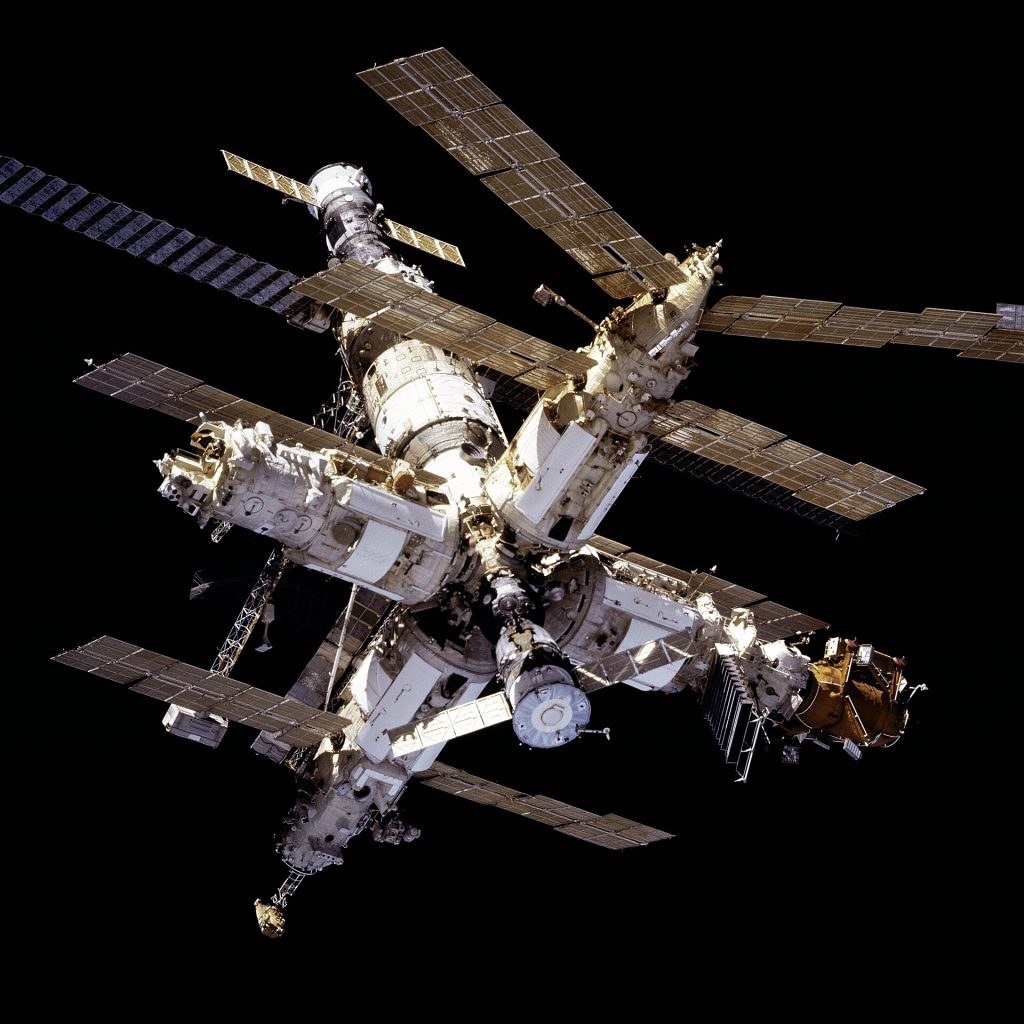
Mir in 1997: Fire, a Failed Docking System and a Progress Collision
The short version
A documentary-style account of the Mir space station, from its 1986 core module launch to the troubled year 1997. It covers a fire, a failed automatic docking system, and the June 25, 1997 collision of a manually docked Progress cargo ship with the Spektr module. It also describes the budget pressures that kept the aging station in service.
Full written account
In 1997, the Russian space station Mir, in orbit for 11 years, suffered a series of accidents that put its crew at risk. The worst came on June 25, when an unmanned Progress cargo ship being docked by hand struck the station's Spektr module, the first collision of its kind between space vehicles. The crew on board were commander Vasily Tsibliyev, flight engineer Alexander Lazutkin and NASA astronaut Michael Foale.
An aging station on a tight budget
Mir's core module was put into orbit in February 1986. It was designed to be permanently manned and to grow from modules assembled in space. Kvant 1 docked in 1987, Kvant 2 was placed in position in December 1989, and Kristall was added in 1990. Later additions included Spektr and Priroda, the latter in April 1996.
After the Soviet Union ceased to exist at the end of 1991, the Russian space program faced a financial crisis. It made a deal with NASA: in return for US dollars, American astronauts could spend time on Mir. Norman Thagard was the first, launching on a Soyuz on March 14, 1995. In June 1995 the shuttle Atlantis linked up with Mir, and in November 1995 it delivered a new docking module.
By 1997 most of the equipment was wearing out. The core module of the new station, Space Station Alpha, was supposed to be launched by the Russians that May but was behind schedule, so Mir had to keep going. Foale, who spent 140 days on Mir in 1997, likened its interior to someone's junk-filled garage. There was a smell of oil, dampness from condensation, and growing leaks of ethylene glycol, used to regulate interior temperature. Cosmonauts were paid low basic pay with bonuses; a spacewalk was worth one thousand dollars, as was a manual docking.
The mishaps of early 1997
In February 1997 an unexplained fire broke out in the Kvant 1 module. The cosmonauts extinguished it before serious damage was done. Two weeks later a Progress cargo craft had to be abandoned in space after its automatic docking system malfunctioned. The parts came from a Ukrainian firm that had not been paid and had stopped making replacement parts. From then on, Progress dockings had to be done manually, which was more dangerous.
The June 25 collision
Ground control ordered Tsibliyev to practice a manual docking of Progress. He relied on images from a video camera in the nose of the cargo ship and used remote controls to guide it toward Mir's docking port. He noticed it was approaching very fast and warned ground control, which appeared unconcerned. At a critical moment he lost the picture on his screen and asked Lazutkin to check from the observation ports. The picture then returned, and within the next minute the Progress struck a solar array and a radiator on Spektr.
The collision caused heavy damage, reduced pressure within Spektr and caused a severe power loss.
Response and aftermath
The crew, working in darkness, sealed off the leaking Spektr. Ground control ordered them to shut down thermal control systems in Kvant 2 and Kristall, along with oxygen production and carbon dioxide removal in Kristall, leaving only emergency oxygen supplies. The crew maneuvered Mir toward the Sun to recharge its batteries, but the stabilizers needed to hold that position kept failing.
Another Progress carrying repair equipment docked on July 7, 12 days after the collision. Tsibliyev, whom ground control blamed for the collision, began to suffer heart problems. In another incident a crew member accidentally pulled a computer connection and plunged the station into complete darkness. The United States questioned its involvement, but the Russians conducted the necessary repairs.
The last NASA astronaut to spend time aboard left in June 1998. In mid-1998 the Russian space agency announced Mir would be abandoned in 1999.
Questions this video answers
What happened to Mir in 1997?
On June 25, 1997, an unmanned Progress cargo ship, being docked manually, struck a solar array and a radiator on the Spektr module. It was described as the first space vehicle collision and caused heavy damage.
Who was on board Mir during the Progress collision?
Vasily Tsibliyev (commander), Alexander Lazutkin and NASA astronaut Michael Foale.
How did the crew respond?
The crew sealed off the leaking Spektr module. Ground control ordered thermal control systems shut down in Kvant 2 and Kristall, along with oxygen production and carbon dioxide removal in Kristall, leaving only emergency oxygen supplies.
When did repair supplies arrive?
Another Progress carrying repair equipment docked with Mir on July 7, 12 days after the collision.
What was announced about Mir's future?
The Russian space agency announced in mid-1998 that Mir would be abandoned in 1999.
Explore related missions
Connected by the topic: Mir