Mir Space Station: Why Its Design Made It a Success
The short version
A design-focused look at the Mir space station, covering its modules, their origins in Salyut, TKS and Buran hardware, and Galina Balashova's interior design. It also covers anecdotes such as the sauna and cognac, and the 1997 fire, collision and mold problems, arguing Mir was a success.
Full written account
How did a station built by a nation that could not afford it, and that fell apart during construction, stay in orbit three times longer than its design life? The answer, in an engineering-focused look at the Mir space station, lies in its design: Mir was built almost entirely from existing Soviet hardware, and it was crewed continuously for just shy of 10 years, until August 1999.
A modular station built on earlier stations
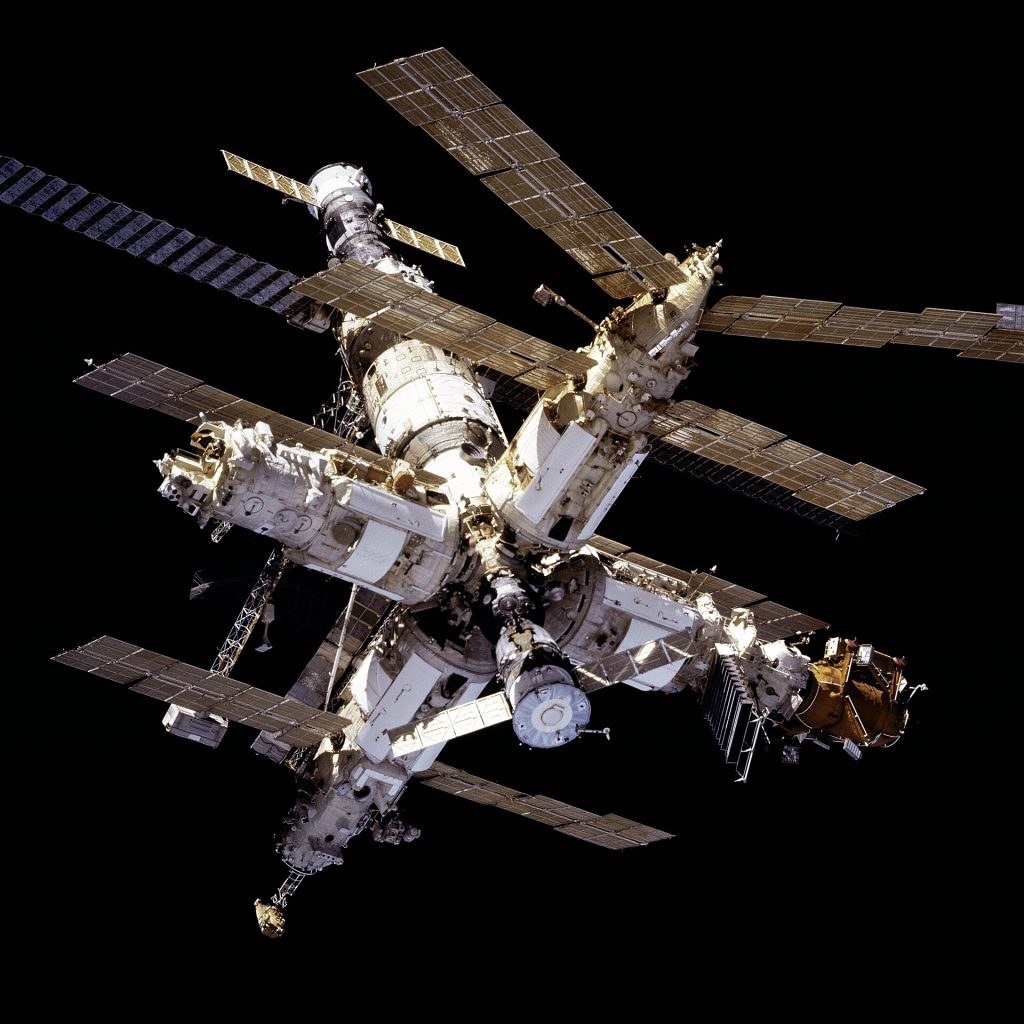
Skylab was a generation 1 station with a single occupied docking port, so it could not be resupplied. Its third and final crewed mission lasted 84 days. Salyut 6 and 7 were generation 2 stations with two active docking ports and were occupied for multi-year periods. Mir built on them, with a total habitable volume of about 350 cubic meters, against about 1,000 for the ISS. Skylab's volume was about the same as Mir's.
The pressurized modules were launched in this order, all but one on Proton K vehicles:
- The base block, or core module, in 1986. It had six docking ports and served as the command hub, and it was designed with long-term habitability in mind.
- Kvant in 1987, an astrophysics observatory with upgraded reaction wheels, which Russian documentation calls gyrodynes, plus oxygen generators.
- Kvant 2 in 1989, with the main airlock, the Orlan suits, the SPK manned maneuvering unit, the shower and a quail incubator.
- Kristall, the last module launched by the Soviet Union, with two APAS docking adapters.
- Spektr in 1995, which generated more power than any other module and was broadly home to the US crew.
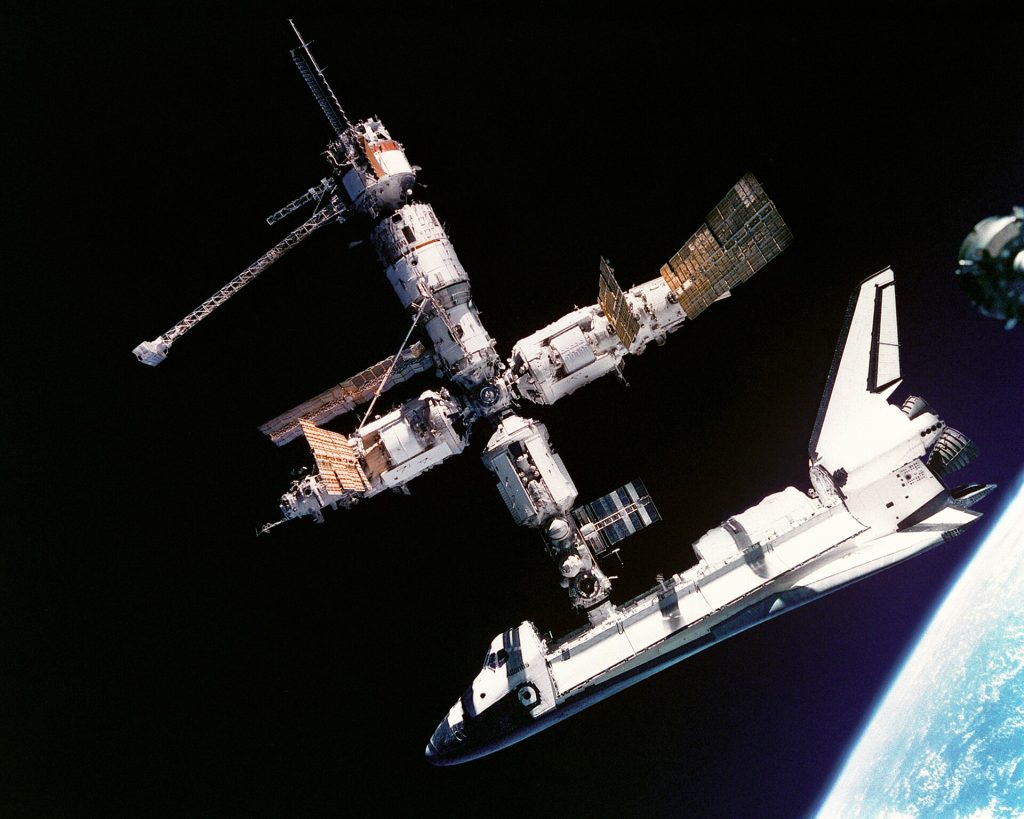
- A docking adapter, installed so shuttles could dock directly. It was the one module without guidance or thrusters.
- Priroda in April 1996, best known for its synthetic aperture radar dish.
The Lyappa arms could move modules around the central docking node. For the first Shuttle-Mir mission, Kristall was moved to the forward port because docking in the 1995 configuration would have left little clearance between the orbiter and the base block solar arrays. That configuration was used on only one occasion.
Reused hardware
The base block was a DOS module, as were Salyut 6 and 7, and Zvezda on the ISS shares the lineage. Kvant was a variant of the 37K module. On its only flight, Buran carried 37KB, and Kvant would have fit in a Buran cargo bay. Kvant was originally built to dock with Salyut 7 and was delivered with a functional service module, since it had no thrusters of its own.
Kvant 2, Kristall, Priroda and Spektr were modified functional cargo blocks (FGB), a development of the TKS freighter from the military Almaz program, with the return capsule removed to leave extra pressurized volume. Kvant 2 was divided into three pressurized compartments and Kristall into two. The docking adapter was a Soyuz orbital module cut in two, with a central section and an APAS adapter at each end.
Externally, the Sofora truss held an array of reaction thrusters whose long moment arm used less fuel for attitude control. The hand-cranked telescoping Strela arms moved cosmonauts and equipment. The station kept this external form from April 1996 until it was deorbited in March 2001.
An interior designed by Galina Balashova
Soviet space architect Galina Balashova designed the layout and appearance of the interior of the base block and Kvant modules, and the color scheme and lighting of the scientific modules. A green-blue scheme marked floors, chosen because it gave low-quality 1980s video cameras a clear background against the crew. Walls were muted yellow and ceilings white. She also designed private sleeping quarters for two crew, each with a window, plus shelving and the Mir typography. Her Apollo-Soyuz emblem led to an episode at Le Bourget, where she received royalties on souvenir pins and had to talk her way out of arrest. She explained that the factory, not she, had registered the copyright.
After the interior went crowded, Kvant became a dumping ground for station litter in later years.
Life aboard
Maggie Aderin-Pocock, a ham radio operator in Australia, made two-way contact with Mir cosmonauts in late 1990 and later formed a bond with Sergei Krikalev, passing him news from the West.
The Kvant 2 shower used about 1 kW and took about 45 minutes to set up and clean. The crew replaced it with a sauna by sending hot air straight into the compartment. Norman Thagard said it was very enjoyable. Russian management later ordered it removed, saying it used too much power, though the NASA line is that it made space for a new gyrodyne.
Intercosmos flew a third, international crew member on arriving Soyuz craft. Helen Sharman's 1991 trip was funded by a private consortium, and when it failed to raise the full sum, the Soviet Union paid. Cognac aboard was often approved as medicinal.
The fire, the collision and the mold
On February 24, 1997, an oxygen generator ignited in Kvant while six people were aboard and two Soyuz craft were docked. It produced a blowtorch-like flame, and the fire blocked access to one of the return craft. It broke out during a mealtime, so the crew were nearby, donned oxygen masks and directed an extinguisher at its base. Valery Korzun operated the extinguisher while Jerry Linenger held him in place. The only lasting damage was some charred panels.
On June 25, 1997, the crew tested a manual docking system by remote-controlling Progress M-34. Recognizing the station against the backdrop of Earth was difficult, and Vasily Tsibliyev realized too late that the craft was coming in too fast. It glanced off the base block and hit Spektr, compromising its hull. Alexander Lazutkin estimated the pressure would drop to an unacceptable level in about 15 minutes, and the crew cut the connections to Spektr and sealed the door. Michael Foale went to the escape craft and later helped stabilize the station, which had been thrown into a slow spin.
In August and October 1997, Anatoly Solovyev and Pavel Vinogradov made two IVAs inside depressurized Spektr, using the docking node as an airlock, restoring about 70% of the module's power.
Of the mold, the story of a basketball-sized accumulation of bacteria-infested water is probably true. Nobody suffered recorded health issues from it, and it led to upgraded air filtration and circulation systems now used on the ISS.
After the Russian crews
In April 2000 the private company MirCorp attempted to save the station. Sergei Zalotin and Alexander Kaleri stayed two months, and a private spacewalk was made to repair exterior damage and inspect the solar arrays. Russia could no longer fund the station, and it reentered in March 2001.
Questions this video answers
Which modules made up Mir?
The base block, launched in 1986, followed by Kvant (1987), Kvant 2 (1989), Kristall, Spektr (1995) and Priroda (April 1996).
Who designed Mir's interior?
Galina Balashova, a Soviet space architect, designed the layout and appearance of the base block and Kvant interiors, plus colour scheme and lighting in other modules.
What caused the 1997 fire on Mir?
The fire of February 24th, 1997 was caused by an oxygen generator igniting in Kvant; the crew extinguished it and the only lasting damage was some charred panels.
What happened in the 1997 collision?
On June 25th, 1997, Progress M-34 collided with Mir during a manual docking test. It glanced off the base block and hit Spektr, whose hull was compromised.
When did Mir end?
It reentered Earth's atmosphere in March 2001, after the station was deorbited.
Explore related missions
Connected by the topic: Mir