Psyche Spacecraft’s Mars Flyby: 1,000 mph Boost and Instrument Test
The short version
On May 15, 2026, NASA's Psyche spacecraft passed about 2,864 miles from Mars and received a gravity assist on its way to the metal-rich asteroid Psyche. Flight team analysis of radio signals showed a boost of 1,000 mph and a shift of more than 3° in its orbital plane relative to the Sun. The imagers, magnetometer and gamma ray and neutron spectrometer were used as a calibration opportunity during the encounter.
Full written account
On May 15, 2026, NASA's Psyche spacecraft passed within 2,864 miles of Mars and left the planet with a 1,000 mph boost. Analysis of radio signals between the spacecraft and NASA's Deep Space Network let the flight team confirm that the gravity assist also shifted its orbital plane relative to the Sun by more than 3°. That put the spacecraft almost perfectly on its planned trajectory to reach the metal-rich asteroid Psyche in the summer of 2029.
A calibration opportunity
The close approach let the team power up the imagers, the magnetometer, and the gamma ray and neutron spectrometer. They compared the measurements with surface and atmospheric data from several other Mars missions.
The spectrometer measured neutrons coming from the planet's surface, something it will do at asteroid Psyche to better understand what that body is made of. The magnetometer detected Mars' magnetic field interacting with the Sun's plasma as the spacecraft passed through the planet's bow shock, a trial run for measuring the asteroid's magnetism.
Imaging Mars
The multispectral imager was especially active. Planning relied on a system called Cosmographia, used to simulate the encounter in advance. The team needed to decide how close images had to be taken to overlap enough to build a large mosaic.
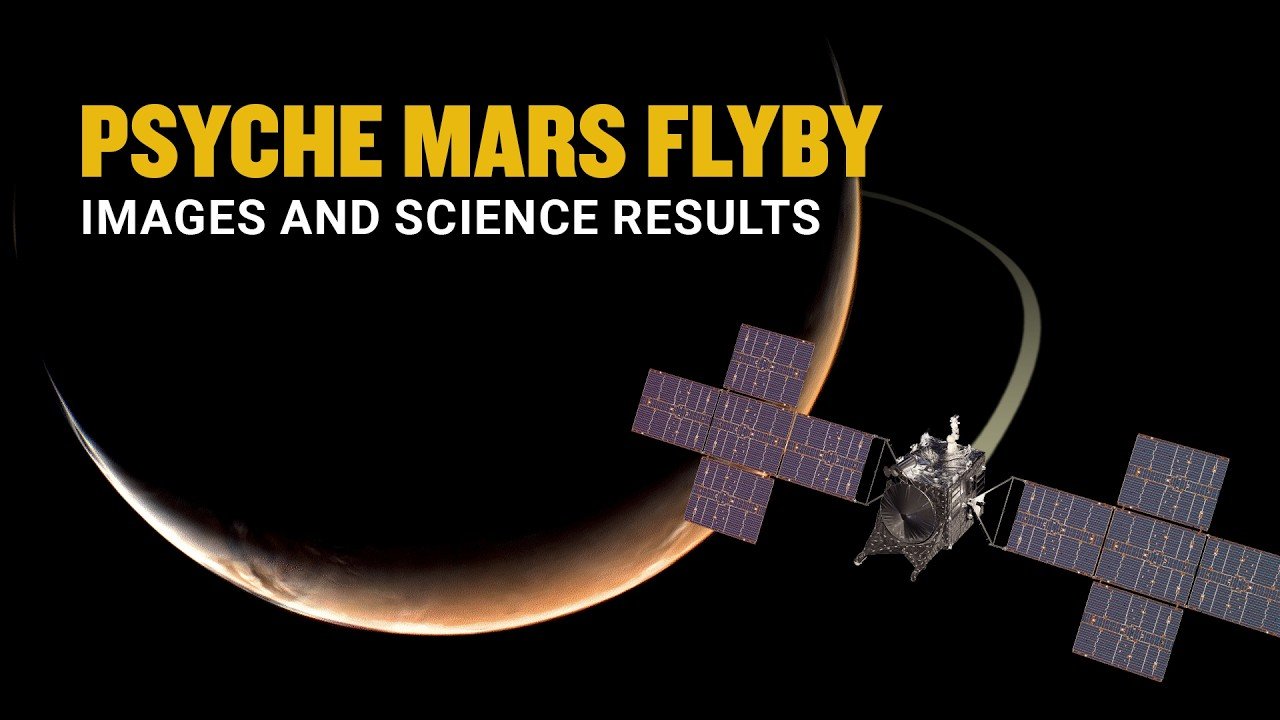
The spacecraft also saw Mars from a rare perspective: in a high-phase crescent, only 4% of the planet was illuminated, and the atmosphere could be seen glowing around it. One team member's favorite image looks like an eye. It starts with Mars as a tiny crescent that grows slightly each day until 14 images are stacked, conveying the speed at which the spacecraft travels.
Team members singled out the southern polar cap, Huygens crater and wind-streaked terrain, which they said shows active processes on Mars.
What comes next
With Mars behind it, Psyche will soon resume thrusting with its solar electric propulsion system, heading for the asteroid belt.
Questions this video answers
How close did Psyche come to Mars?
About 2,864 miles (roughly 4,500 kilometers) from the surface, on May 15, 2026.
What did the gravity assist do?
It gave the spacecraft a 1,000 mph boost and shifted its orbital plane relative to the Sun by more than 3°.
When will Psyche reach the asteroid?
It is planned to arrive at asteroid Psyche in the summer of 2029.
Which instruments were used at Mars?
The imagers, the magnetometer, and the gamma ray and neutron spectrometer.
What happens next for the spacecraft?
It will soon resume thrusting with its solar electric propulsion system on the way to the asteroid belt.
Explore related missions
Connected by the topic: Asteroids and comets