Psyche
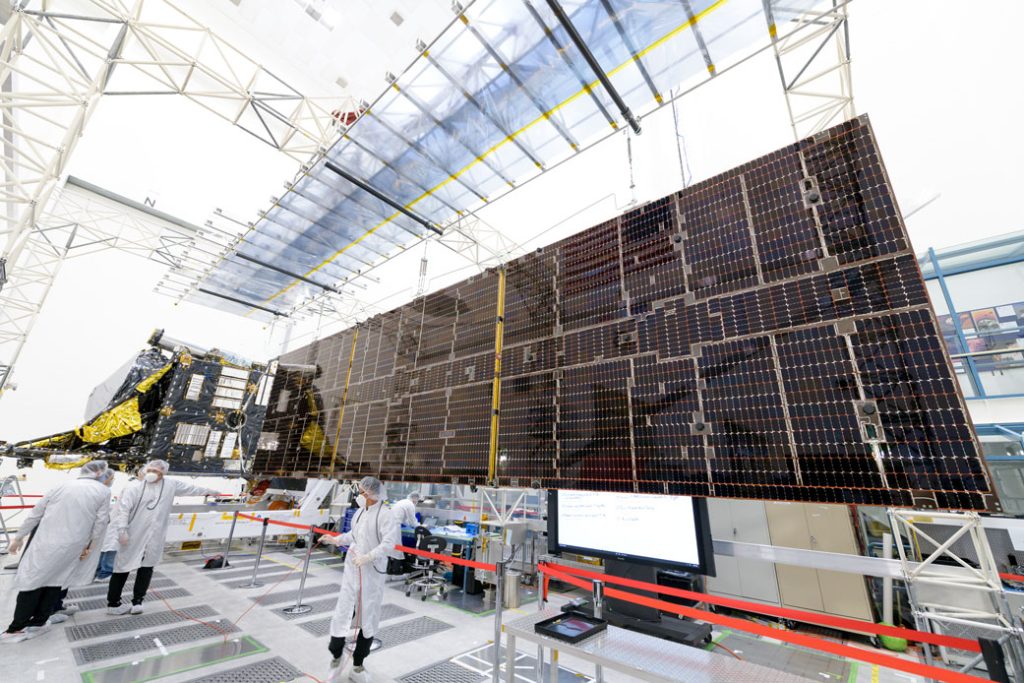
Psyche is a NASA spacecraft that launched on 13 October 2023 to orbit an asteroid of the same name, a metal-rich body in the main belt that may be the exposed core of a planetary building block. On 15 May 2026 it flew past Mars, which bent its path toward the asteroid, where it is due to arrive in 2029.
What happened
-
Watch this moment · 0:22
Launch
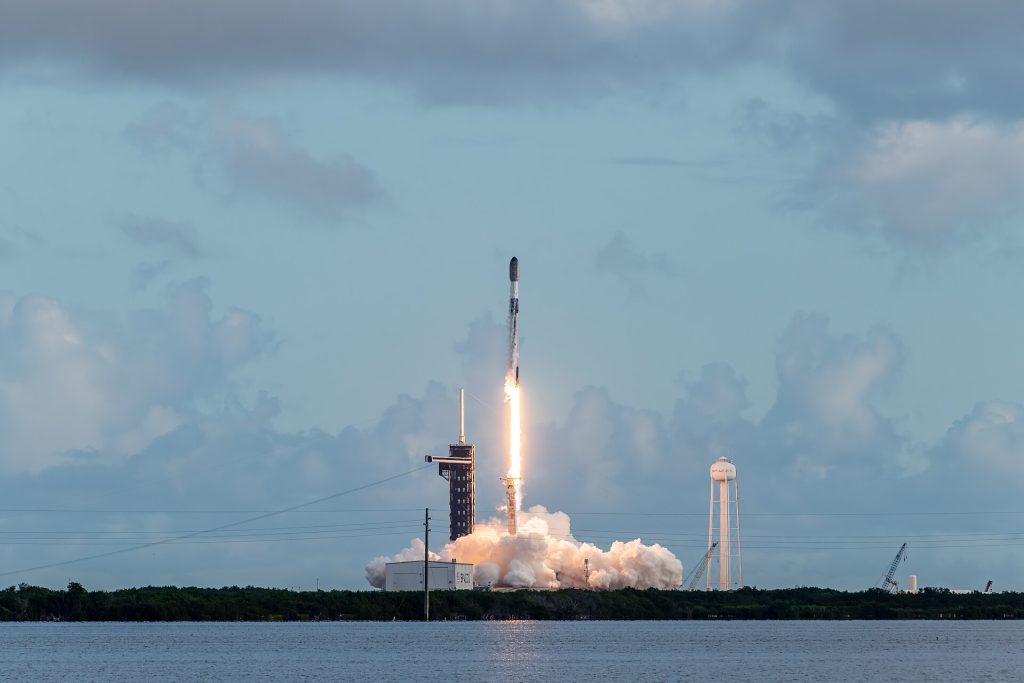
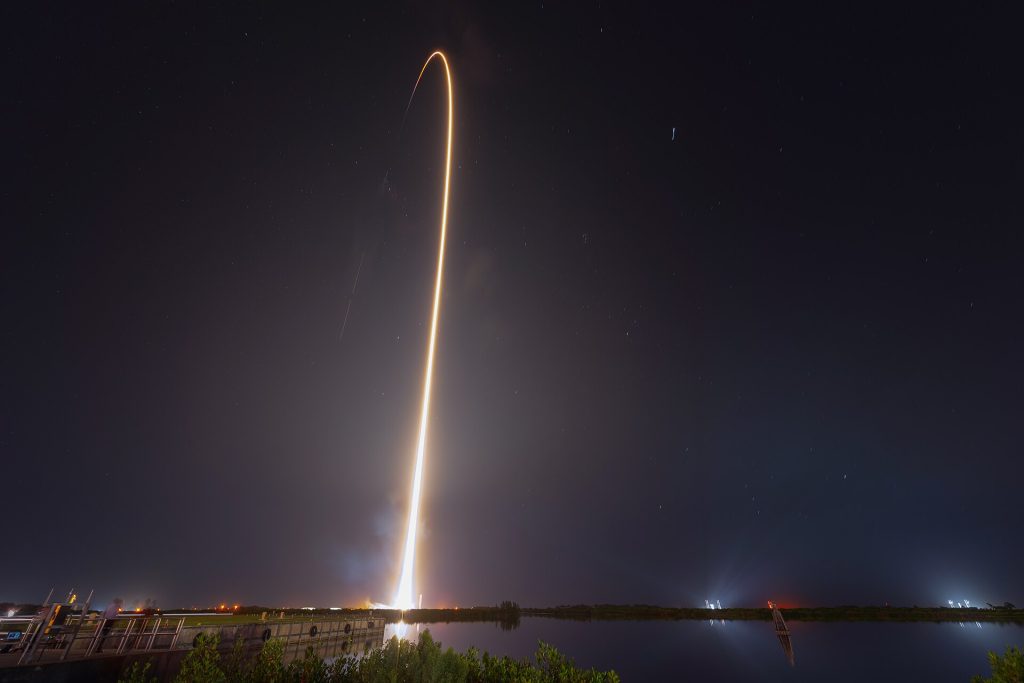
Psyche launched from NASA's Kennedy Space Center. NASA's page says the launch vehicle was a SpaceX Falcon Heavy. The video describes launch and deployment as flawless.
-
Watch this moment · 1:07
Why Mars is needed
A mission speaker says the gravity assist increases speed but, more importantly, changes the plane of the orbit. The plane of Earth's path and the plane of the asteroid Psyche differ by about 3 degrees, and the team says they cannot reach the asteroid without the assist.
-
Watch this moment · 1:29
What the imagers will do
The team planned time-lapse images of Mars as a thin crescent for a short video of the arrival and departure. They also planned thousands of observations with the multispectral imager to sharpen the imaging and navigation techniques needed at the asteroid.
-
Watch this moment · 0:01
Closest approach to Mars
Psyche passed within 2,864 miles of Mars, according to NASA's account. The preview had given about 2,800 miles at 12,328 miles an hour.
-
Watch this moment · 0:12
The assist is confirmed
Radio signals tracked by the Deep Space Network showed a boost of about 1,000 miles an hour and a shift of the orbital plane relative to the Sun by more than 3 degrees. The craft was left almost perfectly on its planned path.
-
Watch this moment · 1:03
Instruments tested at Mars
The gamma ray and neutron spectrometer measured neutrons from Mars's surface, as it will at the asteroid. The magnetometer detected Mars's magnetic field interacting with the Sun's plasma at the planet's bow shock, a trial for measuring the asteroid's magnetism.
-
Watch this moment · 1:53
A crescent Mars
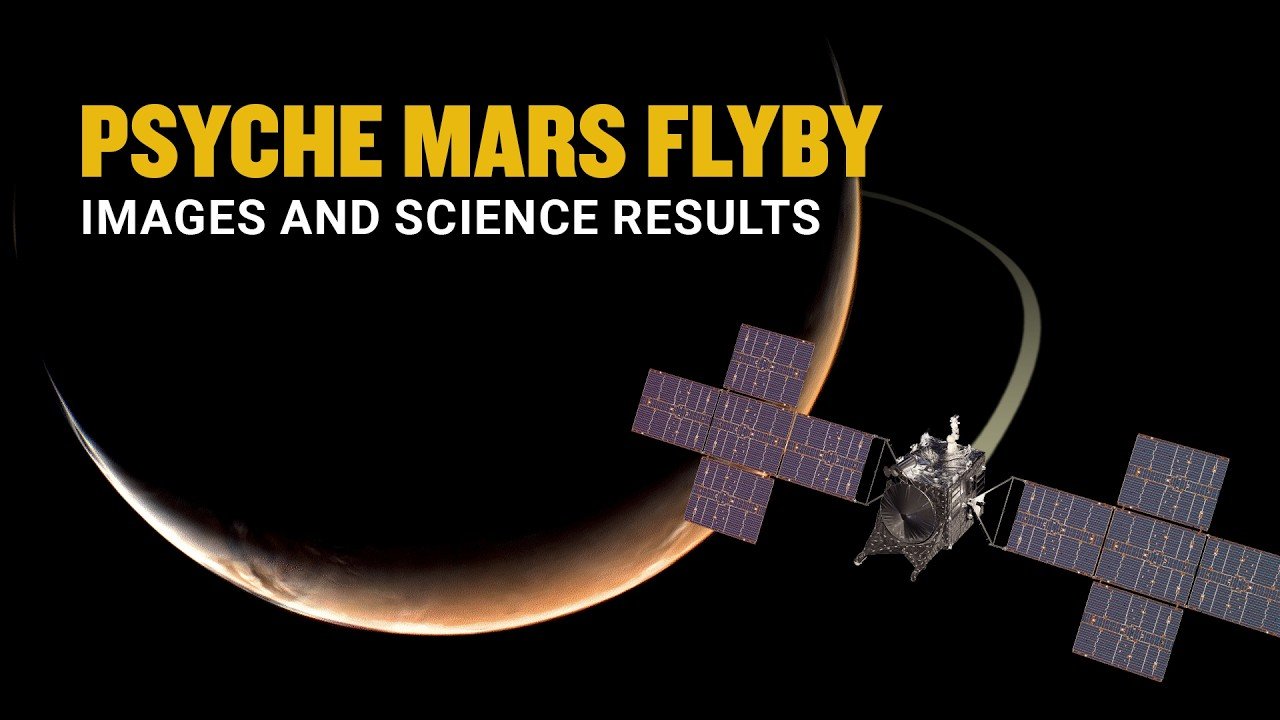
With the approach at a high phase angle, only 4 per cent of Mars was lit, and the atmosphere glowed around the crescent. A stack of 14 images, which one team member likened to an eye, shows the crescent growing as Psyche closed in.
-
Watch this moment · 2:49
Back to thrusting
With Mars behind it, Psyche is to resume thrusting with its solar electric propulsion system, which is the plan for the trip through the asteroid belt. NASA's page gives August 2029 for starting exploration of the asteroid.
Key facts
| Mission name | Psyche |
|---|---|
| Launch site | Kennedy Space Center |
| Crew size | 0 |
| Outcome | In progress |
Videos about this mission
The videos, in date order
Drag, zoom or press play to watch them on this page.
May – July 2026
Drag to explore dates · Select a video to preview.
Psyche Spacecraft’s Mars Flyby: 1,000 mph Boost and Instrument Test
NASA Jet Propulsion Laboratory
Watch videoDates are when each video was first published on YouTube.
Why this asteroid
The asteroid Psyche orbits the Sun between Mars and Jupiter. In the NASA narration in video 447, scientists think it could be the exposed core of a planetary building block, a clue to how planets such as Earth formed. The spacecraft carries instruments to image the asteroid and to measure its geology, composition, topography, and gravitational and magnetic fields. NASA's page also notes that Psyche carries the Deep Space Optical Communications experiment, which tests laser communication beyond the Moon.
How the Mars flyby worked
A gravity assist uses the planet's pull to change the spacecraft's speed and direction without spending propellant. Psyche needed the direction change as much as the speed. Because the asteroid's orbit is tilted about 3 degrees from Earth's, the assist put the spacecraft in the right plane to reach it.
The team also used the flyby to practise. Video 427 says they compared the instruments' measurements with surface and atmosphere data from other Mars missions. Planning for the imagery used a simulation tool called Cosmographia. Team members singled out the southern polar cap, Huygens crater and wind-streaked terrain in the images.
What we still don't know
The asteroid's make-up is still a question. NASA's page and the videos describe an object that may be mostly metal, but the mission has yet to see it close up. The spacecraft is due at the asteroid in 2029 and is to spend about two years in orbit. If the asteroid is a core, the instruments tested at Mars are the ones that would show it.
Questions and answers
When did Psyche launch?
On 13 October 2023, from Kennedy Space Center on a SpaceX Falcon Heavy, according to NASA.
Why did Psyche fly past Mars?
To change its orbital plane and gain speed without extra propellant. The team said the plane change of about 3 degrees could not be done without the assist.
When will Psyche reach the asteroid?
NASA says it is on its way to begin exploring the asteroid by August 2029, and will spend about two years in orbit.
How close did it get to Mars?
Within 2,864 miles on 15 May 2026, according to NASA's account of the flyby in video 427.
What instruments were tested?
The imagers, the magnetometer and the gamma ray and neutron spectrometer, per video 427.
Sources: The facts and written text on this page come from the 2 videos on this page, by NASA Jet Propulsion Laboratory.