Starship Flight 14: First Orbit and 26 Starlink V3 Deployed
The short version
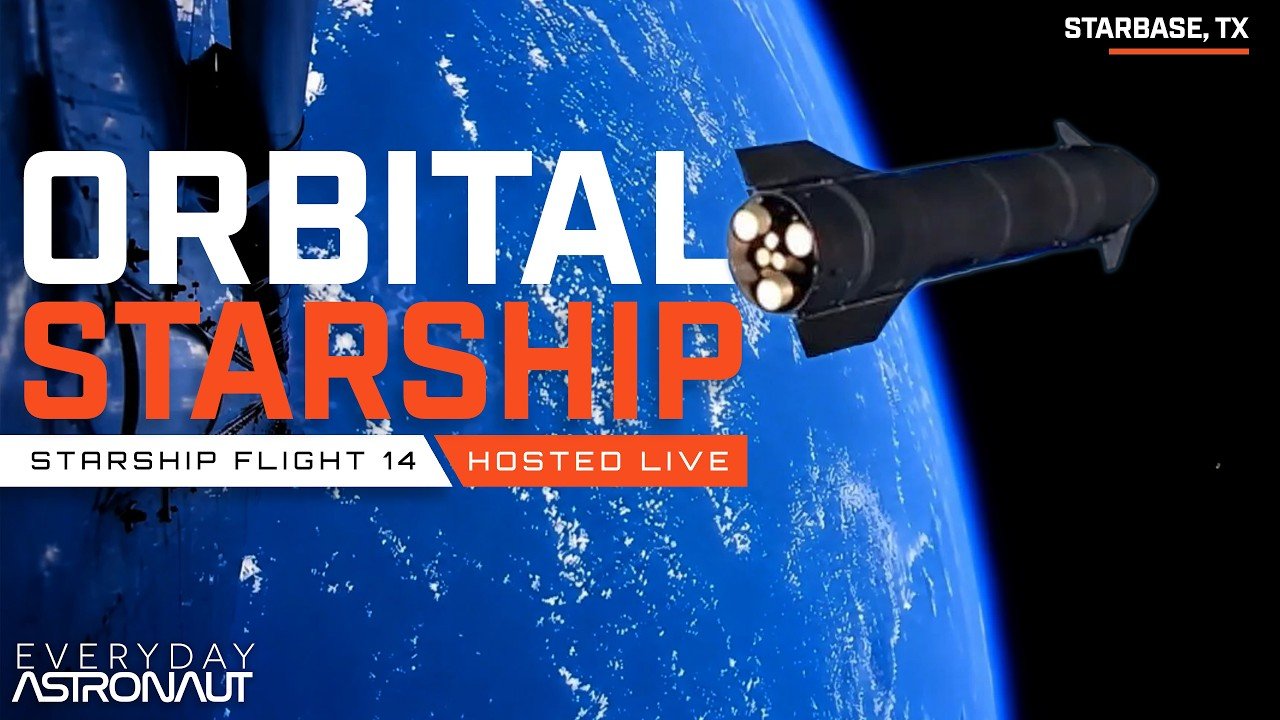
Everyday Astronaut's live 4K coverage follows Starship Flight 14, the first attempt to put Starship into orbit, with 26 Starlink V3 satellites aboard. Booster 21 splashed down softly in the Gulf, a ship engine shut down early, and SpaceX still gave a go for orbit before the insertion burn and satellite deployment. The stream ends with the ship still coasting in orbit ahead of a first checkpoint.
Full written account
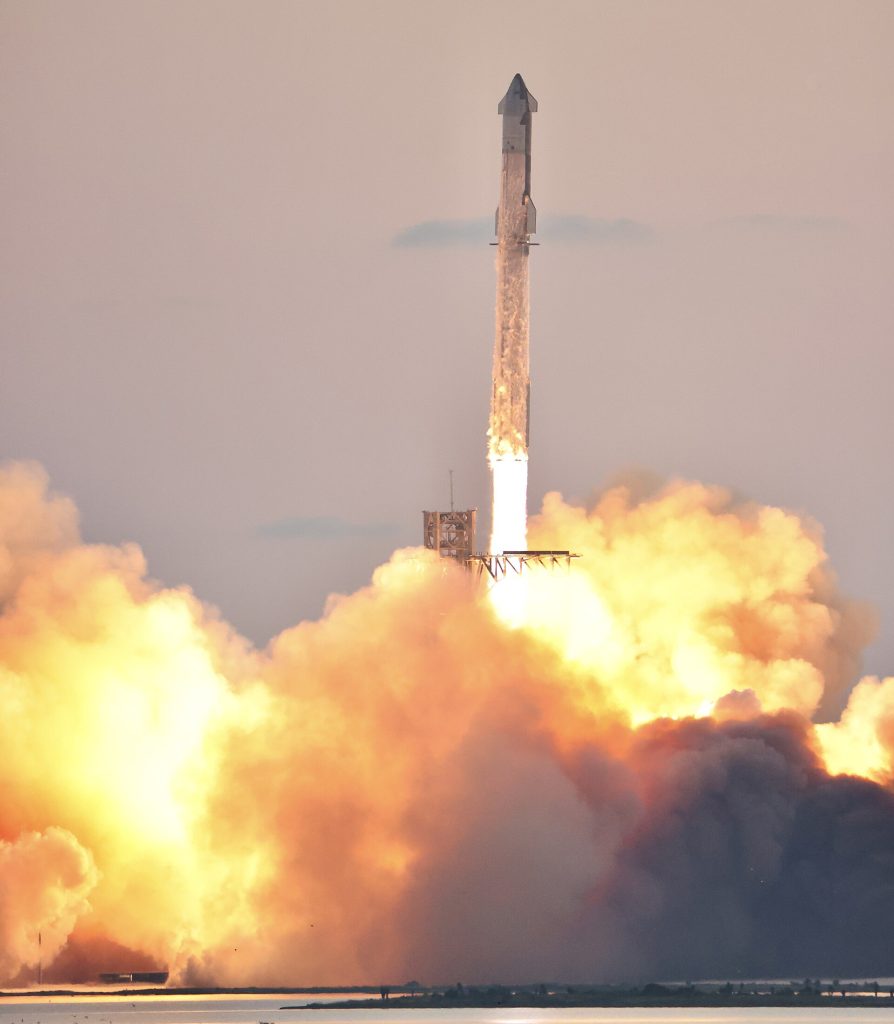
Starship Flight 14 lifted off from Starbase, Texas, at 7:48 a.m. Central on September 28, 2026, and reached orbit after losing one of its vacuum engines on ascent. SpaceX called it the first orbital launch attempt of Starship. The ship was Ship 41, the booster Booster 21, and the payload 26 Starlink V3 satellites. The ship's first burn was left deliberately short of orbit, and a go/no-go poll decided whether to commit to the second burn that would complete the climb.
An engine out before the decision to go
About 33 engines lit on Super Heavy at liftoff, and SpaceX reported 33 of 33 running more than 35 seconds into the flight. Later in the ascent one of the center 13 engines went out, and the booster kept flying on 32. Hot staging followed: the ship lit its six Raptor engines while still attached, and the booster flipped and began its boostback burn.
On the ship's ascent burn, engine 6, one of the Raptor vacuum engines (RVacs), shut down early, as SpaceX communications host Dan Hwitt noted on the telemetry. He compared it to Flight 12, the first flight of V3, which also had an RVac out. The ship adjusted and ran a little longer on five of six engines before engine cutoff. Planned ship engine cutoff was at 8 minutes 11 seconds.
The first word from the team was that they would not do the burn to orbit. Then the hold was reset while teams kept examining the data. The team looked at the condition that shut the RVac down and checked whether it violated launch constraints or flight rules. Their main concern was the three center sea-level Raptors, which are needed for both the orbital insertion burn and the deorbit burn, and these looked healthy. The poll came back as "go for orbit", the first time that call had been made on a Starship broadcast.
The burn that made it orbital
Until now, every one of the previous 13 flights had flown a trajectory that stopped short of orbit. Everyday Astronaut host Tim Dodd described the earlier trajectory as about 98% of the way to orbit, and said it was chosen so the largest object ever launched could not be accidentally left in orbit as uncontrolled debris. The ship was on a passively safe suborbital path toward the Indian Ocean, and it would have come down there if nothing else was done.
The orbital insertion burn was planned for about 25 minutes into flight and to last about 19 seconds. A single Raptor sea-level engine lit, using the header tanks in the nose. SpaceX said it had done on-orbit relights with those tanks before but never an insertion burn. After shutdown, controllers reported no alerts or alarms, and the call came: "Starship is orbital." Dodd called it the largest object ever put into orbit.
The velocity on screen looked low at first, around 26,400 km/h. After checking with others, Dodd concluded the telemetry was still showing speed relative to the ground; adding roughly 1,500 km/h from Earth's rotation brought it close to the expected 28,000 km/h. The orbit was lower than the International Space Station's, about 275 km according to the description, which makes a deorbit burn easier.
Starlink V3 deployment
The ship opened its payload door and began releasing satellites, one at a time. SpaceX said this was the first time a Starship delivered work, and the first deployment sequence in daylight. The first two satellites were in contact within a couple of minutes, and laser contact with three followed. All 26 were out later, with the last handful released in orbital night.
SpaceX described each V3 as adding about 1 terabit per second of capacity, so 26 total, roughly 10 times a single Falcon 9 launch of V2 Mini satellites. Other figures given:
- About a 10 times improvement in downlink capacity and a 22 times increase in uplink over version two satellites.
- Six space lasers of 400 gigabits each per satellite.
- Four quad-band radio-frequency backhaul antennas using Ka, E, V and W bands, giving an 8x improvement in supported capacity over V2.
- Satellites built in Redmond, Washington, with service expected to begin within a few weeks.
- Future missions planned with up to 60 satellites, about 20 times the capacity of a Falcon 9 launch.
Three satellites were modified with cameras to scan Starship's heat shield. Several tiles on the ship were painted white to simulate missing tiles and act as imaging targets. Flap tiles on the leeward side carried different attachment methods as experiments. Tile changes for this flight included extra retention pins on tiles at greatest risk of falling off during ascent, and closed gaps where plasma had been seen getting behind tiles.
Booster 21 and the planned flight
Booster 21 made a landing burn with 13 engines, then five, then three, simulating a tower catch without attempting one, and splashed down softly off Starbase in the Gulf. Two of the center 13 engines had gone out before the burn, and 11 starting were enough. Dodd noted that this was the third V3 flight and that no clean V3 booster splashdown had yet occurred, with ice clogging in engines cited as a problem.
The plan was to coast about 9 hours in six orbits of roughly 90 minutes each, then deorbit with a single Raptor, reenter, and make a landing burn, flip and vertical splashdown in the Pacific off Chile. Checkpoints allowed an early return to a cleared area in the northern Pacific well north of Hawaii. The first checkpoint was at about 1 hour 28 minutes into the flight. At the point where the coverage ends, the ship was still in orbit and the team was preparing to decide whether to continue.
SpaceX said a ship catch was not planned on this flight. Dodd said the next flight could potentially attempt one if this went well.
Questions this video answers
What was Starship Flight 14?
Starship Flight 14 was planned as the first orbital launch attempt of Starship, with Ship 41 and Booster 21 carrying 26 Starlink V3 satellites.
Did Starship reach orbit?
Yes. After an engine shut down early during the ascent burn, SpaceX held a go/no-go poll and announced it was go for orbit; the orbital insertion burn then put Starship in orbit.
Were the Starlink satellites deployed?
Yes. The coverage shows the 26 Starlink V3 satellites being deployed one by one, and all were reported safely in space.
What happened to the booster?
Booster 21 made a landing burn and a soft splashdown in the Gulf off the coast of Starbase.
What went wrong on ascent?
A Raptor vacuum engine (engine 6) shut down early on the ship's ascent burn. The ship had engine-out capability and the team evaluated whether to commit to orbit.
How long was the mission planned to last?
The plan was about six orbits over roughly nine to ten hours, followed by a de-orbit burn, reentry and a vertical splashdown in the Pacific off Chile. This clip covers the launch, orbit insertion and satellite deployment, ending before the later orbits.
Explore related missions
Connected by the topic: Starship