Starship Flight 14: First Orbit and 26 Starlink V3 Satellites

The short version
Starship Flight 14 lifted off from Starbase on September 28, 2026, reached orbit for the first time and deployed 26 Starlink V3 satellites, all of which made contact. The six-orbit, roughly 10-hour plan was not flown in full; the ship deorbited and splashed down in the Pacific. The video also covers Flight 15's planned booster and ship catch, the pending FAA license and an outside $715 million revenue projection.
Full written account
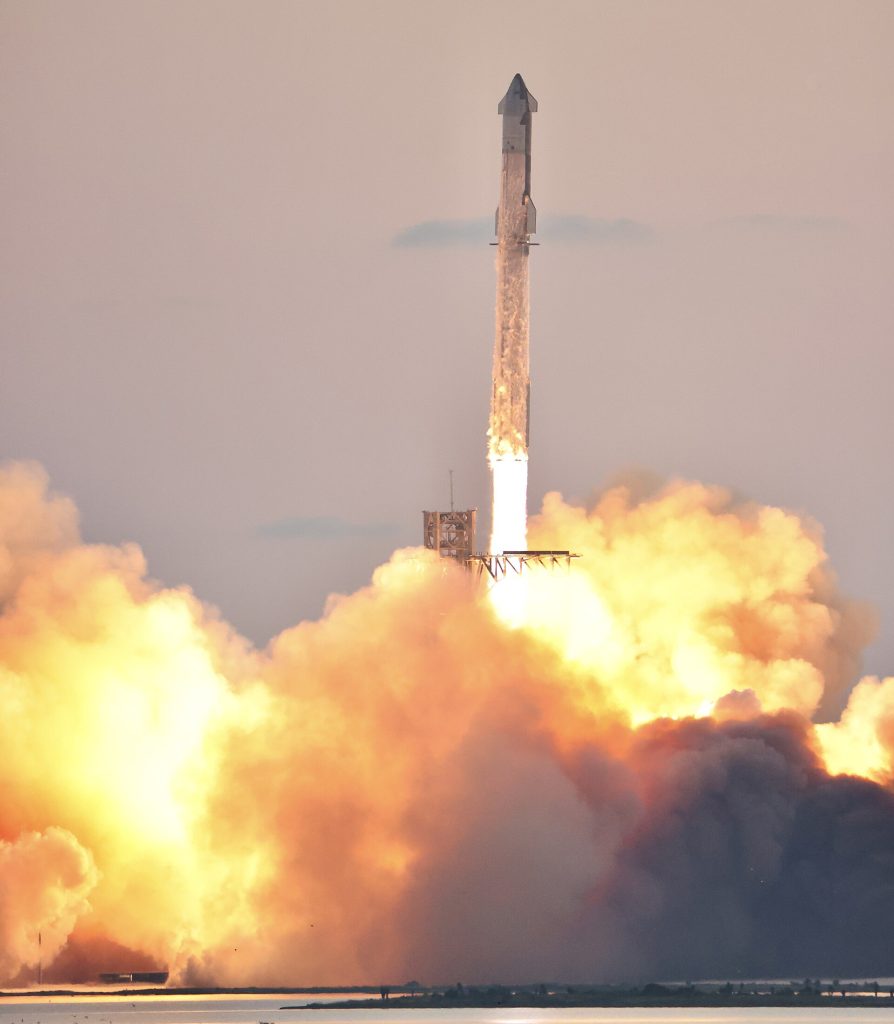
Starship Flight 14 lifted off at 7:48 a.m. Central Time on September 28, 2026, from Orbital Launch Pad 2 at Starbase, Texas, and became the first full-scale Starship to reach orbit. Its ship released 26 Starlink V3 satellites, and SpaceX confirmed contact with all 26. For about 10 minutes during the climb, though, orbit had been called off.
A first orbital attempt
Booster 21 and Ship 41 were both Block 3 vehicles. All 13 earlier full-scale Starship flights had followed suborbital paths. The plan was for the ship to enter orbit about 25 minutes after liftoff, release the satellites, circle the Earth around six times and splash down in the Pacific west of Chile after a flight of nearly 10 hours.
Engine losses on ascent
About 76 seconds in, one of the booster's 33 Raptor engines shut down early, and the other 32 kept firing. The booster passed max Q and separated from the ship by hot staging. In the boostback burn, 26 of 28 engines relit; in the landing burn, 11 of 13 lit. Booster 21 made a controlled splashdown in the Gulf of Mexico about 7 minutes after liftoff.
On the ship, one of the three Raptor vacuum engines shut down early. SpaceX announced the ship would not commit to orbit. Roughly 10 minutes later, after the engineers checked the ship's condition, propellant, trajectory and remaining engines, the call was reversed and Starship was go for orbit.
Orbit and deployment
About 25 minutes after liftoff, a single Raptor burned for roughly 19 seconds to circularize the orbit at around 225 km, with a perigee of 262 km and an inclination of 30.5°. The payload door opened about 34 minutes into the flight, and deployment took around 30 minutes. Three of the satellites carried extra cameras to photograph Ship 41's heat shield in orbit. Deployment was complete about an hour and 5 minutes into the flight.
The satellites were production hardware, not the dummy units flown on earlier suborbital flights. According to SpaceX, each V3 is designed for 1 terabit per second of downlink and 160 gigabits per second of uplink, and the 26 together add about 10 times the downlink capacity of a typical Falcon 9 Starlink launch.
Early return
After checking the ship at its first orbital checkpoint, SpaceX decided not to fly the full mission. Ship 41 fired a Raptor for its deorbit burn about 2 hours and 12 minutes after launch, survived reentry, flipped to vertical and lit its engines. It splashed down north of Hawaii about 3 hours and 8 minutes after liftoff, then tipped onto its side as leftover propellant ignited. SpaceX had never planned to recover it.
The $715 million figure
A 2025 estimate by Rational Futures put about $1.65 billion in extra annual Starlink revenue on a full Starship load of V3 satellites. A Motley Fool analysis published October 31 extended that to roughly $715 million a year for the 26 satellites flown. This is an outside projection of recurring revenue, not cash SpaceX receives at launch.
Flight 15
On the October 20 earnings call, Musk confirmed that Flight 15 will try to catch both the Super Heavy booster and the ship with the tower's chopstick arms. On October 25, Booster 22 ran a full-duration static fire of all 33 engines. Ship 42 fired a single Raptor to simulate a deorbit burn and ran a six-engine full-duration static fire; SpaceX confirmed both on October 28.
Musk put the chance of a successful first ship catch at at least 50 or 60 percent. The FAA had not publicly issued the launch license, and SpaceX had not confirmed a date. Reported targets were no earlier than November 8 or November 12.
Booster catches have been done three times, on flights five, seven and eight. The video notes no Block 3 booster has been caught anywhere, and none has been caught at Orbital Launch Pad 2.
Questions this video answers
When and where did Starship Flight 14 launch?
Starship Flight 14 lifted off at 7:48 a.m. Central Time on September 28, 2026, from Orbital Launch Pad 2 at Starbase, Texas.
What did Flight 14 achieve?
It was the first time a full-scale Starship reached orbit. It deployed 26 Starlink V3 satellites, and SpaceX confirmed contact with all 26.
Why was orbit called off and then reinstated?
Ship 41 lost one of its three Raptor vacuum engines early during ascent. SpaceX announced the ship would not commit to orbit, then reversed the call about 10 minutes later.
What is planned for Flight 15?
SpaceX will try to catch both the Super Heavy booster and the ship with the launch tower's chopstick arms. Its date and payload had not been confirmed by SpaceX as of November 1, 2026, and the FAA license was still pending.
What is the $715 million figure?
It is an outside projection from a Motley Fool analysis of potential annual revenue the 26 satellites could support, not reported SpaceX revenue.
Explore related missions
Connected by the topic: Starship