Tranche 1 Transport Layer C: Falcon 9 Lofts 21 Satellites
The short version
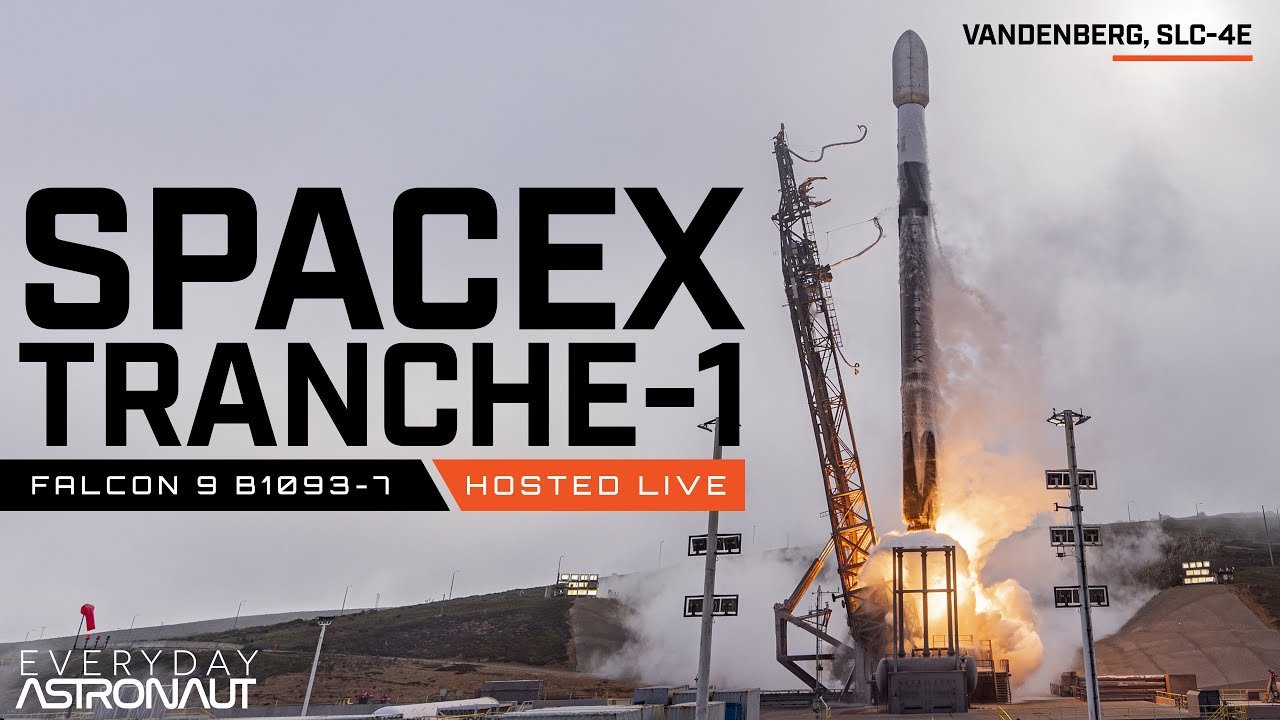
Everyday Astronaut hosts a live watch-along of SpaceX's Falcon 9 launch of 21 Lockheed Martin satellites for the Space Development Agency's Tranche 1 Transport Layer from Vandenberg, with the official SpaceX webcast and viewer Q&A. Liftoff came at 4:06 p.m. Pacific time, and booster B1093 landed on the droneship Of Course I Still Love You on its seventh flight. At the customer's request, no second stage or payload deployment views were shown.
Full written account
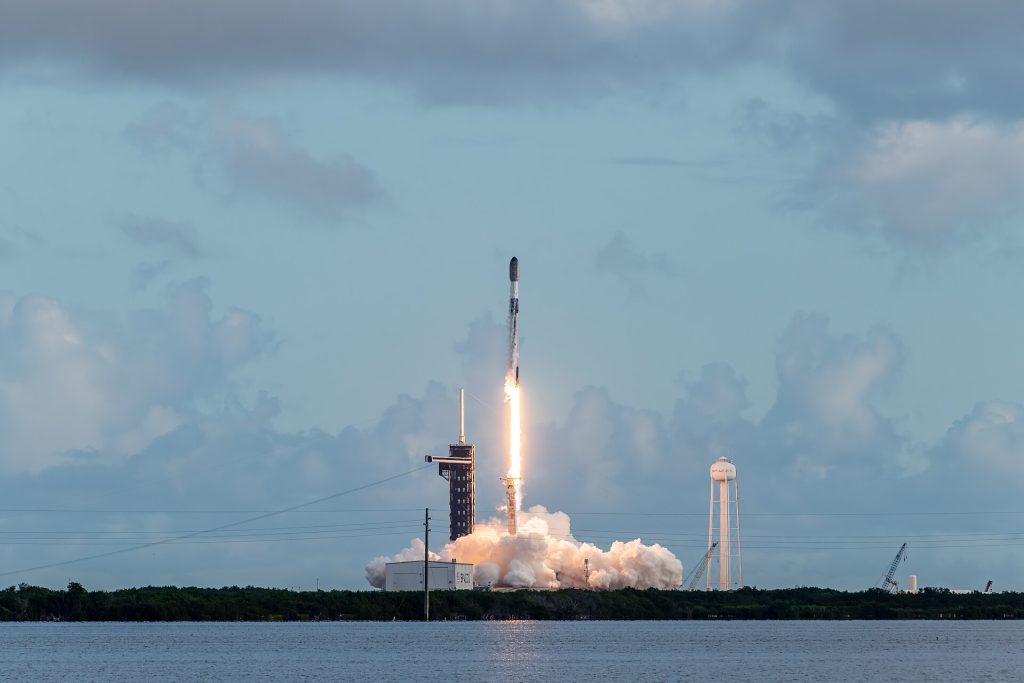
On 14 October 2025, SpaceX launched 21 satellites for the U.S. Space Development Agency from Space Launch Complex 4 East (SLC-4E) at Vandenberg Space Force Base, California. Liftoff came on time at 4:06 p.m. Pacific time, a day after a lightning-induced scrub. The mission, Tranche 1 Transport Layer C, used a Falcon 9 booster on its seventh flight. SpaceX showed no views of the second stage or the payload at the customer's request, so the coverage ended with the booster landing.
The mission and its payload
SpaceX's webcast described the payload as 21 satellites provided by Lockheed Martin for the data transport layer of the Proliferated Warfighter Space Architecture. The data transport function delivers tactical data to warfighters anywhere in the world. The 21 satellites were described as the second of 10 satellite planes that make up the first tranche of warfighter capability. When fully deployed, Tranche 1 will consist of 154 operational space vehicles plus four missile defense demonstration space vehicles.
The Space Development Agency's mesh network of optically connected satellites is focused on tactical data delivery, tracking and targeting for advanced missile threats, and beyond-line-of-sight targeting of time-sensitive or mobile targets. The webcast called it SpaceX's second Tranche 1 mission of the year. The first launched on Wednesday, 10 September at 7:12 a.m. Pacific time from the same pad.
The launch was a sun-synchronous mission flying due south from Vandenberg. Everyday Astronaut host Tim Dodd explained that southbound launches from Vandenberg avoid overflying land and suit polar orbits. A polar launch from Kennedy Space Center would take a performance hit from a dog-leg maneuver. The exact altitude and inclination were not published.
The booster and the vehicle
The booster was B1093, flying for the seventh time. It had previously supported five Starlink missions and the earlier Tranche 1 mission. The two fairing halves were also flight-proven: one was flying for the fourth time and the other for the third. The webcast put the Falcon 9 at 229 ft tall, with more than 1.7 million pounds of thrust at launch. The fairing is a 17-ft-wide carbon composite shell. The first stage burns RP-1 and liquid oxygen through nine Merlin 1D engines. The second stage uses a single Merlin Vacuum engine, the MVac.
The stream put this at the 547th Falcon 9 mission. Dodd noted that the rocket was launching roughly every two or three days.
The countdown
The weather forecast carried a 20% possibility of launch weather constraints, with a backup opportunity the next day from 3:57 p.m. Pacific time. In the countdown the transporter erector, a large truss structure hinged at the base, retracted from the rocket. Clamps around the second stage opened first, and the full recline was expected by T-2 minutes 50 seconds. Both stages were loaded with about a million pounds of propellant, loaded late because colder propellants are denser. The plumbing and engines were chilled down first to prevent thermal shock and boil-off.
At T-60 seconds Falcon 9 entered startup, and the onboard flight computers took over the countdown. The mission director gave the final go for launch, and the nine engines ignited just inside T-2 seconds.
Flight and landing
The callouts came in quick succession after liftoff:
- The vehicle pitched downrange, and Merlin 1D chamber pressures were nominal.
- The rocket passed max Q, the point of greatest aerodynamic pressure.
- Main engine cutoff (MECO), stage separation and the MVac ignition (SES-1) followed back to back.
- Fairing separation was confirmed about 30 seconds after SES-1.
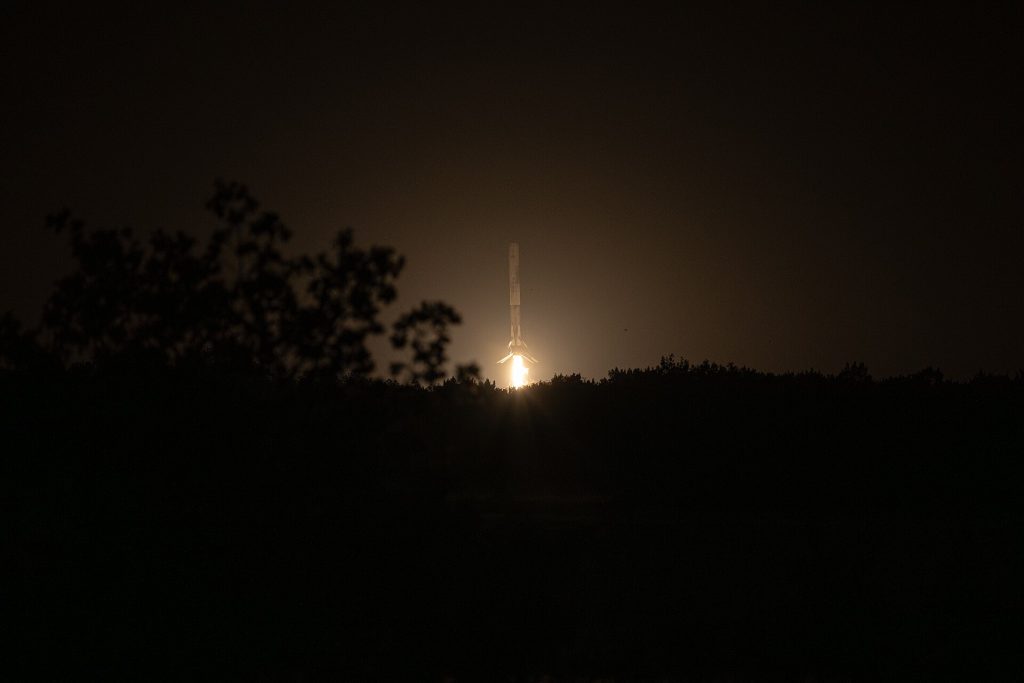
At just over 4 minutes 10 seconds into the mission, the booster headed for the drone ship Of Course I Still Love You in the Pacific. Three engines relit for an entry burn of about 25 seconds. Dodd remarked on roughly 4.5 Gs of deceleration. The flight termination system was called safed on stage one and, later, on stage two. The landing burn followed, the landing legs deployed, and stage one landing was confirmed. It was the seventh launch and landing for that first stage. The webcast then closed, and SpaceX thanked the range and the FAA.
How the range stops a failing rocket
The sponsor of the stream was the U.S. Space Force. It had given Dodd access behind the scenes at Vandenberg, including the Range Operations Control Center, and he previewed a clip from his upcoming video on the range. Cameras were not allowed in the most classified rooms, so the clip used renders. At the station in question, buttons marked arm and destruct sit in front of the operator. Dodd said the arm command comes before the destruct command as a two-step safeguard, though he was unsure of the details for each rocket.
The clip explained that flight termination is not necessarily a bomb. The main goal is to stop thrust, so the rocket follows a ballistic trajectory and lands inside the debris impact zone. The methods it listed were:
- Engine shutdown systems. Astra's Rocket 3 and the first launch of Eisar's Spectrum were given as examples.
- Thrust termination ports on solid motors. Explosive charges blow open vents in the casing to reduce chamber pressure.
- Linear-shaped charges. These slice the tanks open. Falcon 9's in-flight abort on the CRS-7 mission in 2015 was triggered this way after a second-stage issue.
- High-explosive charges at the common bulkheads. These mix the propellants so they burn off. On the first Starship launch, the clip said, the charges were too weak, blowing holes in the side while the rocket kept spiralling. They were strengthened for flight two.
The clip also explained why range officers sometimes seem slow to terminate. As long as the rocket has not crossed the flight termination line, every extra millisecond of telemetry can carry hundreds or thousands of channels of data for finding the root cause. If it is safe, delaying can also shrink the debris field, since terminating at a high altitude spreads debris more widely.
Lightning and the previous day's scrub
The previous day's attempt had been scrubbed for lightning. Dodd used it to recall Apollo 12, which was struck by lightning twice. Instrumentation in the command module went haywire, and the crew considered an abort. The Saturn V's instrument unit was still running properly. An engineer at NASA recognised the pattern and suggested switching the signal conditioning equipment from normal to auxiliary power, which cleared the signals, and Apollo 12 continued.
Dodd said he had assumed that incident ended the matter, but he later learned a lightning strike on an Atlas, much more recently, gave the rocket a hard yaw and broke it apart. That led to the lightning commit criteria, a set of rules for conditions in which not to launch, which are still followed today.
Questions this video answers
When and where did the launch happen?
Falcon 9 lifted off at 4:06 p.m. Pacific time from Space Launch Complex 4 East at Vandenberg Space Force Base, California.
What was the payload?
21 satellites provided by Lockheed Martin for the data transport layer of the Space Development Agency's Proliferated Warfighter Space Architecture.
Did the booster land?
Yes. Booster B1093 landed on the droneship Of Course I Still Love You, on its seventh flight.
Why was there no view of the payload deployment?
SpaceX did not show any stage two or payload deployment views at the request of its customer.
Explore related missions
Connected by the topic: Falcon 9