ViaSat-3 F3 Falcon Heavy: Weather Stops the First Flight Since 2024
The short version
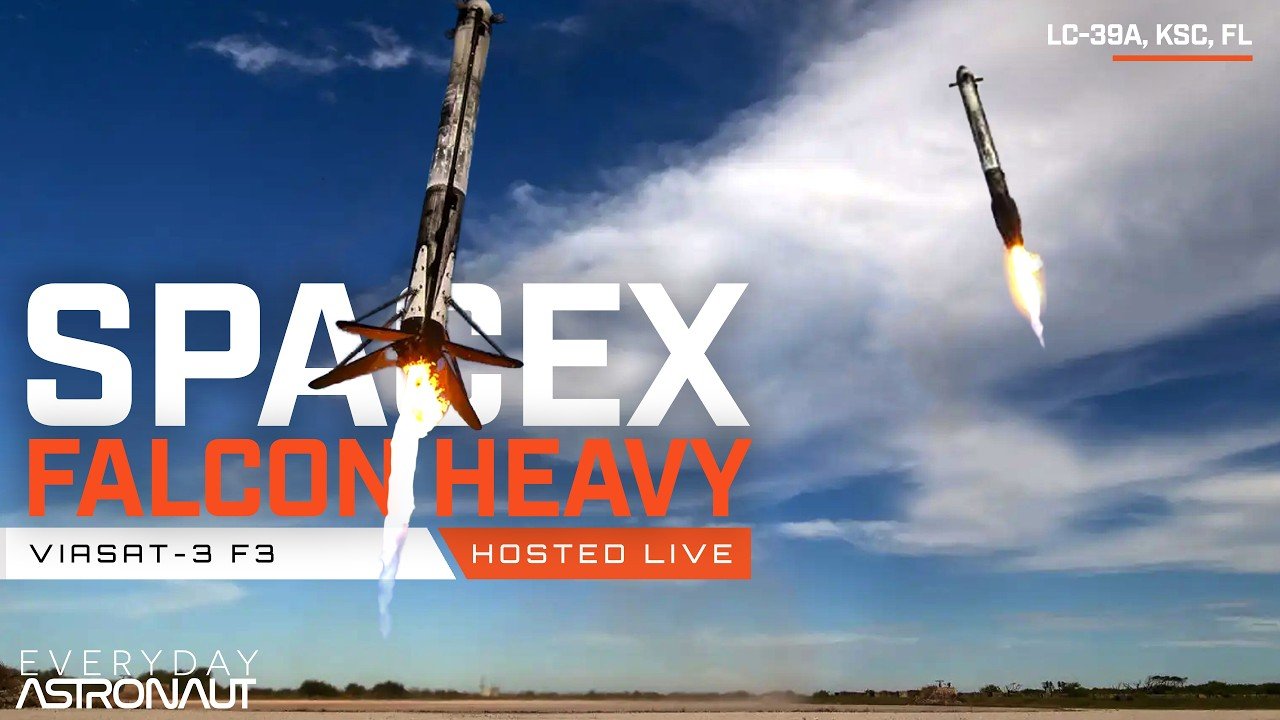
Everyday Astronaut's livestream followed SpaceX's attempt to launch Falcon Heavy with ViaSat-3 F3 from Launch Complex 39A. The countdown went through propellant loading and strongback retraction before a hold and a weather stand-down, with the next opportunity the following day. Host Tim Dodd answered viewer questions on boosters, painting, scrubs and the center core.
Full written account
The Falcon Heavy that was due to launch ViaSat-3 F3 on April 27, 2026 stood on the pad fully fuelled, with propellant loading finished and the countdown nearing T-minus 30 seconds, when the call came: "Hold hold hold." The launch was scrubbed for weather, with a thundercloud within 10 miles of the pad. It would have been the 12th Falcon Heavy flight and the first since October 2024. The vehicle is uncrewed, with no one aboard.
The planned mission
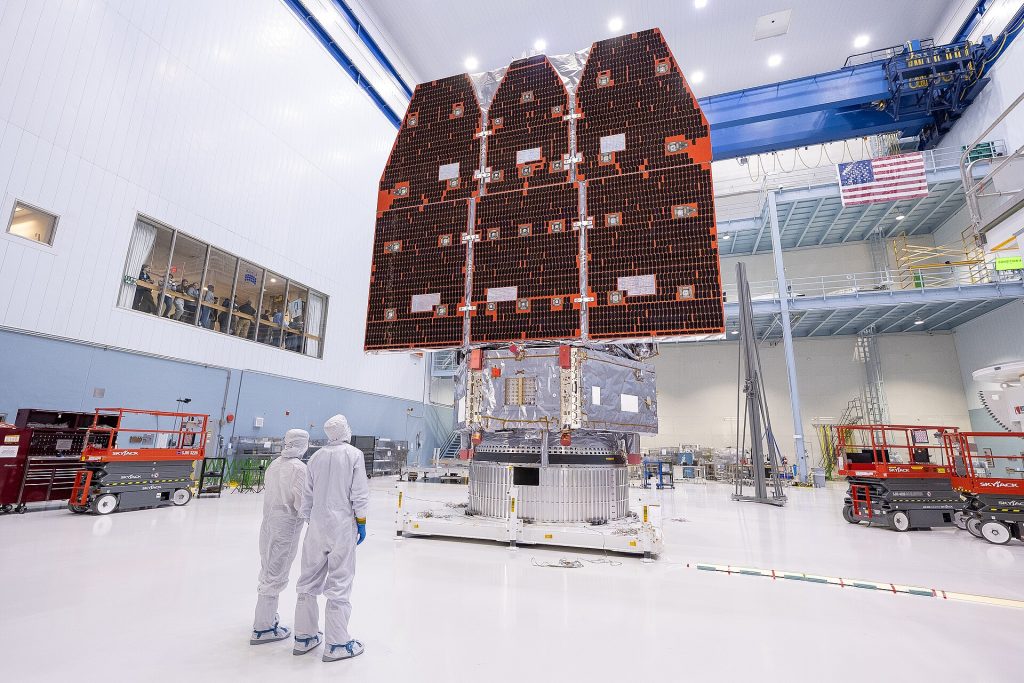
SpaceX targeted liftoff from Launch Complex 39A at Kennedy Space Center in Florida at 10:21 a.m. EDT (14:21 UTC). The payload was the Boeing-built ViaSat-3 F3 satellite, bound for a geosynchronous transfer orbit. It would then use electric propulsion to reach geostationary orbit over the Asia-Pacific region. SpaceX described it as the third of three ultra high-capacity satellites for Viasat. Once in service, it is expected to provide more than one terabit per second of broadband capacity over Asia-Pacific, more than doubling the bandwidth capacity of Viasat's entire fleet and completing the ViaSat-3 constellation.
Weather was 55% favorable on launch day, with no major issues reported on vehicle or payload. A backup opportunity was set for Tuesday, April 28.
Reused boosters and a split landing
Both side boosters were flight proven. One was flying for the 22nd time and the other for its second. Between them they had supported SDA, Transporter 11 and 18 Starlink missions, and another mission named in the broadcast. Both fairing halves were also reused, one on its 25th flight and the other on its 18th.
The side boosters were to separate about two and a half minutes into flight and return to Landing Zone 2 and Landing Zone 40 at Cape Canaveral Space Force Station. Host Tim Dodd explained that two sites were needed because the original Landing Zone 1 pad was being torn out or decommissioned. The center core was to be expended.
Why the center core is thrown away
Dodd walked through the rocket equation, working backwards from the upper stage. His numbers were illustrative, and he said he was making them up. A geostationary transfer orbit needs more velocity than a single Falcon 9 can deliver with a heavy payload. The two extra cores carry the center core so that it runs at reduced throttle, leaving it more propellant at stage separation. That extra propellant can supply the additional kilometer or two per second needed. With no propellant left over, the center core cannot land. He added that Falcon 9 now performs so well that few customers need Falcon Heavy.
The vehicle
SpaceX's own coverage described Falcon Heavy as essentially three reusable Falcon 9 first-stage boosters joined together, with a center core modified to withstand the stresses of the side boosters. It has 27 Merlin engines across the three cores and a 28th, a Merlin Vacuum engine, on the second stage. Together the 27 engines generate more than 5 million pounds of thrust, which the broadcast equated to about 18 747 aircraft. It can lift nearly 64 metric tons (141,000 pounds) to orbit.
The flight plan, as described:
- The side boosters light first, followed by the center core.
- About 40 seconds after liftoff, power on the side boosters is reduced ahead of max Q.
- At about 2.5 minutes, the side boosters shut down at booster engine cutoff (BECO) and separate. The center core then throttles back up.
- First and second stage separate around the 4-minute mark, after which the second stage lights and the fairing separates.
History and upcoming missions
Falcon Heavy's debut was on February 6, 2018, carrying a Tesla Roadster and Starman into heliocentric orbit. The broadcast said the Roadster is still orbiting the Sun. USSF-44 followed in November 2022, then a ViaSat-3 mission in 2023 and the Psyche launch later that year. The most recent flight, in October 2024, carried NASA's Europa Clipper. Before this attempt, Falcon Heavy had flown 11 times with 100% mission success. Upcoming payloads named were NASA's Griffin lunar lander and the Nancy Grace Roman Space Telescope, both manifested for late 2026, and the Rosalind Franklin Mars rover, targeted for 2028.
The scrub
On this attempt the launch window was about 85 minutes. Dodd said that because Falcon Heavy uses super-chilled propellant, it cannot simply recycle within the window: the vehicle must be fully drained and tried again the next day. After the hold, SpaceX said it was standing down due to weather, that the vehicle and payload remained in good health, and that the next opportunity was the following day.
Dodd noted that most weather scrubs come from the lightning launch commit criteria, which bar launching with a thundercloud within 10 miles. He recalled an Atlas launch in about 1997 that failed after being struck by lightning, and Apollo 12's lightning strike, as events that shaped the rules.
Questions this video answers
Did the Falcon Heavy launch on April 27, 2026?
No. The attempt was scrubbed for weather after a hold in the final countdown; the next opportunity was the following day.
What was special about this Falcon Heavy flight?
The 12th Falcon Heavy flight overall and the first since October 2024.
What payload was Falcon Heavy carrying?
Viasat's ViaSat-3 F3, built by Boeing, bound for geosynchronous transfer orbit and then geostationary orbit over the Asia-Pacific region.
Where were the side boosters to land?
One at Landing Zone 2 and the other at Landing Zone 40 at Cape Canaveral Space Force Station.
Was the center core going to be recovered?
Yes. The center core was to be expended.
Explore related missions
Connected by the topic: Falcon Heavy