André Kuipers’ Extended ISS Stay and Alexander Gerst’s Training
The short version
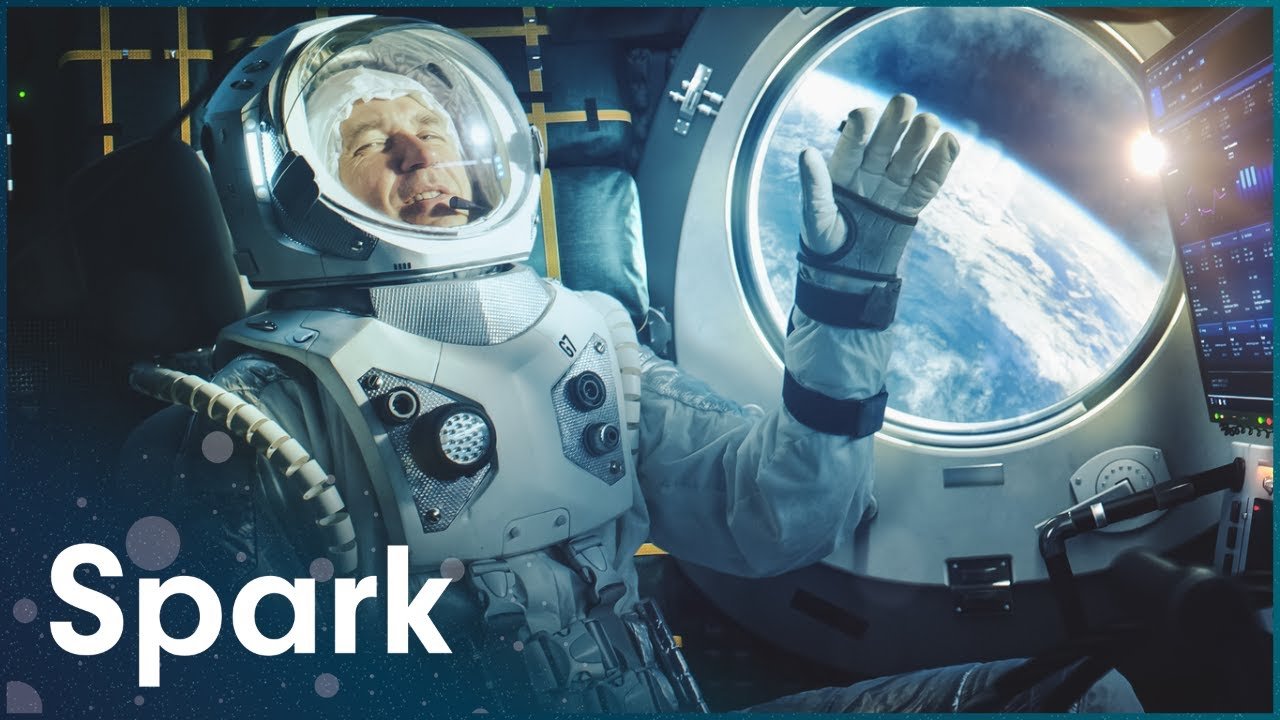
A documentary filmed partly in 3D aboard the International Space Station, following ESA astronaut André Kuipers on his long stay on the ISS and Alexander Gerst through his training in Houston, Moscow and Cologne. It covers the Soyuz launch from Baikonur, daily life and experiments on board, a destroyed Soyuz capsule that extended Kuipers' stay by seven weeks, an ATV cargo docking and his Soyuz return.
Full written account
Dutch ESA astronaut André Kuipers was due to spend five months on the International Space Station; he ended up in space for more than half a year after the Soyuz capsule meant to bring him home was destroyed during tests in Moscow. His stay, filmed in 3D, is one of two threads in a documentary that also follows German astronaut Alexander Gerst through training for his 2014 mission.
Training for the station
Alexander Gerst, described as the third German to travel to the ISS, trains at NASA's Johnson Space Center. In a virtual reality lab he practices what the film calls the worst nightmare: being flung away from the station with a safety tether not connected. He uses the SAFER unit to fire positive pitch and return to the structure; afterwards he says he is glad it was a simulation.
He also learns to control the robotic arm, a task he will perform from the cupola, and he trains in a pool holding 23.5 million liters of water and more than 12 meters deep, with a life-size replica of the station. Sessions last 6 hours, matching real spacewalks. In one exercise an instructor simulates a sudden loss of consciousness by his colleague Clayton Anderson, and Gerst must bring him back to the airlock quickly.
In Russia, Gerst trains at Star City, the former top secret facility outside Moscow, where he practices with the Soyuz spacesuit and a splashdown. He notes that Russian training is structured into unvarying intervals, while the American one is more flexible. The film describes Soyuz as the only means of reaching the station since the last shuttle flight in autumn 2011.
Launch and life on board
Kuipers launched from Baikonur with NASA's Don Pettit and cosmonaut Oleg Kononenko in what he calls the coldest launch ever. He says the crew uses the same launch tower Gagarin took, and that within 9 minutes they were in orbit. The trip to the ISS took 2 days. It was his second flight; his first lasted 9 days in 2004. He entered a new Russian module, which smelled like a new car, and was greeted by commander Dan Burbank, who had been aboard for 4 weeks and brought a guitar.
Astronauts need 2 to 3 hours of fitness training daily to counter muscle and bone atrophy. Kuipers, a medical doctor, also served as subject of a neuropsychological experiment with EEG electrodes. Samples are kept at minus 80 degrees.
The Soyuz problem
At ESA's control center in Oberpfaffenhofen, mission director Claudio Sollazzo learned by call from Moscow that the next Soyuz had failed its test. The capsule intended to bring Kuipers back was destroyed in testing. It followed the crash of Progress 44P before his launch, which raised concern because the same type of stage was used. The planned return date had been May 16th, 2012.
A solution was found: Kuipers would stay seven more weeks and a new Soyuz would bring the crew back. Keeping six crew members longer required more air, food and other supplies. Kuipers said he was never worried and felt sorry for the next crew, whose expedition would be shorter.
ATV and return
The ATV, controlled from Toulouse, delivered more than 6.5 tons of cargo. A critical phase comes at 39 km, when the ATV begins electronic communication with the station and has 20 minutes to establish it. The crew could abort the rendezvous if it left its safe approach corridor. Opening the hatch took 15 hours after docking.
On July 1st, 2012, Kuipers left in the Soyuz. Reentry pressed the crew at up to 4.7 times body weight, and the capsule tipped over briefly on landing.
Questions this video answers
Who are the astronauts followed in the documentary?
ESA astronaut André Kuipers, who filmed on board, and Alexander Gerst, whose training for a 2014 mission is recorded.
Why did André Kuipers stay longer on the ISS?
The Soyuz capsule intended to bring him back was destroyed while undergoing tests in Moscow, so he stayed seven more weeks until a replacement could be used.
What is the ATV?
Europe's unmanned space transporter that brings cargo to the ISS; the one shown delivered more than 6.5 tons and burns up on reentry filled with refuse.
When did Kuipers return to Earth?
The documentary gives July 1st, 2012 as the day he said goodbye and returned in a Soyuz.