How the Sky Crane Landed Curiosity on Mars in Seven Minutes

The short version
An explainer on how the sky crane landing put NASA's Curiosity rover on Mars in 2012. It covers atmospheric braking, the parachute, the eight throttleable landing engines and the cords that lowered the rover. It also notes that Perseverance used the same crane in 2021 with a camera navigation system.
Full written account
How can a rover land before Earth knows it has started?
In 2012, NASA landed the Curiosity rover on Mars by suspending it beneath a hovering rocket-powered platform. The landing lasted about 7 minutes, while a signal from Mars took 13.8 minutes to reach Earth. By the time confirmation of entry could arrive, the rover was already on the surface, safe or not.
Why not airbags?
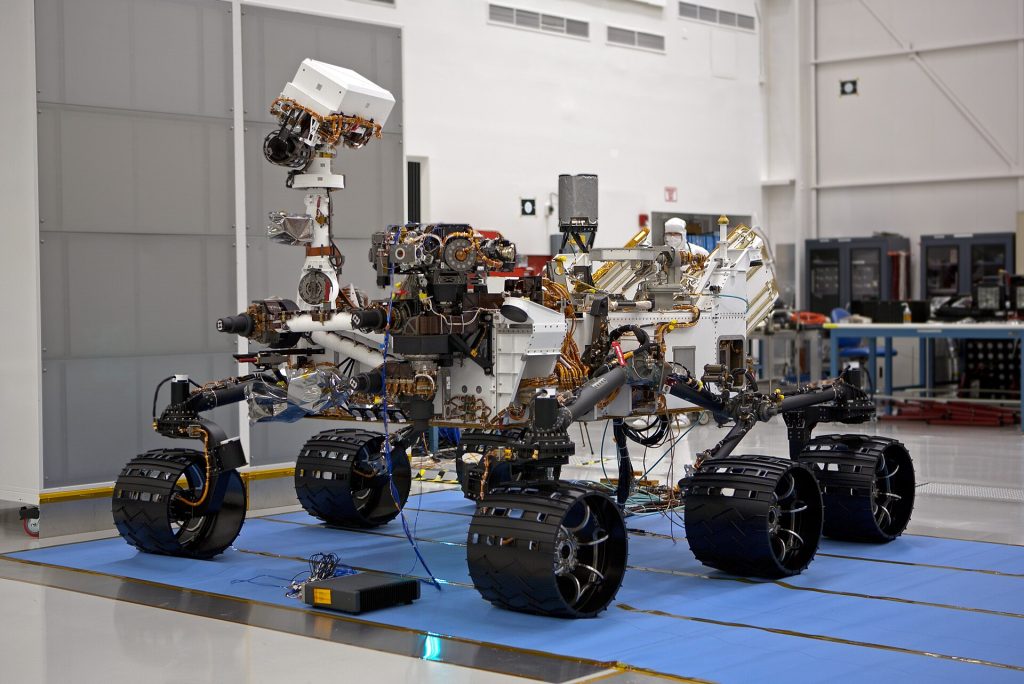
Curiosity had a mass of 899 kg, more than five times the mass of Spirit or Opportunity. For rovers exceeding a ton, NASA says an airbag-assisted landing would simply not be an option.
The atmosphere does the braking
Curiosity entered at about 5,900 m/s behind a heat shield 4.5 m in diameter. More than 9/10 of the deceleration came from atmospheric friction before the parachute opened. The capsule was tilted to generate lift, so it could fly like a wing rather than drop like a rock, steering with banking turns.
Parachute, engines and cords
About 11 km up, still traveling at about 900 mph, the parachute deployed. A parachute alone cannot complete the descent. About 1.6 km up, still descending at about 180 mph, the rover and its descent stage detached, and all eight throttleable Mars landing engines ignited. The descent decelerated to about 3/4 of a meter per second.
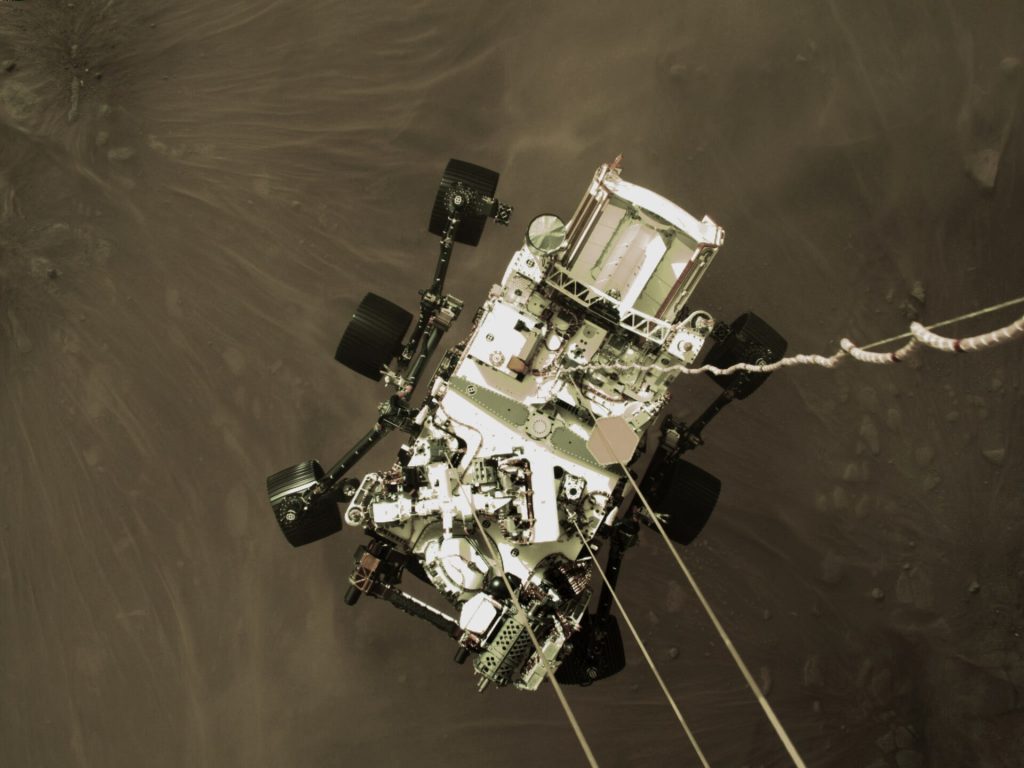
About 20 m up, the descent stage lowered the rover on cords about 7.5 m below it. When the spacecraft detected touchdown, the cords were severed and the descent stage flew away, impacting at least 150 m distant. The spacecraft transitioned through six configurations and detonated 76 pyrotechnic devices.
Perseverance and the limits of the design
In 2021, Perseverance, at about 1,025 kg, used the identical crane plus a camera navigation system that matched the terrain to a map within 40 m. It touched down within 5 m of the point that system targeted in Jezero Crater, a site originally considered unsafe for landing.
A 2007 engineering review noted that every earlier American Mars lander had a landed mass of less than 0.6 metric tons. Human missions to Mars would require 40 to 80 metric tons.
Questions this video answers
Why did NASA use a sky crane for Curiosity?
Curiosity had a mass of 899 kg, more than five times that of Spirit or Opportunity, and NASA says an airbag-assisted landing is not an option for rovers exceeding a ton.
How fast was Curiosity going when it entered the atmosphere?
About 5,900 m/s, behind a heat shield 4.5 m in diameter.
When did the parachute deploy?
About 11 km up, while still traveling at about 900 mph.
How did the rover reach the surface?
The descent stage lowered it on cords about 7.5 m below, from about 20 m up. When touchdown was detected the cords were severed and the stage flew away.
How long did the landing take compared with the signal delay?
The landing lasted about 7 minutes, while a signal from Mars took 13.8 minutes to reach Earth.
How did Perseverance's landing differ?
It used the identical crane plus a camera navigation system that matched terrain to a map within 40 m, and touched down within 5 m of its target point in Jezero Crater.
Explore related missions
Connected by the topic: Mars exploration