Webb’s Ariane 5 Launch from Kourou, Tracked Stage by Stage
The short version
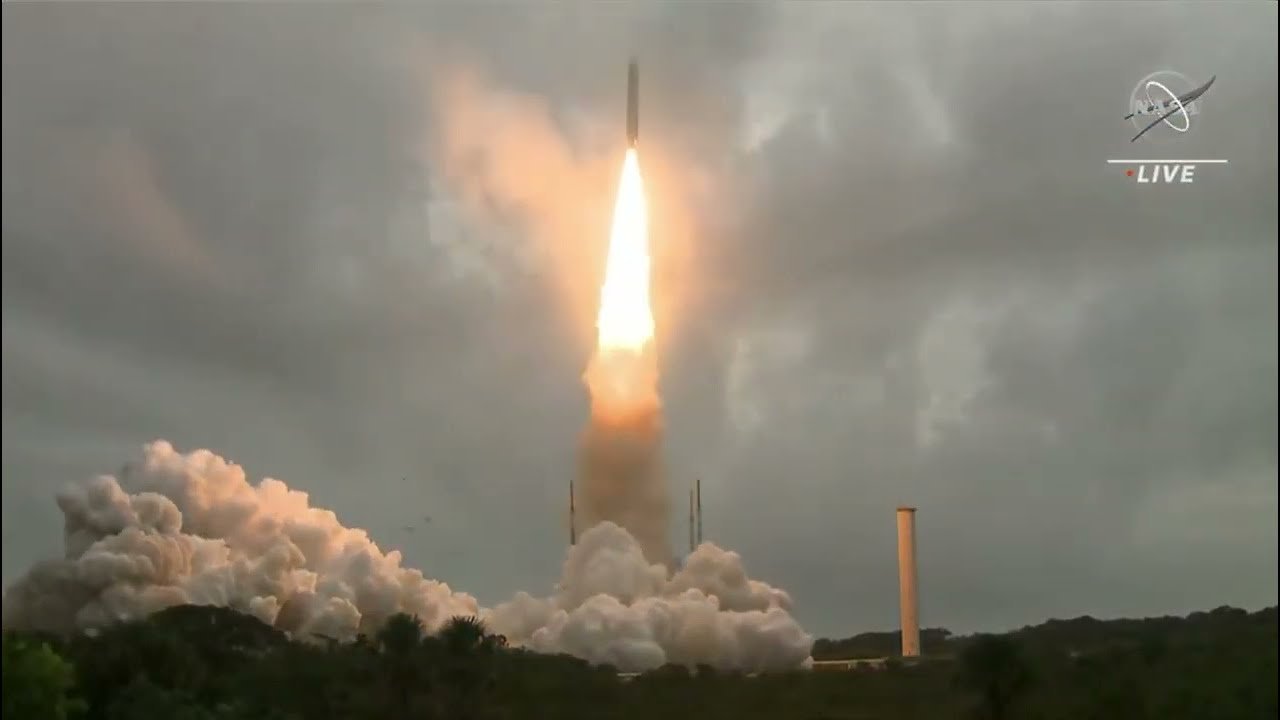
Coverage of the James Webb Space Telescope lifting off on an Ariane 5 from the Guiana Space Centre on December 25, 2021, at 12:20 GMT. Commentators follow the ascent through booster separation, fairing jettison and main stage shutdown, while the trajectory is reported as nominal. The footage ends as the upper stage ignites, so the telescope's later deployment is not shown.
Full written account
The James Webb Space Telescope left French Guiana on an Ariane 5 at 12:20 GMT on December 25, 2021, which was 7:20 a.m. Eastern time. The launch was from the Guiana Space Centre, and the telescope was bound for the L2 Lagrange point about a million miles from Earth. The coverage follows the ascent as the trajectory was repeatedly reported as nominal.
The first minutes
Twenty seconds into the flight, the pitch program was reported as good. At 13 kilometers altitude and 7 kilometers downrange, the rocket was travelling about 0.6 kilometers per second. The range operations manager, Jean-Luc Voyeur, reported the trajectory as nominal. On screen, a yellow line plotting the actual trajectory lay over the green line of the pre-launch plan.
Boosters and fairing
At one minute 41 seconds the solid rocket boosters were about 40 seconds from shutdown. Commentators explained that the computer separates them once it detects a threshold of reduced acceleration. Separation was confirmed at two minutes 15 seconds, at an altitude of 44 miles, with the Ariane 5 and Webb moving at almost 5,000 miles an hour.
About a minute later came the fairing jettison. The fairing shields the satellite from high temperatures and high air flows. Once the launcher leaves the atmosphere it is no longer needed, and since each kilogram matters to performance it is ejected. An Arianespace representative in the Jupiter control center said the fairing release showed the rocket had crossed the limits of the atmosphere.
Watching the telescope
A camera on the upper stage looked back at Webb, with an image delay of about 20 seconds from processing in the control room. The view showed the telescope ready to unfurl its wings.
Tracking the flight
Telemetry was first received by the Galliot tracking station close to the control center in Kourou. The Natal station in Brazil and two stations in Africa, Libreville and Malindi, followed. Webb was to separate roughly over Malindi, which would also acquire the telescope's own telemetry. The telescope would also send telemetry through the Tracking and Data Relay Satellite system. Further out, its telemetry and imagery would be processed through the Deep Space Network at Goldstone, California.
What came next
After main stage cutoff and jettison, the upper stage engine was to ignite for a 16-minute burn putting Webb into a preliminary orbit. About 11 minutes after that, controllers at the Space Telescope Science Institute would send commands for initial commissioning activities. These lead to deployment of the solar array and the start of electrical power generation. The footage ends with main stage shutdown and separation confirmed and the upper stage igniting.
Questions this video answers
When did the James Webb Space Telescope launch?
Liftoff was confirmed at 12:20 GMT on December 25, 2021, which was 7:20 a.m. Eastern time.
What rocket carried Webb?
An Ariane 5 launched it from the Guiana Space Centre in French Guiana.
Where is Webb headed?
To the Lagrange point L2, about a million miles from Earth.
How long was the upper stage burn expected to last?
Commentators said the upper stage would burn for 16 minutes to put Webb into its preliminary orbit.
Did the launch go as planned?
Throughout the coverage the trajectory was reported as nominal, with the plotted trajectory overlaying the pre-launch one.
Explore related missions
Connected by the topic: Ariane 5