Roman Space Telescope Prelaunch Briefing: Falcon Heavy, Weather
The short version
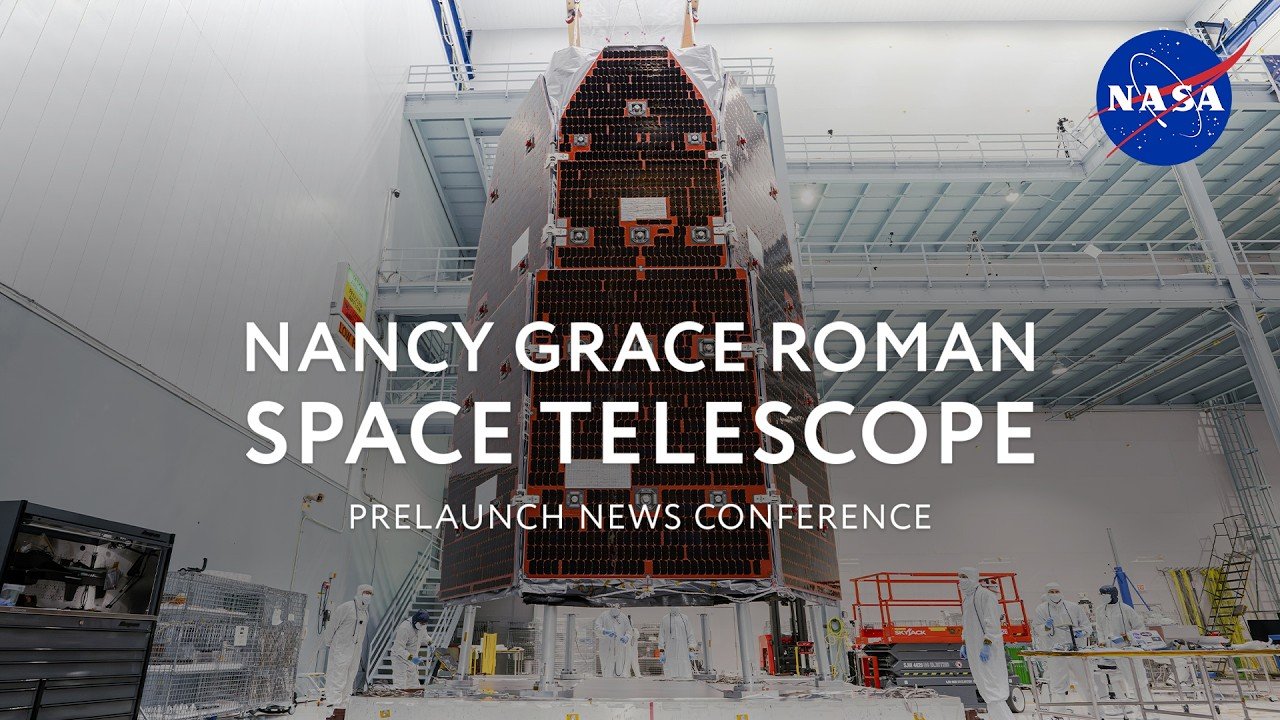
NASA and SpaceX hold the prelaunch news conference for the Nancy Grace Roman Space Telescope, targeting a Falcon Heavy liftoff from pad 39A on August 30 at 7:26 a.m. Eastern. Agency, project, launch and weather officials describe the telescope's capabilities, the launch campaign status, a 50% go weather forecast, the timeline after separation and the 90-day commissioning plan.
Full written account
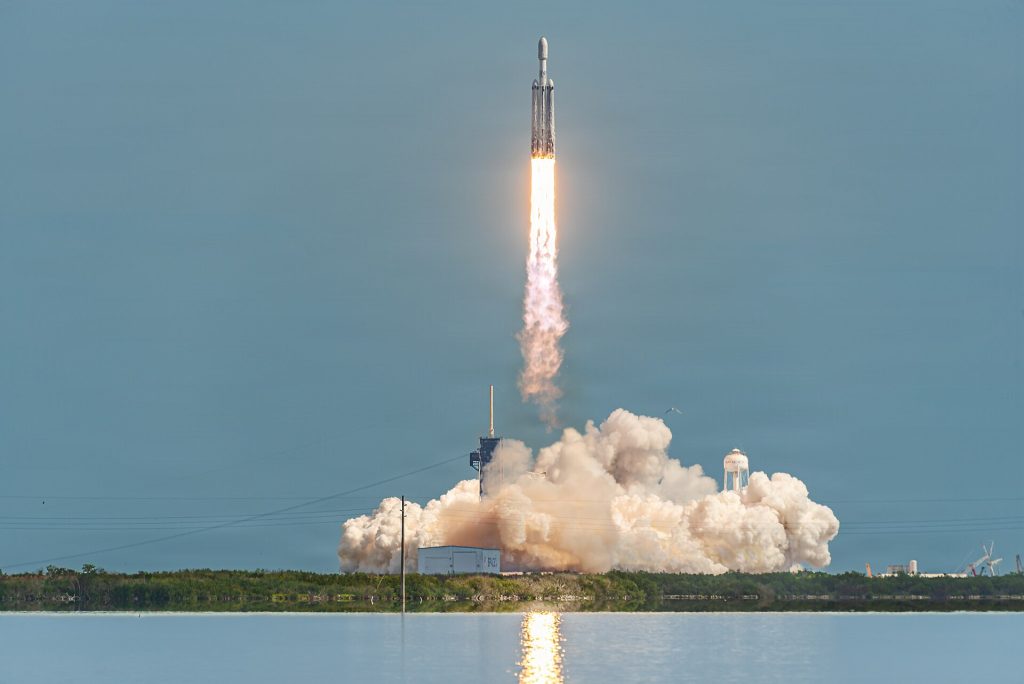
On the eve of launch, NASA and SpaceX were targeting 7:26 a.m. Eastern on August 30 to send the Nancy Grace Roman Space Telescope into space on a Falcon Heavy from pad 39A at Kennedy Space Center. The mission is uncrewed. At the prelaunch news conference, NASA officials described a telescope the size of a tour bus that weighs the same as a T-Rex, and said the project was running nine months ahead of schedule and on budget.
What Roman is meant to do
Nicky Fox, associate administrator of the Science Mission Directorate, said Roman will discover tens of thousands of new planets, billions of galaxies, thousands of supernovae and tens of billions of stars. She said its survey speed is about a thousand times that of Hubble and its field of view about 100 times larger, so what Roman can do in a month would take Hubble a century. Each day of observing, Roman will downlink 1.4 terabytes of data.
Fox said Roman will study galaxies back to when the universe was half a billion years old, about 4% of its current age. Its coronagraph will image giant worlds that are older, colder and in closer orbits than the hot, young Jupiters imaged so far. She called Roman the first milestone for the Habitable Worlds Observatory: once the coronagraph is in orbit and taking data, it proves the technology.
There is no proprietary period for the data. Fox said high school students will get it at the same time as a Nobel Prize-winning scientist, and NASA provides cloud tools, tutorials, a citizen science program and free open-science training.
The launch campaign
Denton Gibson, launch director for NASA's Launch Services Program, said Roman would be the program's 118th mission since 1998 and its 15th with SpaceX. He said he had never seen such a smooth campaign. Roman arrived on a barge on June 21 and was encapsulated in the Falcon fairing, which it nearly fills. It moved to the hangar at 39A on August 24, and the encapsulated assembly was joined to the launch vehicle on August 27.
The previous week the team completed a mission dress rehearsal, a simulated countdown that exercises communication and anomaly handling, and a flight readiness review. The day before the conference, the Space Launch Delta 45 and the joint NASA-SpaceX launch readiness reviews ended with leadership from all three organizations committing to launch. Propellant loading was planned to be committed at about 6:25 a.m., with liftoff at about 7:25 a.m. Launch coverage was set to begin at 6:20 a.m.
The boosters
The Falcon Heavy flies with one new side booster and one that is flying for its third time. Gibson said they were chosen because they met NASA's stringent mission insurance criteria for reliability and qualified service life. Julianna Scheiman of SpaceX added that the reused side booster had previously flown a NASA mission. The boosters were identified as 1104 (plus Y side), 1105 (center core) and 1072-3 (minus Y side).
Gibson said the launch window is about 30 seconds, to allow a potential collision avoidance maneuver if needed, and that the exact liftoff time was 49 seconds past the minute. A Monday attempt would shift by a couple of minutes. Scheiman said the target requires a very high-energy orbit, with an apogee of about a million kilometers, which is why Falcon Heavy is needed.
Weather
Launch weather officer Justin McReynolds of the 45th Weather Squadron gave a 50% probability of violation for launch morning, so a 50% chance of go. Two disturbances watched by the National Hurricane Center were not expected to affect the first attempts. The primary concern was the cumulus cloud rule, since growing cumulus can produce natural or triggered lightning near the pad. An upper-level disturbance over Cuba was adding moisture, and with onshore winds, showers forming along the Gulf Stream could move ashore in the morning. For Monday or Tuesday, the chance of go rose to 70%, as the Cuba disturbance moved west.
After separation
Project manager Jackie Townsend described the timeline. The first chance to sync up by S-band comes at fairing separation, less than five minutes after launch. About 30 minutes after launch Roman separates from the rocket and attempts sun synchronization to establish its attitude. Just before an hour in, the solar arrays and lower instrument sunshields begin deploying, and about an hour and eight minutes in the team expects Roman to be power positive.
Two midcourse corrections are planned, the first about one day after launch and the second four days in. A very accurate release from the rocket could make the first small and the second unnecessary, leaving more fuel for science beyond the five-year prime mission. Roman is headed for the Sun-Earth L2 point, beyond the Moon's orbit, where the Moon, Earth and Sun are on the same side of the observatory, giving it a wide view of the sky.
The 90-day commissioning plan begins with about 10 days of outgassing and settling, then about 30 days commissioning the spacecraft and powering on instruments without taking measurements, followed by 45 days of science commissioning, tuning optics and observing real stars.
Servicing and people
Roman carries a grapple fixture. Townsend said the mission was handed a requirement to accommodate servicing, and after 2020 the focus was on refueling. The blanketing around the fueling port was designed so a robot could reach it. Fuel is the only expendable, and a servicer available in the next 5 to 10 years could refuel Roman at L2.
Lucas Paganini, the program executive, said he was born in Mendoza, Argentina, and noted the team worked through a pandemic and the longest shutdown in US history. Townsend said challenges included a cost cap set before mission design and a detector that was not working in the last thermal-vacuum test. Fox said she hoped the first images would arrive around the holidays.
At about 11:45 a.m. EDT, NASA Administrator Jared Isaacman was to lead a formation of flybys past the pad.
Questions this video answers
When and where was Roman targeted to launch?
NASA and SpaceX targeted 7:26 a.m. Eastern on August 30 from pad 39A at Kennedy Space Center on a Falcon Heavy.
What was the weather forecast?
The launch weather officer gave a 50% go probability for the first attempt, with about 70% go on the backup days of Monday or Tuesday.
How long is the launch window?
About 30 seconds, described as essentially instantaneous; the liftoff time was given as 49 seconds past the minute.
What happens after separation?
Fairing separation comes less than five minutes after launch and rocket separation about 30 minutes after; solar array deployment begins just before an hour in, with power positive expected about an hour and eight minutes in.
Where is Roman going?
To the Sun-Earth L2 point, with two midcourse corrections planned, one after one day and one after four days.
Can Roman be serviced?
It has a grapple fixture and a fueling port with specially designed blanketing, so it could be refueled by a servicer in the next 5 to 10 years.
Explore related missions
Connected by the topic: Falcon Heavy