Roman Space Telescope Launch on Falcon Heavy From Pad 39A
The short version
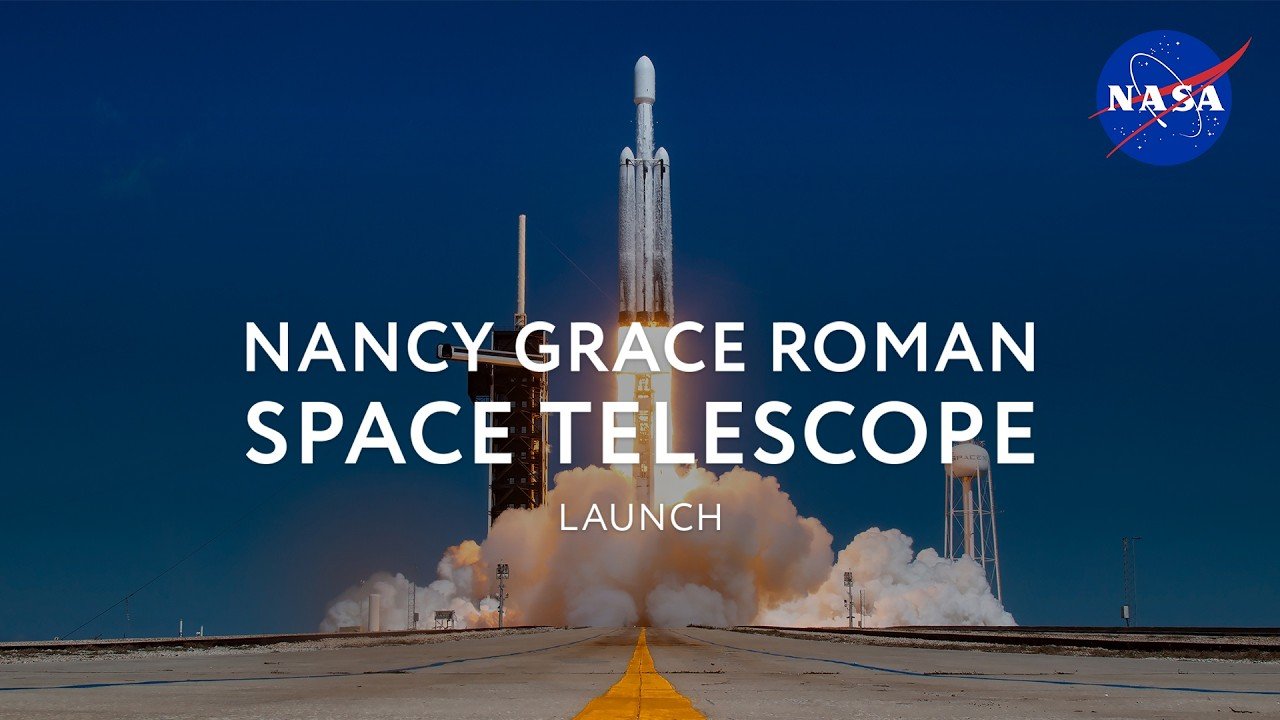
NASA's live broadcast followed the Nancy Grace Roman Space Telescope launch on a SpaceX Falcon Heavy from Launch Complex 39A at Kennedy Space Center, set for 7:26 a.m. EDT. It covers the countdown, propellant loading, liftoff, side booster landings, second stage burns and Roman's separation. Guests explain the wide field instrument, the coronagraph, dark matter and dark energy, and the destination at the Sun-Earth L2 point.
Full written account
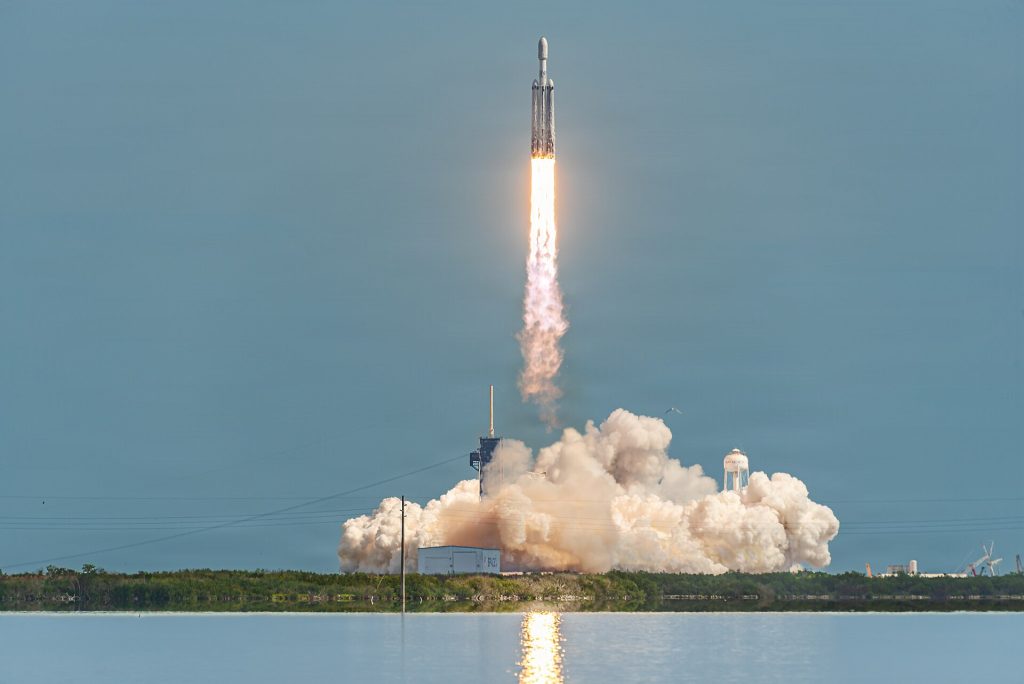
How does a telescope with a view 100 times wider than Hubble's, at the same sharpness, get from a launch pad in Florida to a point a million miles from Earth? NASA's Nancy Grace Roman Space Telescope lifted off at 7:26 a.m. EDT on a SpaceX Falcon Heavy from Launch Complex 39A at Kennedy Space Center. Roughly 31 and a half minutes later it separated from the rocket's second stage, bound for the Sun-Earth L2 point. The mission is uncrewed.
The rocket
Falcon Heavy was flying for the second time that year. Its debut was in February 2018, and a SpaceX commentator said it had since flown 12 times, with 21 booster landings, 18 reflights and 100% mission success. Its 27 Merlin 1D engines, nine on each of three cores, generate more than 5 million pounds of thrust at liftoff, which the commentator equated to about 18 747 aircraft. Both fairing halves on this flight were flying for the first time. The fully fueled rocket carried nearly 3 million pounds of propellant, RP-1 and liquid oxygen.
The spacecraft itself had been fueled about a month earlier with hydrazine, a hypergolic fuel used in thrusters for station keeping at L2. Fine pointing is done with gyroscopes or reaction wheels. Roman weighs 18,000 pounds and is the size of a school bus. It had to be folded, with its solar arrays and deployable aperture cover stowed, to fit a fairing that engineers described as a tight fit.
Countdown
The weather officer's estimate improved to 70% favorable, with cumulus clouds the watch item. The NASA launch manager polled the team for propellant load and everyone reported go. First-stage RP-1 loading took about 15 minutes and liquid oxygen about 10. Engine chill began before launch to prevent thermal shock and boil-off. The white clouds around the rocket were Florida air meeting the cold tank walls. The strongback retracted, the NASA launch manager and then the launch director gave their go, and at T-minus one minute the flight computers took over the count.
Flight
Max Q came about 53 seconds into flight, with the engines throttling down slightly to reduce stress. About two and a half minutes in, the side boosters separated and flew boostback burns, entry burns and landing burns. Both landed at Landing Zone 2 and Landing Zone 40 at Cape Canaveral Space Force Station, and sonic booms were heard nearby. The center core and second stage separated, and fairing separation came at 4 minutes 38 seconds. The second stage's Merlin Vacuum engine made two burns, the first lasting about four and a half minutes and the second about two minutes. Roman separated at T+31:31, and a commentator said it was flying free toward L2. Acquisition of signal had come around seven minutes into the flight.
What Roman is for
Program scientist Dominic Benford said Roman was built to address two questions: dark matter and dark energy, which together with ordinary matter account for the universe's makeup (the ordinary 5% being what we can see), and whether solar systems like our own are common, rare or unique.
The Wide Field Instrument has a 300-million-pixel detector. Benford said the smallest images will be a billion pixels and the largest a trillion, which would need 500,000 4K monitors to display at once. Roman is expected to produce almost 1.5 terabytes of imagery daily. Team members said it will survey the Milky Way, finding tens of billions of stars, and image a patch of sky every 12 and a half minutes to build a movie of hundreds of millions of stars. Roman is expected to find around 100,000 new exoplanets, about a thousand of them through microlensing, compared with about 6,000 known now.
Dark matter is mapped through gravity bending light. Roman measures the distortion of distant galaxies and infers the dark matter between them and us. Benford demonstrated this by looking at the Roman logo through champagne flutes.
The coronagraph was designed by NASA's Jet Propulsion Laboratory and is about the size of a baby grand piano. Jason Rhodes said it will be 100 to 1,000 times more powerful than any previous space coronagraph. It uses single-photon-counting detectors and small deformable mirrors with about 2,000 pistons. It will not see Earth-size planets around sunlike stars, but should image a Jupiter-like planet in reflected light. Benford said Jupiter is 10 million times fainter than its star and Earth about one ten-billionth as bright. A future Habitable Worlds Observatory would carry this forward.
Final preparations
Before launch, Roman was tested on shaker tables, in an acoustic chamber and in a thermal vacuum chamber at Goddard. In June it was driven to Baltimore and placed on a barge, arriving nine days later at Kennedy. It was then serviced in the Payload Hazardous Servicing Facility, built in 1986, where technicians wore full-body suits to keep out hair and skin particles. Curiosity and Perseverance were also serviced there.
Next steps
Roman will take about three months to reach L2, about four times farther than the Moon. During the trip the team will turn on the instruments, align the telescope and calibrate. Jeremy Perkins described the first hours: pointing the solar arrays at the sun, a midcourse correction within about a day, and deployment of the high-gain antenna. First-light images are expected in early 2027, and data will be public right away. Roman will share L2 with the James Webb Space Telescope, though both orbit the point on paths larger than the Moon's orbit around Earth.
NASA also announced an adopt-a-pixel campaign, and more than 1.3 million names, including those of the Artemis 2 crew, were sent with Roman on an SD card.
Questions this video answers
When and where did Roman launch?
It was scheduled to lift off at 7:26 a.m. EDT on a Falcon Heavy from Launch Complex 39A at NASA's Kennedy Space Center in Florida.
Where is Roman headed?
To the Sun-Earth L2 point, about a million miles from Earth, roughly four times farther than the Moon. The trip takes about three months.
Did the side boosters land?
Yes. Both side boosters were confirmed landed, at landing zones 2 and 40 at Cape Canaveral Space Force Station.
What does Roman study?
Dark matter, dark energy and exoplanets, using a wide field instrument and a coronagraph.
When will first images come?
First light images are expected in early 2027, after commissioning.
Explore related missions
Connected by the topic: Falcon Heavy