Vega C Launches FLEX and Sentinel-3C on a Shared Flight
The short version
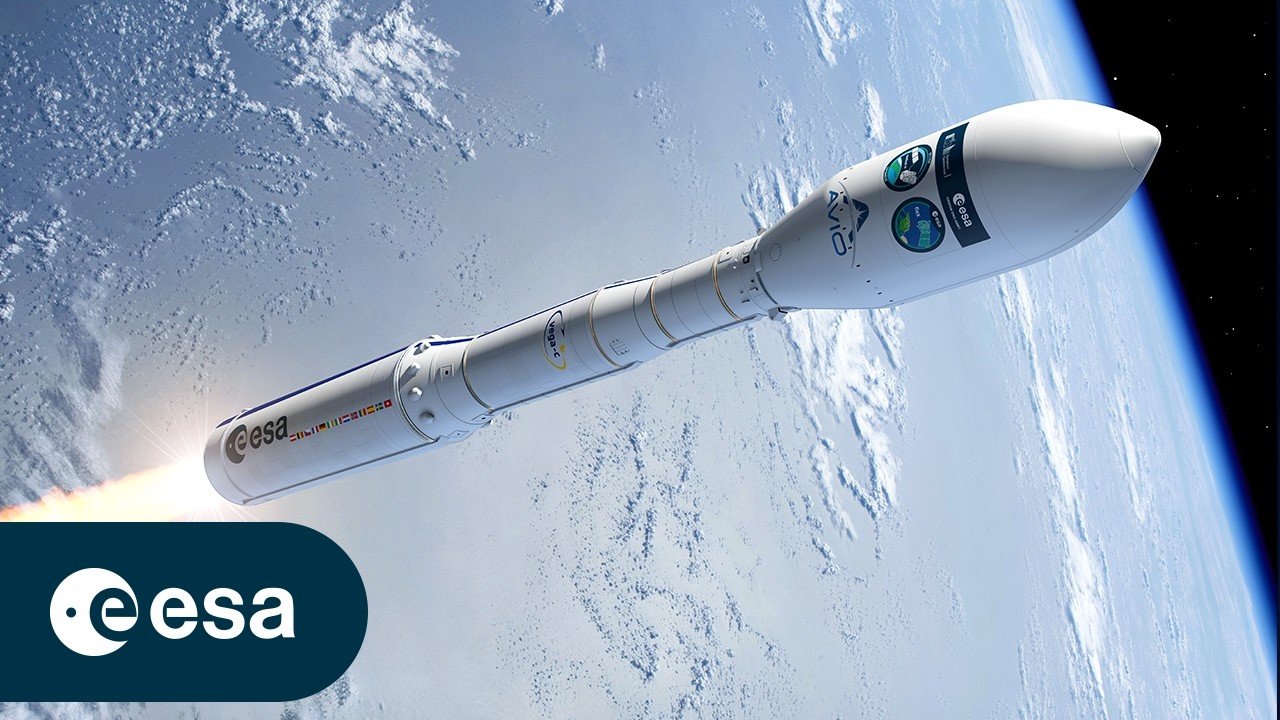
A Vega C rocket lifted off from Europe's Spaceport in French Guiana carrying ESA's FLEX satellite and the Copernicus Sentinel-3C satellite, using the new Vespa Plus R adapter to deliver them to different orbits. Sentinel-3C separated first, followed by FLEX, and both satellites' signals were acquired by ground controllers. The broadcast also covers interviews with mission and industry officials.
Full written account
One rocket, two satellites, two different orbits: on 15 September 2026 at 03:21 CEST (14 September at 22:21 local time), ESA's Vega C lifted off from Europe's Spaceport in French Guiana carrying Sentinel-3C and FLEX, and released them roughly an hour and a half apart using a new payload adapter called Vespa Plus R. It was the first time Vega C flew with that adapter, which lets the rocket deliver payloads into different Sun-synchronous orbits in a single flight.
A new adapter for a two-satellite flight
Vespa Plus R is an evolution of the Vespa Plus adapter used on earlier Vega flights; the R stands for reinforced. Vespa first debuted on Vega's VV7 flight, was upgraded to Vespa Plus with room for a larger payload, and now has a structure reinforced with carbon-fibre skins. Its developers describe it as able to accommodate main payloads of up to 1,700 kg. It was developed by ESA, Avio and Airbus Spain.
On this flight Sentinel-3C sat on top and FLEX was hidden inside the adapter, which is why controllers could not see the smaller satellite until the Vespa was separated. Avio's CEO Giulio Ranzo explained the plan: release the upper satellite first, then open the adapter and release the second payload. Both satellites were built by Thales Alenia Space. Sentinel-3C is for the European Commission's Copernicus programme, while FLEX is an ESA satellite. FLEX was developed to fly within the Vespa, and it took advantage of Sentinel-3C being lighter than what Vega C can carry.
FLEX's mission manager said the team was told at the end of 2024 that a shared launch with Sentinel-3 was possible. To keep the schedule, the Leonardo-built FLORIS instrument was integrated at satellite level before its final acceptance, under ESA's control.
The flight, step by step
Avio's Ricardo Pelle walked through the sequence. The P120 first stage burned about 140 tons of propellant over the first two and a half minutes. The Zefiro 40 second stage burned for two minutes, and the Zefiro 9 third stage for about two and a half. The fairing was jettisoned at 150 km, outside the atmosphere. At 88 km the rocket was travelling at roughly 3 km/s, according to the on-screen telemetry. During the Zefiro 9 phase the vehicle flew a neutral axis manoeuvre, which ensures the spent stage falls into a bounded area of ocean where nobody is present.
The AVUM upper stage then took over. Its first burn lasted about 8.5 minutes and raised the orbit to over 800 km. After a coasting phase in which the launcher rolled slowly in what the team called barbecue mode, to even out temperatures, a second burn circularised the orbit. At 825 km the telemetry showed 7.51 km/s.
Sentinel-3C separated forward at about 0.5 m/s, pushed by springs released by pyrotechnics. Its signal was acquired shortly afterwards. A third AVUM burn of about 30 seconds lowered the orbit so the Vespa Plus R could be separated away from both satellites; it is expected to decay and burn up within the next 20 years. A fourth burn raised the orbit again, and FLEX was released at about 90 degrees to the direction of travel, again at about 0.5 m/s. Its signal was then acquired at ESOC, and the control centre in Kourou erupted in cheers. A fifth AVUM burn, not shown live, was planned to deorbit the upper stage so it would not remain as debris.
Sentinel-3C
Sentinel-3C is the third Sentinel-3 satellite, joining 3A and 3B. It carries four instruments: a radar altimeter (SRAL) that measures sea-surface height, wind over the sea, river and lake levels and ice thickness; a microwave radiometer that measures atmospheric water vapour to correct the altimeter; cameras at different wavelengths, including ocean colour; and the SLSTR radiometer for land and sea surface temperature. It will fly at around 800 km in tandem with Sentinel-3B. The project manager said the satellite, begun in 2015, was stored for four years after integration. Next come solar array deployment, calibration and validation near Sentinel-3B, and then, in two to three months, a move close to Sentinel-3A to replace it. EUMETSAT takes over routine operations after ESA's commissioning, and ESA says the mission should deliver services into the 2030s.
EUMETSAT's director general Phil Evans said the SLSTR-based fire radiative power product, which shows where fires are and how large, now reaches users in about 60 to 90 minutes, down from 3 hours. He cited 500,000 hectares burnt in Europe this year.
FLEX
FLEX, the Fluorescence Explorer, is ESA's eighth Earth Explorer mission and weighs about 400 kg after roughly ten years of development. It is the first mission dedicated to mapping vegetation fluorescence from space. When chlorophyll absorbs sunlight for photosynthesis, it also emits a faint glow in the red and near-infrared. FLORIS separates this emitted light from reflected light using many hundreds of colours. It observes at 300 m resolution in a band from 500 to 680 nanometres. Mission scientist Marco Celesti-Grapow's team lead, named in the broadcast as Marco Jali, said stress such as drought or heat lowers photosynthesis and changes the fluorescence immediately.
FLEX will fly 40 to 100 km ahead of Sentinel-3 and observe the same area 6 to 15 seconds apart, so Sentinel-3 data on vegetation, surface temperature and water vapour can complement it. FLEX reuses Sentinel-3 avionics. ESOC will operate it for the whole mission.
Outcome
Avio's CEO called it a mission accomplished, with both satellites in the correct orbit and their signals acquired. ESA's Earth observation director Simonetta Cheli said Sentinel-3C is expected to take about six months of testing before it joins its siblings in operational service.
Questions this video answers
What launched on this flight?
ESA's FLEX satellite and the Copernicus Sentinel-3C satellite, on a Vega C rocket.
What does FLEX measure?
The faint fluorescence plants emit during photosynthesis, to assess vegetation health and stress.
How were two satellites delivered to different orbits?
A new Vespa Plus R adapter held them one on top of the other; Sentinel-3C was released first, then the adapter opened to release FLEX.
Did the launch go to plan?
Commentators reported the flight as nominal, both satellites separated in the correct orbits, and signals from both were acquired.
Explore related missions
Connected by the topic: Low Earth orbit