New Glenn NG-2 Countdown: ESCAPADE Launch and Booster Landing Plan
The short version
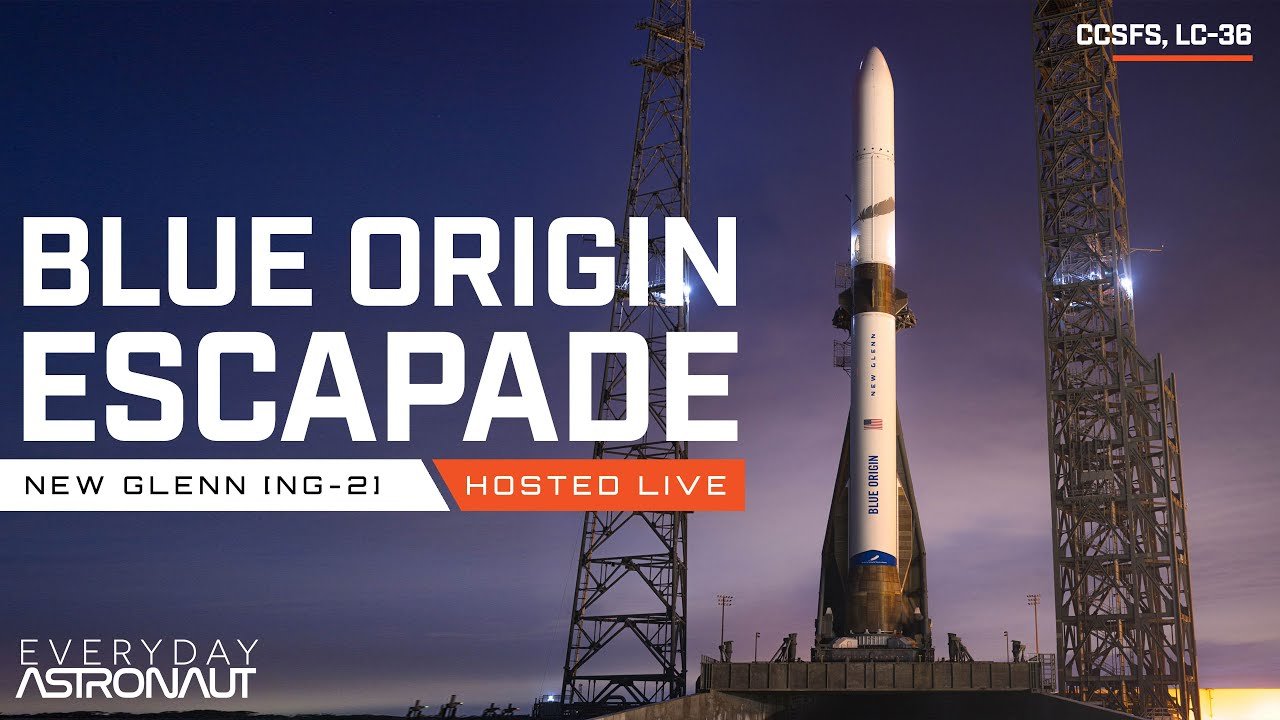
Livestream coverage of the countdown for NG-2, the second New Glenn flight, from Launch Complex 36 at Cape Canaveral. The rocket carries NASA's twin ESCAPADE spacecraft toward Mars plus a Viasat technology demonstration, and Blue Origin plans to land the booster on the droneship Jacklyn. The coverage includes a hold at T-minus 20 seconds and a later return to terminal count, mixed with host Q&A. The recording ends before liftoff.
Full written account
New Glenn's second flight, NG2, was set to lift off from Launch Complex 36 at Cape Canaveral Space Force Station with two goals: deploy NASA's ESCAPADE twin spacecraft toward Mars, and land the reusable first stage on a droneship for the first time. The launch window on the day covered here opened at 2:57 p.m. Eastern and ran about 90 minutes, to 4:25 p.m. An earlier attempt on Sunday had been scrubbed for weather.
The rocket and the mission
New Glenn is a super heavy lift rocket, about 95 meters tall and 7 meters wide, nearly as tall as the Saturn V. Its booster has seven BE4 engines burning liquid methane and liquid oxygen, producing 3.8 million pounds of thrust at liftoff. Only three of the seven engines gimbal to steer; four are fixed. The upper stage uses two BE3U engines on liquid hydrogen and liquid oxygen. Blue Origin quotes 45 tons to low Earth orbit while landing the booster.
The payload, ESCAPADE, is a pair of satellites built by Rocket Lab for NASA, nicknamed Blue and Gold after the UC Berkeley colors. They are Mars orbiters meant to study the planet's atmosphere and magnetosphere, and how solar wind and coronal mass ejections drive atmospheric escape. A Viasat communications technology demonstration was also aboard.
Because Earth and Mars were poorly aligned for a transfer, the plan was not a direct trip. New Glenn would place the spacecraft in a Lagrange point region (L2, as the host recalled it), where they would loiter and later use their own propulsion to head to Mars once the alignment improved. The launch heads almost due east to gain Earth's rotation. The host noted NASA paid a little less than a few hundred million dollars for the mission, a low-cost, higher-risk interplanetary flight, and suggested a light payload made it a good shakedown for the rocket.
Flight plan
The webcast laid out the profile. Max Q comes at about 40,000 feet (12 km). Around 3 minutes into flight the booster engines shut down, and the first stage reorients with its reaction control system, performs a reentry burn, then a landing burn onto the droneship Jacklyn, about 375 miles offshore. The booster, named Never Tell Me the Odds, carries forward fins and strakes to help it fly back and relight its engines. The fairing separates at about 400,000 feet (120 km). The two ESCAPADE satellites deploy about 30 seconds apart after the second stage's burns, and the Viasat demonstration turns on about 38 minutes into flight. The first flight's booster had failed at the engine relight for reentry, which the host said was the key thing to watch.
The countdown
Call-outs went around the control stations, each reporting go, and launch director Megan Lewis cleared the vehicle for terminal count. From there the vehicle runs autonomously on software. The seven engines were to start staggered, three first and four about a second later, and the pad was to be flooded from the large water tower to dampen vibration and heat.
At T-minus 20 seconds the countdown went into a hold, and the team announced a terminal count abort and said it was investigating. The host noted it was a single "hold" rather than "hold, hold, hold", which he said usually means a scrub for the day, and guessed the vehicle had triggered an automatic abort on a threshold. The cause was not stated in the broadcast. The clock was later reset, the team recycled the vehicle, and terminal count began again at around T-minus 3:30 with the window still open.
Blue Origin also said it had played it safe earlier in the week because of coronal mass ejections, since a storm could damage satellite electronics that could not be repaired once in space.
Questions this video answers
What is NG-2?
NG-2 is the second flight of Blue Origin's New Glenn rocket, launching from Launch Complex 36 at Cape Canaveral Space Force Station.
What is New Glenn carrying?
NASA's twin ESCAPADE spacecraft, built by Rocket Lab, and a Viasat communications technology demonstration.
Why was there a hold?
The countdown went into a hold at T-minus 20 seconds after a terminal count abort. Blue Origin said the team was investigating, and the clock was later reset.
What happens to the booster?
Blue Origin planned to land it on the droneship Jacklyn, about 375 miles offshore. The coverage ends before the attempt.
Do the spacecraft go straight to Mars?
No. The host says they are placed near the Earth-Sun L2 point first and fly to Mars later, once Mars is better aligned.
Explore related missions
Connected by the topic: New Glenn