New Glenn NG-2 Live: ESCAPADE to Mars and a Booster Landing Try
The short version
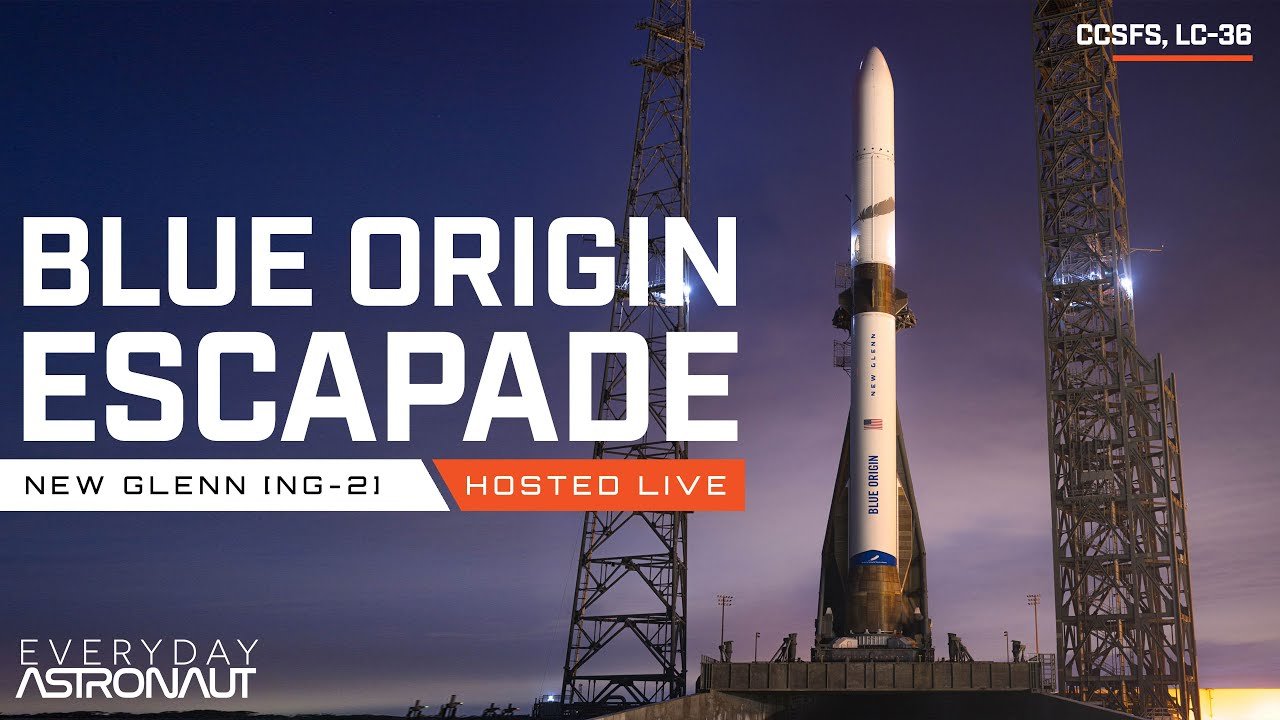
Live coverage of Blue Origin's second New Glenn launch, NG-2, from Launch Complex 36 at Cape Canaveral Space Force Station, carrying NASA's twin ESCAPADE spacecraft toward Mars along with a Viasat communications demonstration. The stream covers the weather and boat holds, the two mission objectives (deploying the payload and landing the booster on the ship Jacklyn), and explanations of the vehicle and the loiter-then-depart trajectory. The recording ends before liftoff is shown, so the outcome is not stated.
Full written account
Blue Origin's second New Glenn rocket, flight NG-2, was set to lift off from Launch Complex 36 at Cape Canaveral Space Force Station carrying NASA's twin ESCAPADE spacecraft toward Mars. The mission had two stated goals: deploy the payload on the right trajectory to Mars, and land the first-stage booster on a platform called the Jacklyn, about 375 miles (roughly 600 km) offshore to the east. The mission is uncrewed. The coverage came from Everyday Astronaut's Tim Dodd, who ran commentary alongside Blue Origin's own webcast.
The mission and its payload
ESCAPADE is a dual-spacecraft mission of twin satellites that will study Mars' magnetosphere and solar wind interactions, and how the planet's weather changes over time. The spacecraft were built by Rocket Lab, based on its Photon design. Dodd described the mission as low-cost, at less than 100 million dollars in total for NASA by his recollection, and said Blue Origin gave NASA a good deal on the launch as the second flight of the rocket. A Viasat communications technology demonstration, tied to Viasat's HaloNet network, also flew, relaying launch telemetry in real time.
NASA's Dr. Nikki Fox, who said she helped select the mission, called it a day of firsts: the first NASA science mission on New Glenn, the first heliophysics mission going to Mars and the first interplanetary spacecraft for Rocket Lab.
An unusual trajectory
Rather than leaving at the Mars launch window, the spacecraft are to fly around the Earth-Sun L2 Lagrange point. Fox explained that this avoids waiting about 13 months for Mars to be in the right place: the mission launches, waits, and then accelerates toward Mars when the planet is in position. Dodd added that the spacecraft must then use their own propulsion to return toward Earth, where an Earth gravity assist flings them toward Mars. He named the loitering period as the main added risk, since the spacecraft must do their own maneuvers, while noting it let New Glenn launch at its earliest opportunity and allowed an extensive shakedown of the two vehicles.
The rocket
Blue Origin's Arian Cornell, New Glenn's vice president of strategy and business operations, described the vehicle as a two-stage rocket 320 feet tall, five times the height of New Shepard. Dodd gave 95 meters, close to the 105 meters of Saturn V, and noted a 7-meter-wide payload fairing.
- The first stage, GS1, is fully reusable and is powered by seven BE4 engines, built in Huntsville, Alabama.
- Each BE4 produces 550,000 pounds of thrust, for about 3.85 million pounds at liftoff, roughly half the thrust of Saturn V by Dodd's comparison.
- The upper stage uses BE3 engines running hydrogen.
Dodd said that in reusable mode New Glenn can carry roughly the same to low Earth orbit as a recovered Falcon Heavy, and more to high-energy orbits such as the Moon and Mars. He estimated about 15 tons to the Moon if the booster were expended.
Landing the booster
Eddie Safford of Blue Origin described the landing sequence. After separating from the upper stage, the booster performs a 180-degree flip using a reaction control system of peroxide monopropellant thrusters, which Blue Origin calls severe weather agility thrusters. These worked perfectly on the first flight, he said. The three center BE4 engines then relight for the exo-atmospheric re-entry burn, which slows the booster so that its long strakes and forward fins can guide it over the Jacklyn. Dodd expected the booster to come off to the side of the ship and translate over to land, and said the ship would be stationary during landing.
Cornell said that if the booster were not landed that would be acceptable, as several more vehicles were already in production. She noted that the first launch, NG-1 in January, aimed to reach orbit, which it did.
Blue Origin said the team ran an integrated hot fire a week before launch: the rocket was rolled out one evening and fired the next, within 24 hours, where previous attempts had taken several tries.
Questions left from NG-1
Dodd said it was not clear why NG-1 left the pad slowly. Possibilities he raised were deliberate throttling for engine margin, or engines rated conservatively; he said the reason was not known. He hoped NG-2 would clear the tower in about half the time, and estimated a liftoff thrust-to-weight of about 1.3. He also said NG-1 appeared not to reach its intended orbit exactly after the second-stage relight but otherwise met most milestones.
A countdown held by weather
The launch window was about an hour and a half. About 42 minutes before the planned time the first and second stages were both fueled and the pad was clear of personnel. The countdown clock was then reset to allow weather to clear. Dodd explained the weather decision belongs to the range, not Blue Origin: an anvil or cumulus cloud nearby violates the lightning launch commit criteria, because the rocket and its exhaust plume could conduct ground-attached lightning. He cited an Atlas failure from lightning and Apollo 12 being struck twice.
Rain fell on the pad during a hold at about 24 minutes 50 seconds before launch. Later, with weather improving, a hold at about 20 minutes was attributed to boats in the flight path. Dodd said loading propellant starts about 4 hours before launch and, unlike Falcon 9's load-and-go, the rocket can sit in a hold with hydrogen topped off from ground reserves. Cornell said the pad's methane flare stack burning off boil-off was normal. Launch had not yet occurred in the portion of coverage available, and the window was due to close at 4:15 p.m. local time.
Context from the broadcast
Launch Complex 36 previously hosted 140 Atlas II and III launches, including Mariner, Pioneer and Surveyor missions. Cornell said Blue Origin landed its New Shepard booster 10 years earlier, and that the company now has over 10,000 employees. Dodd also discussed a proposed FAA restriction on daytime commercial launches, tied to the government shutdown, and said Blue Origin was reportedly seeking an exemption.
Questions this video answers
What was New Glenn NG-2 launching?
NASA's twin ESCAPADE spacecraft to study Mars' magnetosphere and solar wind interactions, plus a Viasat communications technology demonstration.
What were the two goals of the mission?
First, deploy the payload on the right trajectory to Mars; second, land the first-stage booster on the platform Jacklyn downrange.
Why was the launch held?
The stream describes holds for weather, including lightning launch criteria with a nearby cloud, and for boats in the flight path.
How tall is New Glenn?
The hosts give about 320 feet (about 95 to 100 meters), with seven BE4 engines on the first stage.
Did the launch happen?
The coverage provided does not show liftoff, so the outcome is not stated.
Explore related missions
Connected by the topic: New Glenn