Super Heavy’s 33 Raptors vs Saturn V’s Five F1 Engines Explained
The short version
Compares the 33 Raptor engines on SpaceX's Super Heavy booster with the five F1 engines of the Saturn V. It covers the F1's combustion instability problem, the Soviet N1's many-engine design, and how reusability, throttling and manufacturing cost favour many smaller engines. It ends by noting that SLS uses RS-25 engines from the Space Shuttle in a one-way role.
Full written account
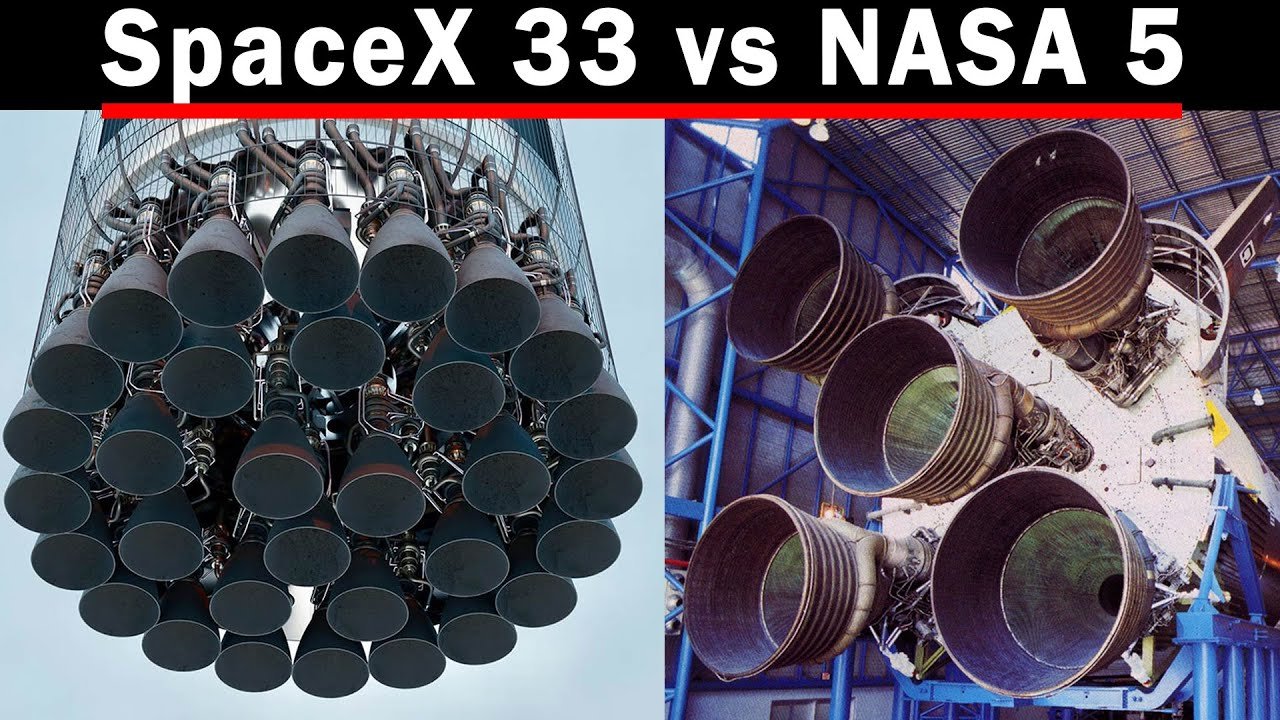
Super Heavy, the booster of SpaceX's Starship, flies on 33 Raptor engines, while the Saturn V used five F1 engines and SLS uses four RS-25 engines plus two boosters. Starship with Super Heavy generates twice the thrust of the Saturn V, but the aim of the Artemis mission is the same: put a lander with a human crew on the Moon and bring them home.
The Saturn V's five engines
The Apollo and Skylab programs launched 13 Saturn Vs, including the uncrewed Apollo 4, 5 and 6 test flights, and used 65 F1 engines with a 100% success rate. All ended up in the Atlantic, since they were designed to be used once. The Saturn V grew out of the Jupiter rocket family, designed under Wernher von Braun, who called the Jupiter an infant Saturn. The Saturn C3 started with two F1 engines, raised to three by 1961. The C4 would have used four and needed two launches per Moon landing. The C5, with five F1 engines in the first stage, would do it in one launch.
The F1's instability problem
Early tests showed combustion instability: oscillations around 4 kHz with harmonics up to 24 kHz that could cause the combustion chamber to fail. They were intermittent and varied in strength. The problem took almost 2 years to solve and threatened to end the Apollo program. Engineers detonated small black powder charges in a tube while the engine ran to see how the oscillations moved through the chamber. After many design iterations, baffles on the injector plates damped them, and the engine could self-damp an artificially induced instability within a tenth of a second.
The Soviet alternative
Soviet engineers met the same instability and split engines into a single turbopump feeding several combustion chambers, usually four, as on the RD-107 engines of the R7. For the N1 moon rocket they used 30 smaller engines with a specific impulse of 331 seconds against 263 for the F1. The N1 steered by differential thrust instead of gimbals, relying on a control computer called KORD. If one engine failed, its counterpart on the opposite side was shut down, so two or more failures meant shutting down four, six or eight engines. With a budget limit and no test facilities for so large a rocket, only about one in six engines was tested. The first four N1 launches failed. Sergey Korolev died in 1966, and by 1972 the Soviet Communist Party canceled the program.
Why many engines suit reuse
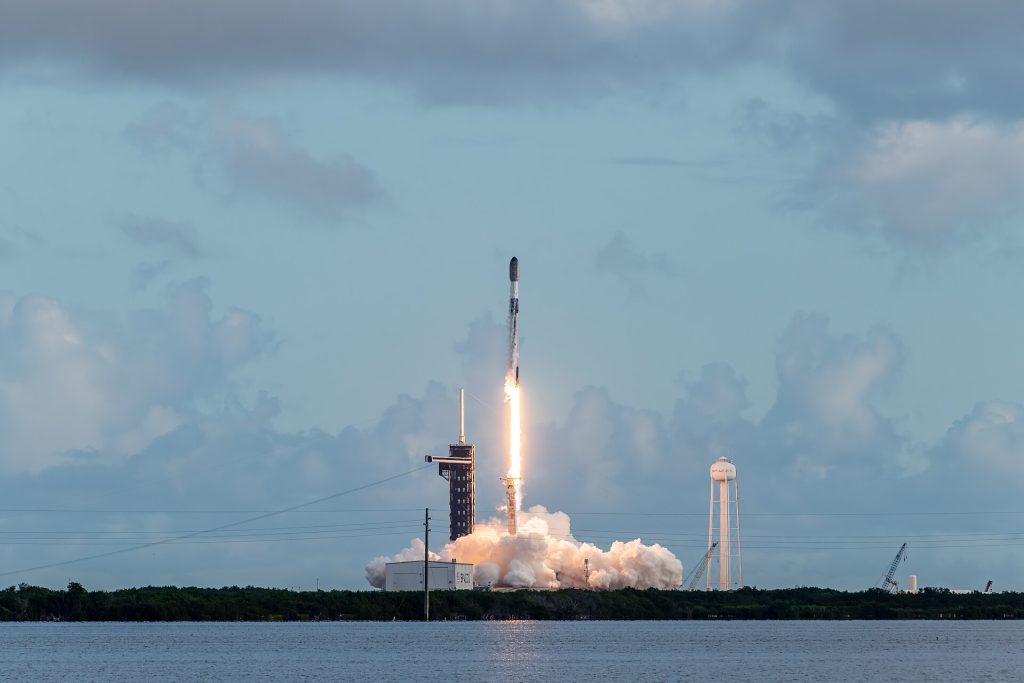
The Falcon 9 uses nine Merlin engines and Falcon Heavy 27. The F1s were rated for 10 reuse flights, but there was no way to return them, and a 1970s Rocketdyne study of a flyback S-IC stage got no further than the drawing board. A Super Heavy booster weighs 3,600 metric tons at launch, 3,400 of it fuel, leaving 200 tons of dry weight plus landing fuel, so landing needs far less thrust than takeoff. The F1 could not be throttled down, and even a throttled engine would need to go below 40%. In the landing, 13 engines slow the booster from high altitude at about 1,200 km/h, and then three are used below 10 km/h for the final touchdown.
Cost
F1 engines were effectively handmade with thousands of welds, at an estimated $15 million each in today's money. 98 were produced for NASA. In testing, one engine ran 20 tests for 2,256 seconds and another 34 tests for 2,913 seconds, while in flight they ran only 159 to 165 seconds. Raptor production runs at about one per day, with new manufacturing cutting parts by 80 to 90%, and the cost is expected to fall under $250,000 each at mass production.
SLS uses RS-25 engines from the Space Shuttle, which were made reusable but now fly one-way and drop into the Atlantic, while the reusable part of SLS is the solid rocket boosters.
Questions this video answers
Why does Super Heavy use 33 engines?
Many engines give the thrust needed for takeoff, and then allow the nearly empty booster to land using 13 engines at first and then three, with throttle control and gimbaling.
How much thrust does Starship with Super Heavy generate compared with Saturn V?
Twice as much thrust as the Saturn V.
What problem did the F1 engine have?
Combustion instability, oscillations around 4 kHz with harmonics up to 24 kHz, which could cause the combustion chamber to fail. It took almost 2 years to solve, using baffles on the injector plates.
How did the Soviet N1 handle engine failures?
It used 30 smaller engines with differential thrust for steering; if an engine failed, its counterpart on the opposite side was shut down to keep thrust balanced.
How many F1 engines were produced?
98 were produced and delivered to NASA in total.
Explore related missions
Connected by the topic: Falcon 9