Deep Space Updates: MMX to Phobos, Crew-12 Return, Neutron Delay
The short version
A roundup of space news from early to late October, covering launches from Korea, China, the US and Japan, including Japan's H3 launch of the Martian Moons Explorer. It also covers the Crew-12 return, Perseverance's driving record, Rocket Lab's Neutron delay to 2027, New Glenn updates, Ship 40's return to Starbase, SpaceX's earnings call and NASA's Moon plans.
Full written account
On 19 October an H3 24L lifted off from Tanegashima carrying the Martian Moons Explorer, Japan's first Phobos sample return mission. It was one of many events in a roundup covering launches, a crew return, rover records, rocket delays and Moon-program changes.
Launches
On October 7th Korea launched the Nuri rocket on its intended day for the first time, on its fifth flight. It carried five NEONSAT microsats for Earth observation, deployed into a 575 km sun-synchronous orbit. Nine of ten CubeSats were deployed; one stayed attached to the stage.
On October 9th a Long March 12 launched nine Guowang satellites from Wenchang, with over 200 of these satellites now deployed. On October 10th a Falcon 9 from Vandenberg launched 21 Northrop Grumman-built SDA Tranche 1 transport layer satellites, and the booster returned to the launch site rather than landing on a ship.
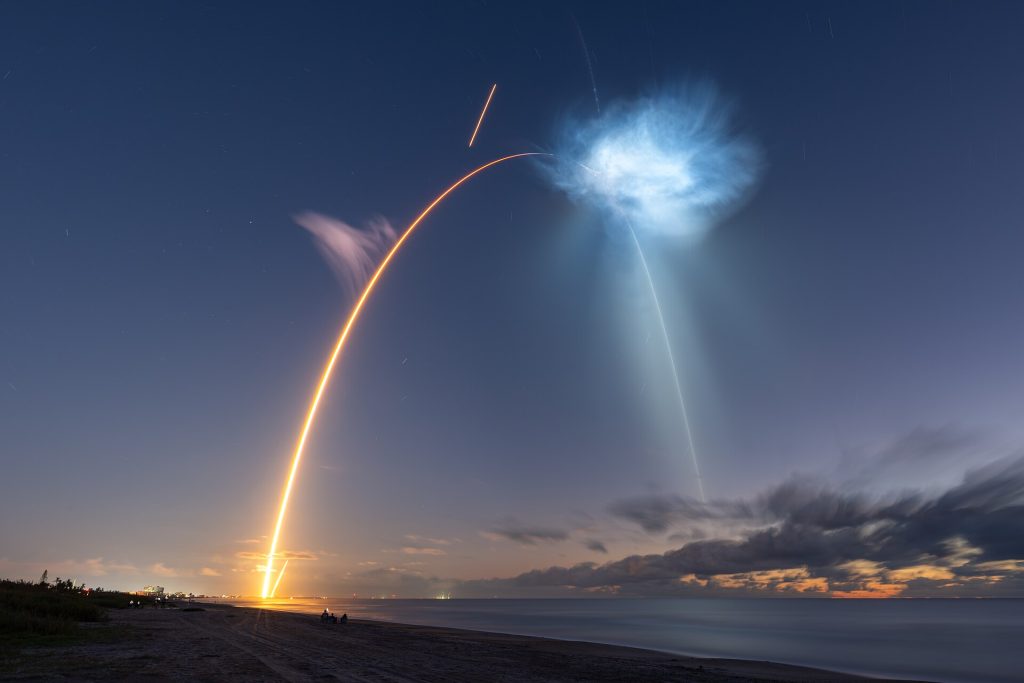
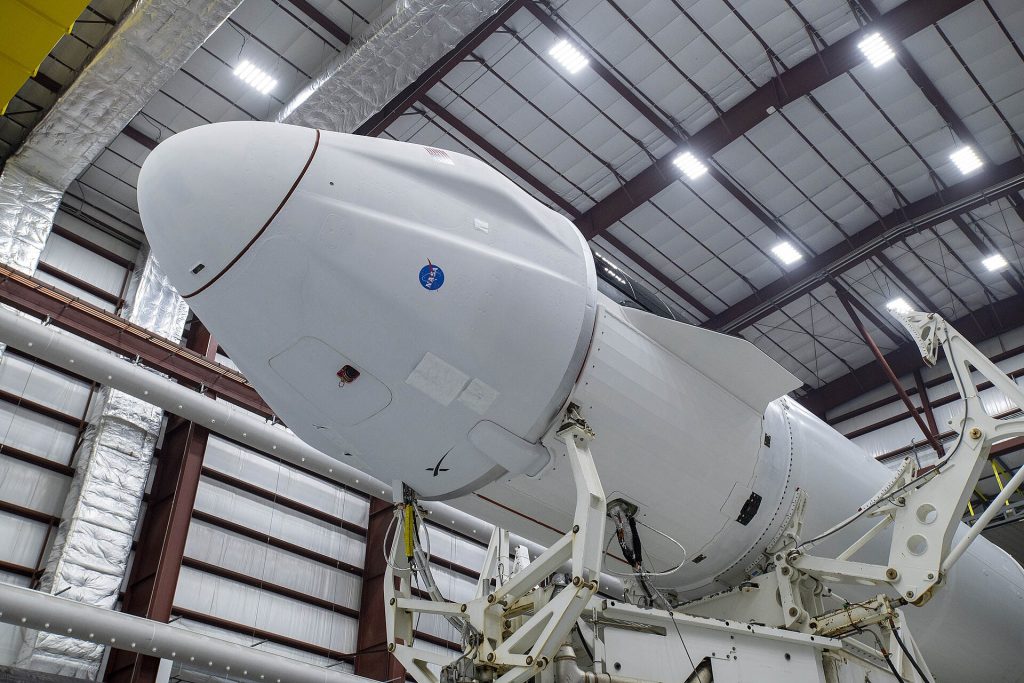
A Falcon 9 launched Cargo Dragon CRS-35 on October 13th. Its instantaneous window just before sunrise produced striking jellyfish-shaped exhaust plumes. The trunk held the last pair of iROSA solar panels, and the Dragon docked autonomously to the Harmony module on the 15th.
The Bandwagon 5 rideshare carried 32 payloads, including the first Starfall demo spacecraft seen. Its capsule held an Air Force Research Laboratory point-to-point cargo experiment with water, rations, a radio, a compass, batteries and duct tape.
Martian Moons Explorer
MMX will explore both Martian moons and land on Phobos, with a rover and a sample return spacecraft. Samples are due back in 2031, about 10 g of material. NASA, ESA, CNES and DLR supplied instrumentation. Earlier attempts failed: the Soviet Phobos 1 lost contact en route, Phobos 2 lost contact just before reaching the moon, and Russia's Fobos-Grunt, launched in 2011, stayed stranded in Earth orbit. MMX is on its transfer trajectory to Mars.
Crew 12 and records
Crew 12 undocked on October 8th and splashed down west of Los Angeles. The crew were Jessica Meir, Jack Hathaway, Sophie Adenot and Andrey Fedyaev. Adenot set an ESA endurance record of 237 days, longer than a typical Dragon mission because the crew launched early to relieve Michael Fincke.
On October 11th, Sol 2006, Perseverance's odometer reached 45.22 km, passing Opportunity's 45.16 km. It took 5.5 years, against nearly 15 for Opportunity, with Autonav handling 90% of the driving.
Rocket Lab and Blue Origin
Rocket Lab said Neutron is delayed until 2027. A forward dome built by an outside contractor had problems in hydrostatic testing in January, so dome manufacture moved in-house. Testing then found voids between carbon fiber layers, which can become weak points in a pressure structure. Layup procedures were redesigned, and the after dome made with revised methods looks good.
Blue Origin has seven tower modules stacked at its pad and the launch bridge back in place after the New Glenn failure. A leaked GIF of the explosion carried the caption "North Star fixes this." Air traffic control slides list a potential New Glenn flight on December 28th. Blue Origin is also talking about scaling to 50 launches per year.
SpaceX
Ship 40, the Flight 13 upper stage that survived splashdown, returned to Starbase after 75 days at sea and a few more days to arrive. It showed dented nozzles, oxidation and heat shield damage. SpaceX's earnings call reported revenue of $14.6 billion, net income of 4.4 billion and 13.6 million Starlink subscribers. It also noted the first revenue-generating Starship launch and said SpaceX and Tesla are looking into merging. SpaceX bought 14 megahertz of 800 megahertz spectrum from Grain Management. The next Starship flight, scheduled for November 8th, plans to catch the ship and booster.
In Ukraine, Starshield terminals stopped working above 100 miles per hour from around October 13th.
NASA plans
Slides from NASA's Steve Creech show Artemis 3 still at Q3 2027. SpaceX plans propellant transfer in Q1 2027 and an uncrewed Moon landing demonstrator in late 2027. Blue Origin targets a crewed lander demo in early 2028. Axiom is now the only spacesuit provider, and NASA is de-scoping Artemis IV suit requirements, including six EVAs in a week and two hours in a permanently shadowed region.
Commercial LEO Destinations proposals are due in December, with awards hoped for spring 2027. Contracts have a guaranteed minimum of $100 million.
Questions this video answers
What did Japan launch to Phobos?
On 19 October an H3 24L from Tanegashima launched the Martian Moons Explorer (MMX), Japan's Phobos sample return mission. It will land on Phobos, with a rover and a sample return spacecraft, and return samples in 2031.
How much material is MMX expected to bring back?
About 10 g of material is expected on the return capsule.
Why is Rocket Lab's Neutron delayed?
Rocket Lab said Neutron is delayed until 2027. Testing found voids between the layers of the carbon fiber forward dome, so layup procedures were redesigned.
Who was on the Crew 12 mission?
Jessica Meir (commander), Jack Hathaway, Sophie Adenot of ESA and Andrey Fedyaev. They undocked on October 8th and splashed down just west of Los Angeles.
What record did Perseverance break?
On 11 October, on Sol 2006, its odometer reached 45.22 km, passing Opportunity's 45.16 km.
When might New Glenn fly again?
Air traffic control slides from South America list a potential New Glenn flight on December 28th, though the video says it may well slip.
Explore related missions
Connected by the topic: Cargo Dragon