Why Webb Had to Unfold, Align and Cool Before Seeing Clearly
The short version
An explainer on why the James Webb Space Telescope had to travel folded and then become an aligned, cooled, tested observatory. Following NASA's documented design, it covers the 18 hexagonal beryllium segments with a thin gold coating, the five-layer sunshield, the ordering of deployment steps, and why alignment and commissioning came after opening. The channel's own analogies and toy experiments illustrate the ideas and are not models of Webb's actual procedures.
Full written account
The James Webb Space Telescope carries a primary mirror wider than the space inside its launch vehicle and a sunshield described as roughly the size of a tennis court. Neither could stay extended during launch, so the observatory travelled folded and had to become a working instrument in space. The central point is that this was not one transformation but a sequence of mechanical, thermal and optical requirements that all had to agree.
A mirror in separate pieces
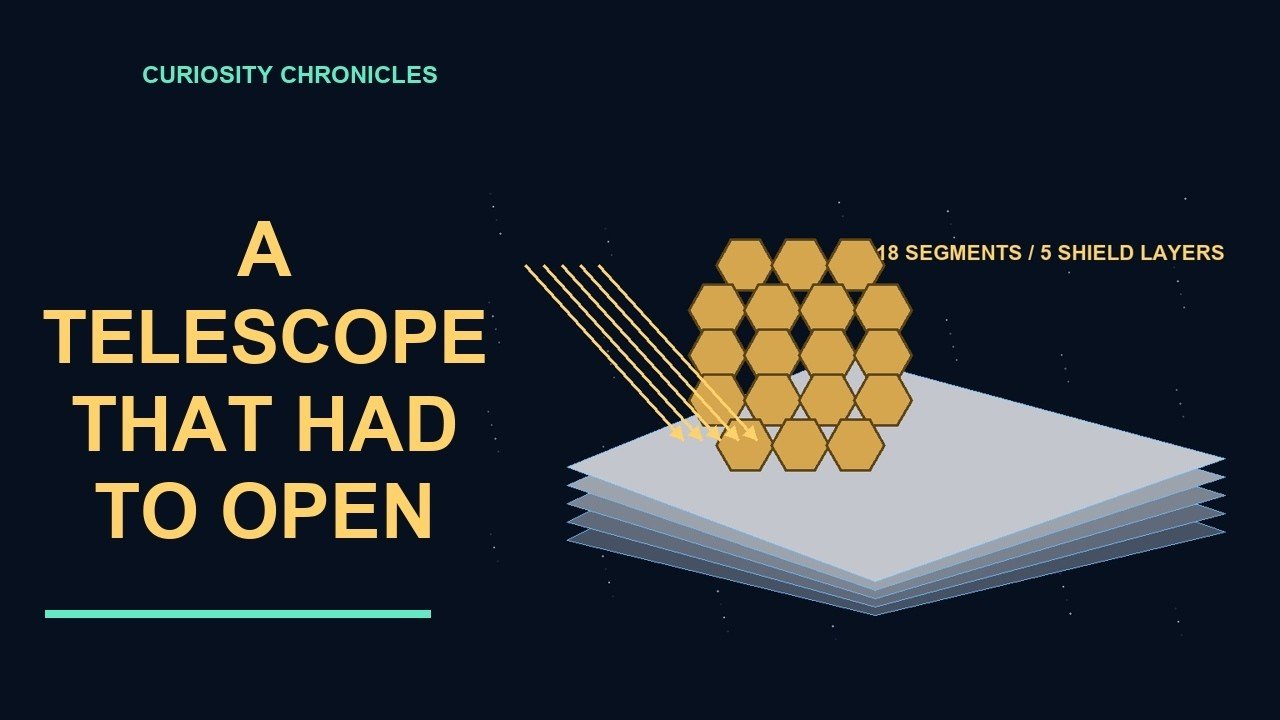
Webb's primary mirror contains 18 hexagonal segments. NASA describes them as beryllium with a very thin gold coating, and the gold is part of the reflecting surface: the telescope is not carrying 18 solid gold slabs. Folded wings allowed a larger assembled mirror than a rigid full-diameter structure would have permitted in the same launch envelope. The engineering question is how many movable surfaces can act like one carefully shaped mirror.
A shield with a different job
The large five-layer sunshield protects the telescope from external heat and helps separate its hot and cold sides. Webb studies infrared light, so its own thermal environment matters to the signals it is trying to detect. The shield is neither a focusing lens nor a parachute; it manages unwanted energy, and NASA describes heat radiating from the spaces between the layers. A large collecting mirror cannot rescue every problem if the instrument produces too much interfering background.
Why deployment has an order
A folded structure cannot always open all its parts at once, because components share space and later steps can depend on earlier clearances. NASA describes Webb's sequence as including sunshield deployment and tensioning, the secondary mirror support, and unfolding the primary mirror wings. The secondary mirror routes collected light into the instruments. The channel illustrates dependency with a four-panel puzzle in which B needs A, C needs B, and D can move any time after A; three orders begin with A: ABCD, ABDC and ADBC. This is not a model of Webb's actual mechanism.
Open is not yet aligned
After deployment the segments still have to be aligned to work as one mirror. NASA explains that actuators adjust segment alignment and shape. Seeing all 18 mirrors is not the same as seeing their beams meet. During alignment, an imperfect image can reveal what needs adjusting, so a test image can count as successful because it exposes an error clearly enough to correct it.
Time, color and trade-offs
Deployment and commissioning took time: cooling, checking instruments and aligning optics could not be replaced by declaring the structure open. Changing an environment and reaching a stable operating condition are different events. The mirror looks golden, but NASA explains that gold helps reflect infrared light, and different instruments are designed around particular wavelengths. A familiar Webb image is therefore a translation of measurements outside ordinary human vision.
Folding adds mechanisms and dependencies, while a rigid structure may not fit the launch constraints at the desired size. A segmented mirror can offer a larger aperture after deployment but requires alignment. Matching panel outlines is not enough; a useful test measures where beams arrive, not whether panels look level. Opening is an event, while readiness is a collection of tested conditions.
Questions this video answers
How many segments does Webb's primary mirror have?
18 hexagonal segments, which NASA describes as beryllium with a very thin gold coating.
Is Webb's mirror made of solid gold?
No. The gold is a thin coating that is part of the reflecting surface, and NASA explains it helps reflect infrared light.
What does the sunshield do?
The five-layer sunshield protects the telescope from external heat and helps separate its hot and cold sides. It is not a focusing lens.
Why was Webb's deployment not the end of the job?
The separate mirror segments still had to be aligned to act as one mirror, and cooling, instrument checks and optical alignment took time.
Why did Webb need to be folded for launch?
The mirror is wider than the space available in the launch vehicle, so folded wings allowed a larger assembled mirror than a rigid structure would have in the same launch envelope.