Ariane 5 VA256 Launches Webb Telescope From Kourou, 25 Dec 2021
The short version
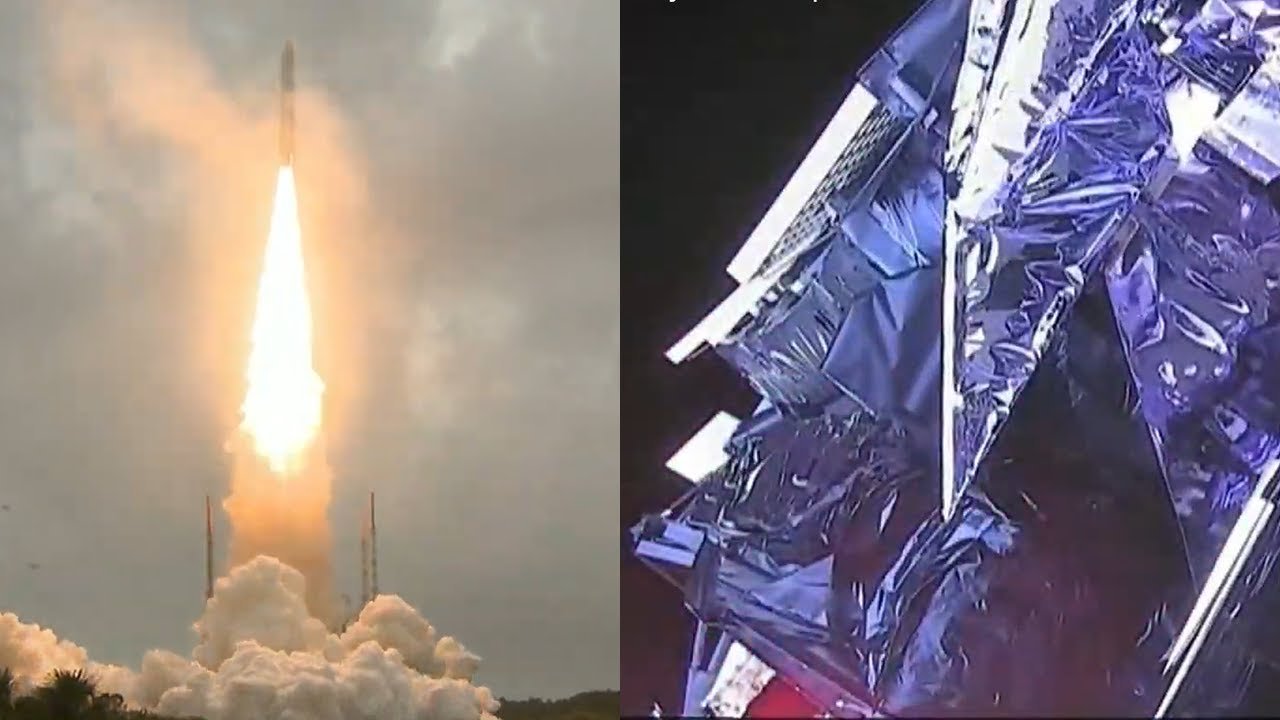
An Ariane 5 (flight VA256) launched the James Webb Space Telescope from ELA 3 at the Guiana Space Centre in Kourou on 25 December 2021 at 12:20 UTC. The coverage follows the ascent with callouts of altitude, speed and trajectory, the separation of the solid rocket boosters and the fairing jettison. It ends with a view from the upper stage camera of the telescope, which is headed for the L2 point.
Full written account
An Ariane 5 launch vehicle, flight VA256, lifted the James Webb Space Telescope from Ariane Launch Complex No. 3 (ELA 3) at the Guiana Space Centre in Kourou, French Guiana, on 25 December 2021 at 12:20 UTC. That was 09:20 local time, 07:20 EST and 13:20 CET. The broadcast calls the flight a voyage back to the birth of the universe.
The telescope
The James Webb Space Telescope, also called JWST or Webb, is a large infrared telescope with a 6.5-meter primary mirror. It is intended as the successor to the Hubble Space Telescope and was funded by three space agencies: NASA, ESA and CSA. The description says it is 100 times more powerful than Hubble and incorporates improved and different technologies to capture 70% more light.
The ascent
Twenty seconds into the flight the pitch program was reported, and soon after the vehicle performance was called nominal. Commentators described the rumble of the Ariane 5 being felt in the control center. At 13 kilometers altitude and 7 kilometers downrange, the rocket was traveling about 0.6 kilometers per second.
The range operations manager reported the trajectory as nominal. On screen, the yellow line of the live trajectory plot lay perfectly over the green line of the pre-launch trajectory.
Booster separation
At one minute 41 seconds, the solid rocket boosters were about 40 seconds from shutdown. Separation is triggered when the computer detects a threshold of reduced acceleration. It came at two minutes 15 seconds, at an altitude of 44 miles, with the Ariane 5 and Webb traveling almost 5,000 miles an hour.
Fairing jettison
About one minute five seconds later came the next critical milestone, fairing jettison. The fairing shields the satellite from high temperatures and high airflow. Once the launcher leaves the atmosphere the satellite no longer needs that protection. Since each kilogram matters for launch performance, the fairing is ejected.
Raphael Chevrier of Arianespace, on the floor of the Jupiter control center, said everything was nominal. He confirmed separation of the two boosters and then the fairing, meaning the rocket had crossed the limits of the atmosphere.
View of the telescope
The coverage then showed the view from the upper stage camera, looking back at the telescope on a delay of about 20 seconds because of how the imagery is processed in the control room. The commentary described the telescope as ready to unfurl its wings and begin its journey to the L2 Lagrange point, about a million miles from Earth.
Questions this video answers
When and where did the James Webb Space Telescope launch?
On 25 December 2021 at 12:20 UTC (09:20 local time), from Ariane Launch Complex No. 3 (ELA 3) at the Guiana Space Centre in Kourou, French Guiana.
Which rocket launched it?
An Ariane 5, flight VA256.
Who funded the telescope?
NASA, ESA and CSA.
Where is the telescope going?
To the L2 Lagrange point, about a million miles from Earth.
Why is the fairing jettisoned?
It protects the satellite from high temperatures and airflow in the atmosphere. Once the launcher leaves the atmosphere it is no longer needed, and every kilogram matters for performance.
Explore related missions
Connected by the topic: Ariane 5