How Webb Works: Infrared Design, Build and Ariane 5 Launch
The short version
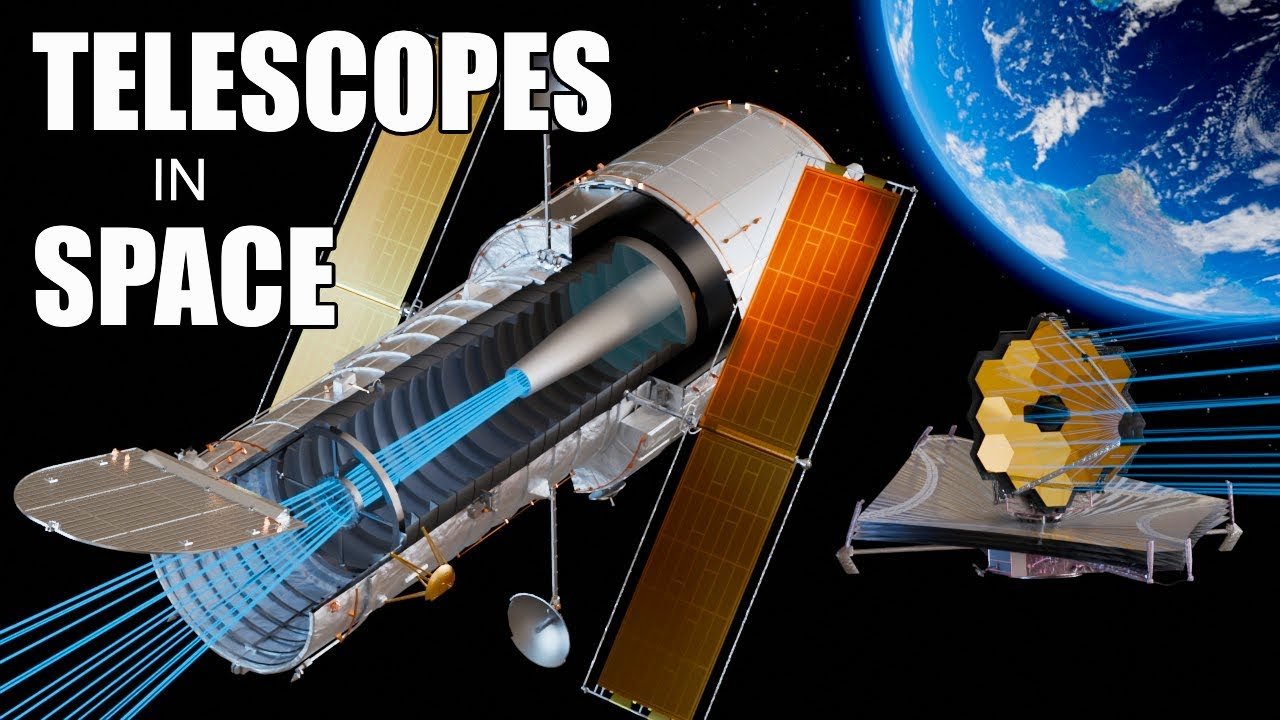
An animated explainer of how space telescopes work, comparing Hubble and the James Webb Space Telescope. It covers Webb's infrared design, sunshield, 18-hexagon mirror, construction across several US sites, launch on an Ariane 5 from French Guiana on Christmas Day 2021, and its deployment on the way to L2. As of December 2024 the video says Webb has operated successfully for almost three years.
Full written account
The James Webb Space Telescope lifted off on an Ariane 5 rocket from the Guiana Space Center in French Guiana on Christmas Day 2021. Its sunshield is about the size of a tennis court, and its five layers are each about as thick as a human hair.
Why infrared
Hubble, launched in April 1990 aboard the space shuttle Discovery, is mostly an optical telescope. Webb is an infrared telescope. Because the universe is expanding, light from sufficiently distant galaxies is stretched, and what was once visible light is shifted into the infrared, known as redshift. Hubble can see some infrared and ultraviolet light, but mostly visible light. Webb was designed to observe these distant objects.
Position and design
Webb is not in Earth orbit. It sits near the L2 Lagrange point, about 1.5 million kilometers away, roughly four times as far as the Moon. A spacecraft near a Lagrange point uses less fuel to stay close to it. L2 is close enough to Earth but far enough that the Sun's light does not interfere. Because the instruments detect infrared, they are sensitive to heat, even their own, so they must stay cold and dark. Pointing at the Sun, even temporarily, could ruin them.
The primary mirror consists of 18 hexagonal segments, which fit together without gaps, and the side portions fold for launch. The segments are made of beryllium and coated with a very thin layer of gold, a good reflector of infrared light. Four scientific instruments sit in the back.
Building Webb
Construction started in 2004, the project was almost canceled in 2011, and after many delays it launched in 2021. NASA, the Canadian Space Agency and the European Space Agency took part. The mirror segments were built at several US sites, with final assembly in Boulder, Colorado, then shipped to Greenbelt, Maryland. A giant robotic arm placed them on the frame, and installing every mirror took about three months. The sunshield layers were started in Huntsville, Alabama, and shipped to Redondo Beach, California.
The combined mirror and instrument section, called OTIS, was flown in a C-5 to the NASA Johnson Space Center in Houston. It spent about 100 days in Chamber A for cryogenic vacuum testing. Final assembly at Northrop Grumman in Redondo Beach happened in August 2019. The complete telescope then traveled by road and cargo ship, via the Panama Canal, to French Guiana in 16 days.
Launch and deployment
About two minutes 21 seconds after liftoff the solid boosters detached. The payload fairing separated at three minutes 26 seconds, main stage separation came at about eight minutes 48 seconds, and the upper stage burned for about 16 minutes. At 25 minutes the upper stage shut down and the telescope separated.
The trip to L2 takes about a month, with about two weeks spent unfolding. The solar array and high gain antenna deployed first. After the tower assembly, aft momentum flap and sunshield, the secondary mirror, the radiator and the primary mirror deployed. Mirror phasing, tiny adjustments to the 18 segments, took many weeks. The first images were released on July 12th, 2022.
Questions this video answers
When did Webb launch?
Christmas Day 2021, on an Ariane 5 from the Guiana Space Center in French Guiana.
Where is Webb located?
Near the L2 Lagrange point, about 1.5 million kilometers from Earth, roughly four times as far as the Moon.
Why does Webb use infrared?
Light from very distant galaxies is redshifted into the infrared, which Hubble mostly cannot see.
Why are the mirrors hexagons?
They can be built in segments and fit together without gaps, and the sides can fold for launch.
When were Webb's first images released?
July 12th, 2022.
Explore related missions
Connected by the topic: Ariane 5