NASA’s SpaceX Crew-12 Re-Entry & Splashdown
The short version
NASA's live coverage follows Dragon Freedom carrying Crew-12 from deorbit burn through re-entry to splashdown off Los Angeles at 8:34 a.m. Pacific time. The crew completed a 237-day mission, 235 days of it docked to the International Space Station. Coverage continues through recovery on the ship Shannon and the crew's exit from the capsule.
Full written account
Dragon Freedom slowed from about 17,500 miles per hour to roughly 16 miles per hour at splashdown, off the coast of Los Angeles, California, at 8:34 a.m. Pacific time (11:34 a.m. Eastern) on Thursday, October 8. Aboard were NASA astronauts Jessica Meir and Jack Hathaway, ESA astronaut Sophie Adenot and Roscosmos cosmonaut Andrey Fedyaev, ending the 237-day Crew 12 mission. NASA's live coverage followed the return from the de-orbit burn to the crew's exit from the capsule. All four crew members came out of the spacecraft, and the coverage described the re-entry and splashdown as going smoothly.
From undocking to the de-orbit burn
Dragon Freedom undocked from the International Space Station at 8:05 a.m. Eastern (5:05 a.m. Pacific) on Wednesday, October 7. After exiting the approach ellipsoid, an imaginary ellipsoid around the station that governs arriving and departing vehicles, control passed from joint NASA and SpaceX operations to the SpaceX team, which stayed in charge through splashdown. The crew took off their suits after leaving the station, then put them back on and did leak checks before re-entry. The whole trip home took about 27 and a half hours.
The de-orbit burn began at 7:46 a.m. Pacific and lasted about nine and a half minutes. It used the four Draco thrusters on the forward bulkhead and was executed at the apogee, the highest point of Dragon's orbit. It was the last time those four thrusters were to fire. After the burn, SpaceX mission control called "performance nominal" and trunk separation was initiated. The nose cone, which had been open since the crew reached orbit in February, was closed for entry.
The trunk is the unpressurized lower section, and it was jettisoned to expose the heat shield. Dragon had to separate its claw mechanism first, which ended the data, power and fluid connections to the trunk. With the trunk gone, no new power could be generated, but Dragon had enough stored battery power for the return.
Re-entry and parachutes
Entry began around 8:22 a.m. Pacific. A planned communications blackout of about six to seven minutes, caused by plasma forming around the spacecraft, was predicted for 1521 to 1527 Zulu. During the blackout there is no telemetry, commanding or voice communication, and Dragon flew itself. The temperature around the vehicle was given as up to about 3,500 degrees Fahrenheit, and the cabin view showed a reddish glow from the plasma. The crew faced a peak load of roughly 3 to 5 G.
Before re-entry the crew's SpaceX crew operations resource engineer, Mary Cooper, asked them to verify that tablets were secure, visors down and restraints tightened no later than 150 km. The crew confirmed, and reported four visors down. Dragon's heat shield is made of PICA 3.0, phenolic impregnated carbon ablator, while the rest of the spacecraft uses SpaceX's proprietary thermal protection material.
Contact returned with a call of "loud and clear". The sequence of speeds and altitudes was:
- Drogue parachutes: deployed at about 350 miles per hour and about 18,000 feet. Just before, the seats rotated automatically to about 26 degrees. The crew reported two healthy drogues.
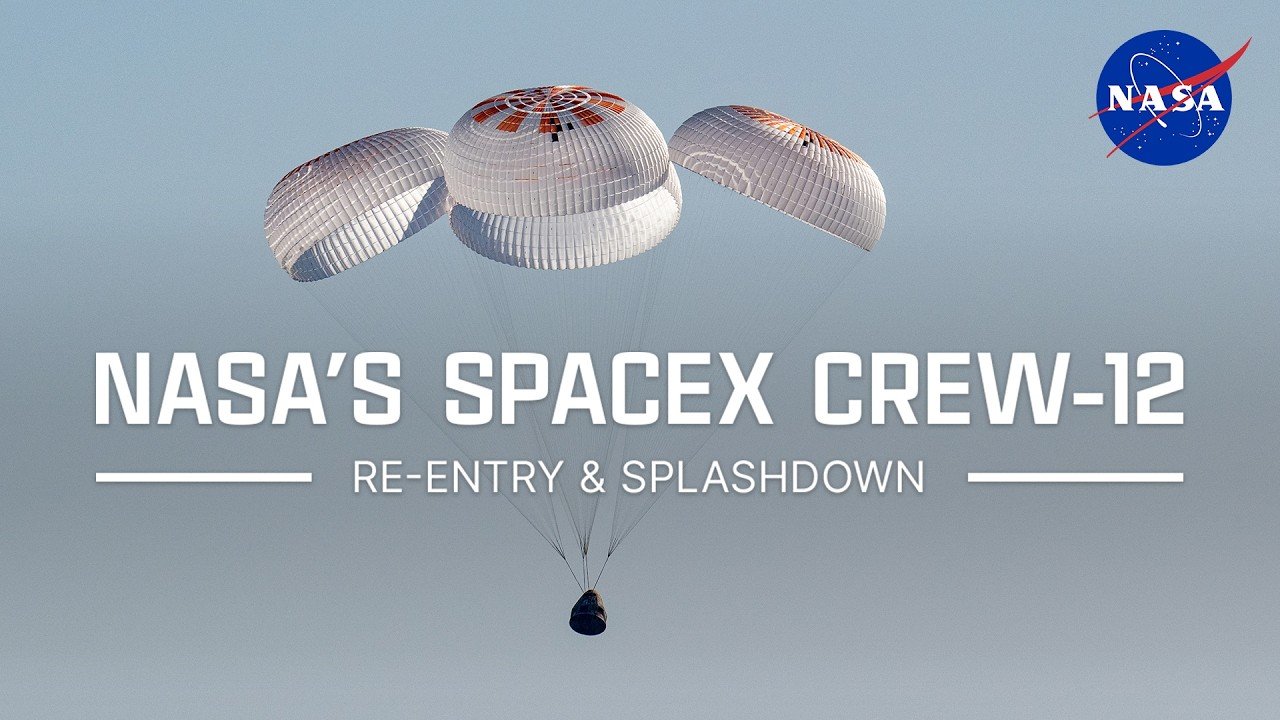
- Main parachutes: deployed at about 119 miles per hour and about 6,500 feet.
- Splashdown: about 16 miles per hour.
The coverage noted that without drogues the main parachutes would have to be made three times stronger and heavier. After splashdown the crew reported four main parachutes and said they were "stable one", the nominal landing configuration with the nose cone pointing up.
Recovery on the ship Shannon
The recovery vessel Shannon had been staged about three nautical miles away, with two fast boats and a team member on a jet ski. The fast boats went first for hypergolic vapor sweeps and checks, then rigged the capsule for lifting. Weather was calm, with waves of about four feet and winds of about seven knots. Rigging was in progress about 25 minutes before the lift, and the crew held a private medical conference with the SpaceX flight surgeon.
Shannon's hydraulic lift raised Dragon out of the water and seated it in a nest on deck, after which it was translated across the deck to the egress platform and washed of ocean water, since salt water can erode things quickly. A SpaceX doctor entered first and checked on the crew. Another team member photographed the hatch seal, and a protective device was installed to avoid damaging the sealing surface. The astronauts exited through the side hatch, assisted out one by one: Meir first, then Hathaway, Adenot and Fedyaev. The coverage said the crew would go by helicopter to land and then by plane to Houston to begin about 45 days of reconditioning.
The crew and the mission in numbers
Crew 12 spent 237 days in space, 235 of them docked to the station. The crew orbited Earth 3,792 times and travelled more than 100 million statute miles. They contributed to more than 250 investigations and spent more than a thousand hours on science. One investigation was IV Generation Mini, a compact system meant to produce intravenous saline from drinkable water.
- Jessica Meir, commander: 442 days in space over two flights, the 10th most by a NASA astronaut. She did four spacewalks totaling 27 hours 38 minutes on this mission, and seven spacewalks totaling 49 hours 22 minutes in her career.
- Jack Hathaway, pilot: his first flight, 237 days.
- Sophie Adenot: her first flight, 237 days, the seventh most by an ESA astronaut, and three spacewalks totaling 19 hours 42 minutes.
- Andrey Fedyaev: his second mission after Crew 6, 423 days in space in total, and the first Russian cosmonaut to fly twice inside Dragon.
Dragon Freedom
Dragon Freedom first launched on April 27, 2022 on Crew 4. It was later used for Axiom Mission 2 in May 2023, Axiom Mission 3 in January 2024 and Crew 9. The name honors Freedom 7, Alan Shepard's Mercury capsule. Crew 4 astronauts chose it. Jessica Watkins, who flew on Crew 4, launched again the previous week on Crew 13 aboard Dragon Grace.
Crew 13 launched and docked on Thursday, October 1, in about seven and a half hours, so the station held 11 people during handover and returned to seven after Crew 12 left. The next SpaceX cargo mission, the 35th commercial resupply services flight, was targeted for Tuesday, October 13, carrying more than 6,300 pounds of supplies and the final two International Space Station rollout solar arrays.
Questions this video answers
When and where did Crew-12 splash down?
8:34 a.m. Pacific time (11:34 a.m. Eastern), off the coast of Los Angeles, California.
Who was on Crew-12?
Jessica Meir (commander), Jack Hathaway (pilot), ESA astronaut Sophie Adenot and Roscosmos cosmonaut Andrey Fedyaev.
How long was the Crew-12 mission?
The mission lasted 237 days, 235 of them docked to the International Space Station, with 3,792 orbits of Earth.
Which spacecraft brought the crew home?
Dragon Freedom, which first flew on Crew 4 and also supported Axiom missions 2 and 3 and Crew 9.
How long did the trip home take?
About 27 and a half hours passed between undocking and splashdown.
How fast was Dragon going at splashdown?
About 16 miles per hour at splashdown, after drogue deployment at about 350 mph and main chute deployment at about 119 mph.