Voyager 1 and 2: Launch, Grand Tour and Crossing into Interstellar
The short version
A documentary on NASA's twin Voyager probes, from the 1970s planetary alignment and the 1977 launches through the encounters with Jupiter, Saturn, Uranus and Neptune. It covers the Golden Record, the crossing of the heliopause by Voyager 1 in 2012 and Voyager 2 in 2018, and the dwindling power that will eventually silence them.
Full written account
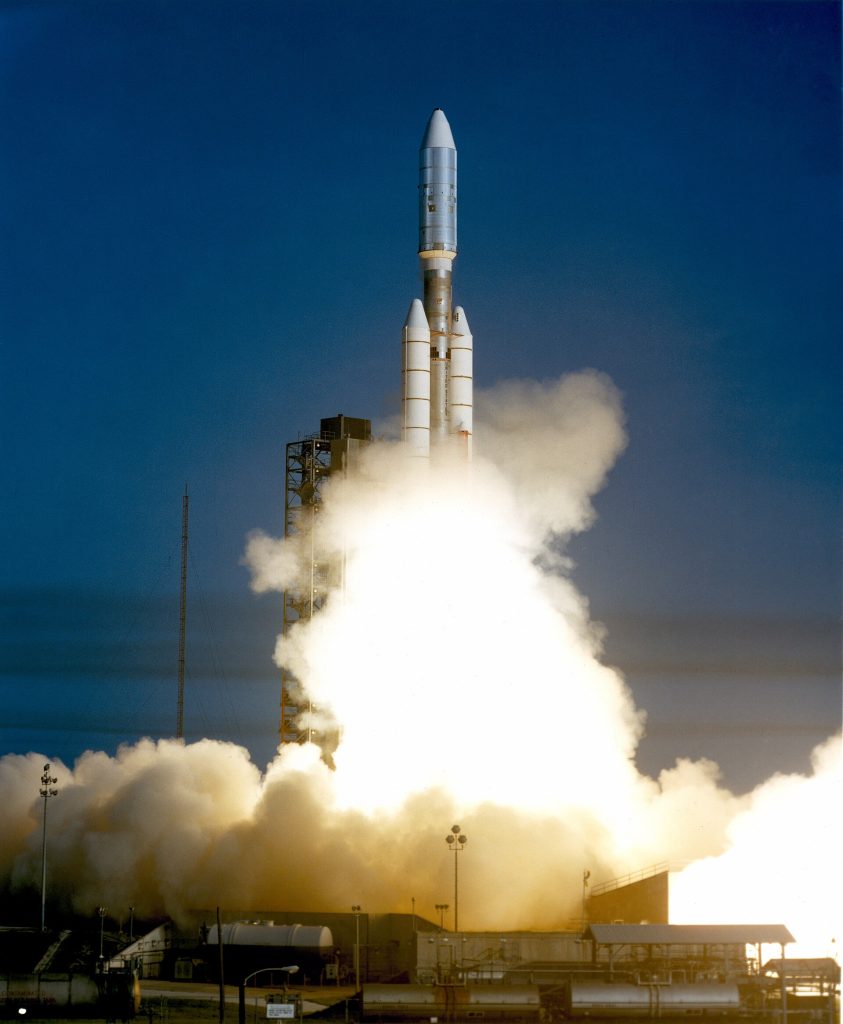
Two probes, Voyager 2 and Voyager 1, left Cape Canaveral, Florida, on Titan 3E Centaur rockets in late summer 1977. Voyager 2 went first, on August 20, and Voyager 1 followed on September 5. Voyager 1's Centaur upper stage reached the correct trajectory with only 3.4 seconds of usable propellant left. In 2012 Voyager 1 became the first human-made object to cross into interstellar space.
A rare alignment and a cancelled tour
In 1965 Gary Flandro, a young aerospace engineer at the Jet Propulsion Laboratory (JPL), was studying the orbital mechanics of the outer planets. He found that in the late 1970s Jupiter, Saturn, Uranus and Neptune would line up in a sweeping arc, something that happens only once every 176 years. A spacecraft using gravity assists at each planet could cut the flight time to Neptune from 30 years to 12. Flandro called the trajectory the Grand Tour.
NASA first proposed a multi-billion-dollar fleet of heavily armored probes, but the Nixon administration balked at the cost. In 1972 the Grand Tour was cancelled and replaced by a cheaper mission, Mariner Jupiter Saturn 1977 (MJS77), funded only for two probes flying past Jupiter and Saturn. JPL engineers, aware the alignment was too valuable to waste, quietly overengineered every component so the craft could survive the longer trip. Shortly before launch NASA renamed the project Voyager.
Power came from radioisotope thermoelectric generators fed by plutonium-238, since solar panels are nearly useless in the outer solar system. Each probe carried three dual-redundant computer systems with a combined memory of 68 kilobytes.
Two difficult launches
Voyager 2 launched first because its slower trajectory preserved the option of continuing to Uranus and Neptune. Voyager 1 was on a faster path, prioritizing a flyby of Saturn's moon Titan, and would overtake its twin in the asteroid belt and reach Jupiter four months earlier.
- August 20, 1977: Launch vibrations confused Voyager 2's gyroscopes. Its safety protocols shut down the high-gain antenna, switched to a low-power backup radio and fired thrusters. Engineers spent several days sending commands through the Deep Space Network, then persuaded the computer to ignore the faulty gyroscope readings.
- September 5, 1977: A minute leak in a propellant line left the Titan booster underperforming. The Centaur had to burn much longer than planned to make up the shortfall and shut down with 3.4 seconds of usable propellant remaining.
The planetary encounters, 1979 to 1989
Voyager 1 made its closest approach to Jupiter in March 1979, and Voyager 2 followed in July. They returned the first high-resolution time-lapse movies of the Great Red Spot. JPL navigation engineer Linda Morabito spotted an umbrella-shaped anomaly at the edge of Io, a volcanic plume, which showed that moons could be geologically active. Europa's smooth, fractured ice suggested a shell floating on liquid water. Voyager 1 also imaged a faint ring of dust around Jupiter.
Voyager 1 reached Saturn in November 1980 and Voyager 2 in August 1981. The rings resolved into thousands of ringlets, and shepherd moons were found, including Prometheus and Pandora on either side of the F ring. Voyager 1's path took it within 4,000 miles of Titan, whose atmosphere is thicker than Earth's. To make that flyby it used Saturn's gravity to swing out of the ecliptic plane, which ended its planetary tour.
Voyager 2 reached Uranus in January 1986, in sunlight roughly 400 times weaker than at Earth. NASA reprogrammed its computers during the cruise from Saturn, adding new image processing and data compression and teaching it to rotate so the cameras stayed on target. It found Uranus tipped at 98 degrees, a magnetic field tilted 60 degrees from the rotation axis and off-center, 10 new moons and dark narrow rings. Miranda showed fault canyons and the cliff Verona Rupes.
At Neptune in August 1989, Voyager 2 recorded winds of up to 1,200 mph, a Great Dark Spot the size of Earth, and, at Triton, active geysers of dark nitrogen. Triton orbits backwards, implying it was captured, and its surface temperature was -391°F. Voyager 2 passed about 2,500 miles above it.
The Golden Record
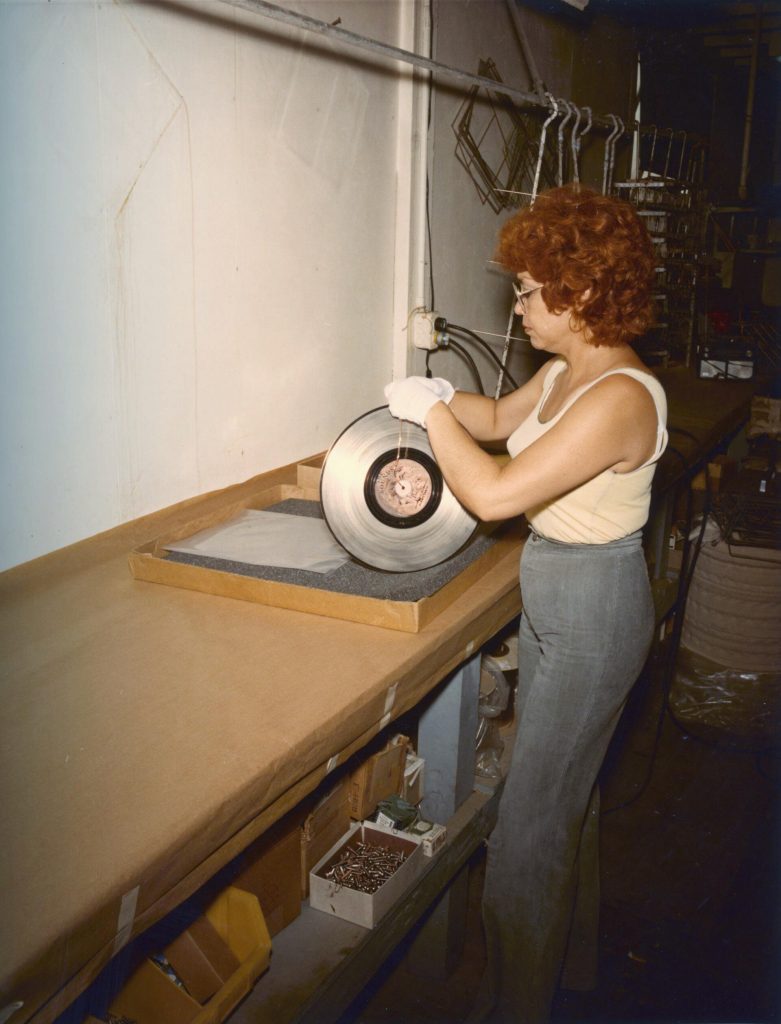
Bolted to each spacecraft is a 12-inch gold-plated copper disc inscribed "To the makers of music, all worlds, all times." NASA turned to Carl Sagan, whose committee included Frank Drake, Ann Druyan, Timothy Ferris, Jon Lomberg and Linda Salzman Sagan, and gave them roughly six months. They chose a phonograph record over magnetic tape because the copper disc could survive for a billion years or more.
The aluminum cover is an instruction manual. It shows a stylus and phonograph, and binary arithmetic based on the hydrogen atom's transition time that sets the speed at 33 and 1/3 revolutions per minute. It also carries a pulsar map of 14 lines designed by Drake and a patch of uranium-238 that serves as a clock.
The record holds 115 images encoded as analog audio signals, chosen by a team led by Lomberg. War, poverty, disease and nuclear explosions were deliberately left out. It also holds greetings in 55 languages, including the English line "Hello from the children of planet Earth." There is a 12-minute montage of the Sounds of Earth produced by Druyan, and nearly 90 minutes of music curated with help from ethnomusicologist Alan Lomax. The music ranges from Bach, Beethoven and Mozart to Chuck Berry's "Johnny B. Goode" and Blind Willie Johnson's 1927 track. Druyan's brain waves, heart rate and eye movements, recorded during an electroencephalogram, were compressed into a one-minute file.
Crossing into interstellar space
In 1990, at Sagan's urging, Voyager 1 turned its cameras back from 3.7 billion miles away and took a 60-frame mosaic that includes the Pale Blue Dot image of Earth. Soon after, the imaging systems on both probes were powered down to save power, and the Voyager Interstellar Mission began.
Voyager 1 crossed the termination shock in December 2004 at 94 astronomical units. Voyager 2 crossed it in 2007. Beyond lies the heliosheath and then the heliopause, where the solar wind's pressure is matched by the interstellar medium's.
In mid-2012 Voyager 1 entered a region dubbed the magnetic highway, where cosmic rays surged but the magnetic field still aligned with the Sun's. On August 25, 2012, low-energy particles from the Sun fell to near zero while galactic cosmic rays hit record highs. The team, led by project scientist Ed Stone, held off announcing because the field direction had not shifted as predicted. Voyager 1's plasma science instrument had failed in 1980, so they waited for a coronal mass ejection from March 2012. It reached the probe in April 2013, 13 months later, and made the plasma ring. The pitch indicated a plasma density 40 times that of the outer heliosphere, so Voyager 1 was judged to have crossed the heliopause on August 25, 2012.
Voyager 2, with a working plasma instrument, crossed at about 119 astronomical units on November 5, 2018, in less than a day. Comparing readings inside and outside, scientists calculated that the heliosphere blocks roughly 70% to 75% of high-energy cosmic radiation.
Keeping them alive
Plutonium-238 has a half-life of 87.7 years, and each Voyager loses about 4 watts of power a year. JPL has switched off the cameras, the planetary radio science instruments and the ultraviolet spectrometers, and more recently internal heaters. Instruments designed for no colder than -30°F still work at far lower temperatures.
Voyager 1 is over 15.9 billion miles away, and a signal takes more than 22 hours to reach Earth. It arrives roughly 20 billion times weaker than the power needed to run a digital wristwatch, and is caught by the 70-meter antennas of the Deep Space Network in California, Spain and Australia. In 2017, with Voyager 1's attitude control thrusters degrading, engineers fired backup trajectory correction thrusters unused since the 1980 Saturn flyby. They ignited after 37 years and extended the probe's life by several years.
The power is expected to fall below what a single instrument or the transmitter needs in the late 2020s or early 2030s. After that, Voyager 1, at about 38,000 mph, is projected to pass within 1.6 light years of the red dwarf Gliese 445 in about 40,000 years. Voyager 2, at about 35,000 mph, should pass within 1.7 light years of Ross 248 in about 40,000 years, and within 4.3 light years of Sirius in roughly 296,000 years.
Questions this video answers
When did the Voyagers launch?
Voyager 2 launched on August 20, 1977, and Voyager 1 on September 5, 1977, both on Titan 3E Centaur rockets from Kennedy Space Center.
When did the Voyagers reach interstellar space?
Voyager 1 recorded the change on August 25, 2012; Voyager 2 crossed the heliopause on November 5, 2018 at roughly 119 astronomical units from the Sun.
Which planets did each Voyager visit?
Voyager 1 flew past Jupiter and Saturn (Titan included). Voyager 2 flew past Jupiter, Saturn, Uranus and Neptune, the last encounter being August 1989.
What is the Golden Record?
A 12-inch gold-plated copper disc on each probe, carrying 115 images, greetings in 55 languages, the Sounds of Earth and nearly 90 minutes of music.
How are the Voyagers powered?
Radioisotope thermoelectric generators using plutonium 238. The probes lose approximately 4 watts of electrical power each year.
Explore related missions
Connected by the topic: Voyager and Grand Tour probes