Voyager 1 and 2: Planetary Tour to One Light-Day From Earth
The short version
Voyager 1 launched on September 5, 1977, after its twin Voyager 2, and flew past Jupiter and Saturn before heading out of the solar system. It crossed the heliopause on August 25, 2012, and NASA projects it will reach one light-day from Earth on November 18, 2026. The documentary also covers Voyager 2's planetary flybys, the Pale Blue Dot image, the Golden Record and the work of keeping both probes operating.
Full written account
Voyager 1, launched on September 5, 1977, is expected by NASA to reach a distance of one light-day from Earth on November 18, 2026 at 2:16 in the morning Pacific time, about 16.1 billion miles away. At that point a radio message moving at the speed of light takes a full day to arrive. It will have taken 49 years, two months and 11 days.
An alignment and a smaller plan
In the late 1970s and into the 80s, Jupiter, Saturn, Uranus and Neptune lined up in an arrangement NASA says comes around only about once every 175 years. It allowed gravity assists, where a planet bends a spacecraft's path and increases its speed. NASA's fact sheet says this cut the flight time to Neptune from 30 years to 12.
Planners had dreamed of a grand tour using four complex spacecraft, but NASA cancelled that plan in January 1972, largely because of expected cost. Two spacecraft were approved instead, based on the older Mariner probes and for a while called Mariner 11 and Mariner 12. They were named Voyager in March 1977, and each was built to last 5 years.
The spacecraft and the launches
The two Voyagers were identical, each weighing about 720 kg and carrying instruments for 10 experiments. Because sunlight would be too weak out there, each carried three generators turning the heat of decaying plutonium into electricity, producing about 158 watts at launch. More than 10,000 possible trajectories were studied before two were chosen.
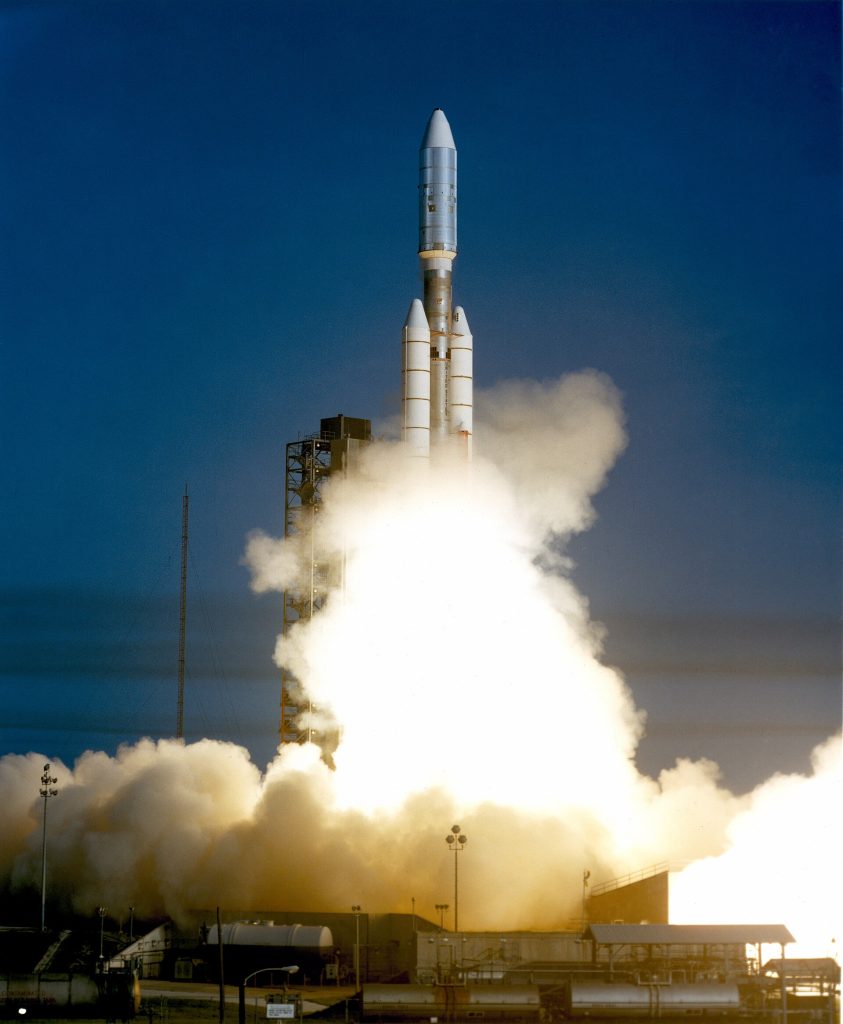
Voyager 2 launched first, on August 20, 1977, from Cape Canaveral, Florida. Voyager 1 followed on September 5 on a faster, shorter path and overtook its twin on December 15, which is why it carries the number one.
The planetary encounters
- Jupiter: Voyager 1's closest approach came on March 5, 1979, and Voyager 2's on July 9. The two found a faint ring and new small moons. On Io they watched nine volcanoes erupting, with plumes rising more than 300 km; NASA calls it the greatest unexpected discovery at Jupiter. Scientists think tides cause the heating.
- Saturn: Voyager 1 arrived on November 12, 1980 and Voyager 2 on August 25, 1981. Voyager 1's close pass of Titan, wrapped in a thick nitrogen-rich haze, bent its path up and out of the plane of the planets, so it had no more planets to visit.
- Uranus: Voyager 2 reached it on January 24, 1986, and is still the only spacecraft to visit. It found a tilted, offset magnetic field and 10 new moons.
- Neptune: On August 25, 1989, Voyager 2 passed about 3,000 miles above the cloud tops. It found the Great Dark Spot, measured the strongest winds on any planet, found six new moons and saw nitrogen geysers on Triton, whose surface was about -391° F.
A last look back
On February 14, 1990, about 3.7 billion miles from the Sun, Voyager 1 took a series of 60 images, the first family portrait of the solar system. Earth was about one pixel in size. Thirty-four minutes later the cameras were powered off for good, the last of about 67,000 images taken by the two Voyagers.
Each Voyager also carries a gold-plated copper disc about 30 cm across with greetings in 55 languages, 90 minutes of music and 115 images. Voyager 1 is drifting toward the star Gliese 445, which NASA estimates it will pass within about 1.7 light-years in about 40,000 years.
Leaving the Sun's bubble
On February 17, 1998, Voyager 1 passed Pioneer 10 to become the most distant human-made object. It crossed the heliopause on August 25, 2012. Voyager 2 followed on November 5, 2018, with a working instrument measuring the solar wind directly. Per NASA, they remain the only two spacecraft to operate outside the heliosphere.
Keeping them alive
In July 2023 a planned series of commands turned Voyager 2's antenna 2° away from Earth, cutting communication. Engineers used a dish near Canberra, Australia to send what NASA called an interstellar shout, and full communication returned on August 4.
That November Voyager 1 began returning unreadable data. Engineers traced it to a failed memory chip in one of its three computers, with about 3% of that memory corrupted. They rewrote code and moved it elsewhere in memory. Commands went out on April 18, 2024, and the answer arrived on April 20.
Each probe loses about four watts a year. In April 2026 Voyager 1's low energy charged particle instrument was turned off, leaving two science instruments on Voyager 1 and three on Voyager 2. A procedure nicknamed the Big Bang swapped three devices on each craft for lower-power alternatives, with Voyager 1 following in early September 2026. On October 18 and 19 the Deep Space Network heard nothing from Voyager 1; its signal returned on October 20 after a group of thrusters went offline and backups switched on automatically. As of October 29 the cause was still under investigation.
Questions this video answers
When did Voyager 1 launch?
Voyager 1 launched on September 5, 1977, about two weeks after Voyager 2, which launched on August 20, 1977 from Cape Canaveral, Florida.
Why is Voyager 1 numbered first if it launched second?
It was on a faster, shorter path and overtook Voyager 2 on December 15.
When did Voyager 1 leave the heliosphere?
Voyager 1 crossed the heliopause on August 25, 2012, the first spacecraft to leave the Sun's bubble. Voyager 2 followed on November 5, 2018.
What is the one light-day milestone?
NASA projects that on November 18, 2026 Voyager 1 will be about 16.1 billion miles from Earth, so a radio message takes a full day to arrive.
What went wrong with Voyager 1 in 2023?
It sent unreadable data starting in November 2023. Engineers traced it to a failed memory chip affecting about 3% of one computer's memory and moved rewritten code elsewhere. It reported on its own health again on April 20, 2024.
Explore related missions
Connected by the topic: Voyager and Grand Tour probes