Webb and Rubin Compared: Deep Fields Versus the Whole Southern Sky
The short version
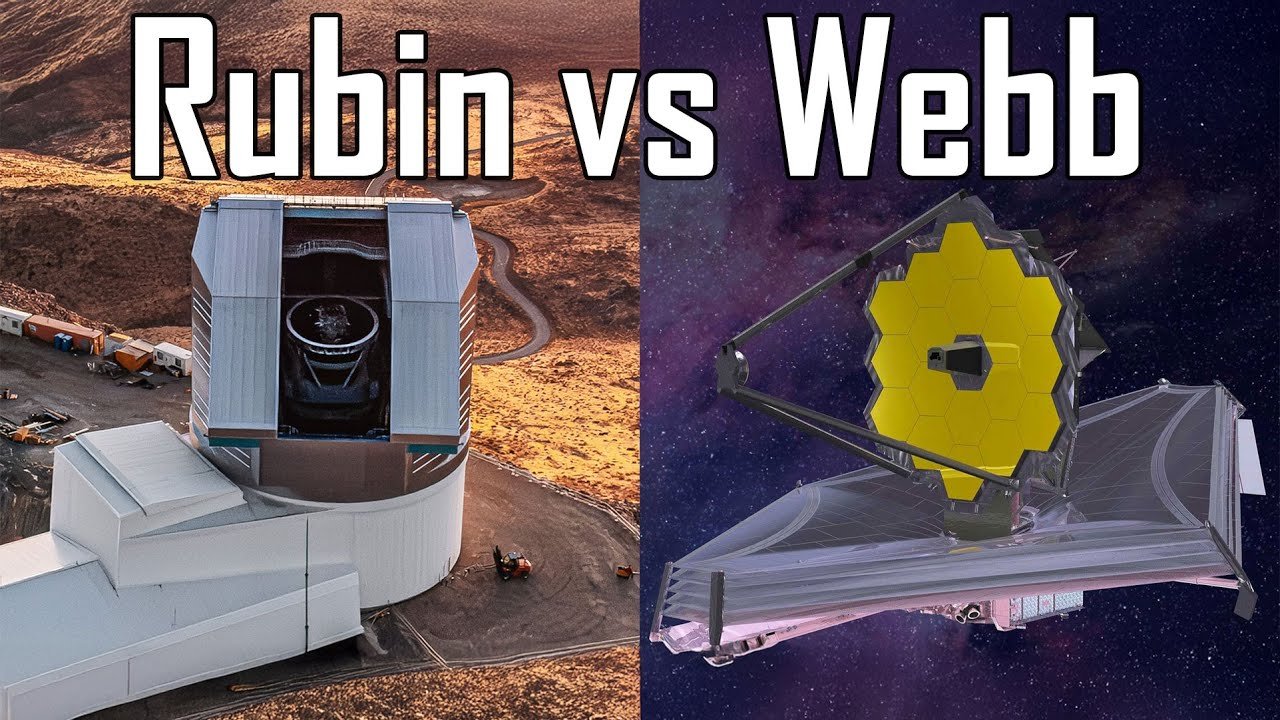
A comparison of the James Webb Space Telescope and the Vera Rubin Observatory, which released its first images the week the video was made. Webb stares at tiny patches of sky in infrared from near the Sun-Earth L2 point, while Rubin images the whole southern sky from Chile every few days with a 3.2-gigapixel camera. The video covers their sensors, data volumes, alert systems and how researchers get access to each.
Full written account
The Vera Rubin Observatory released its first images in the week this comparison was made, and in its first 10 hours of observing the night sky it had already found more than 2,000 new asteroids, including a few near-Earth objects. It sits alongside the James Webb Space Telescope as a second way of looking at the same sky, but the two instruments are built for opposite jobs: Webb looks deep at very small patches, Rubin looks wide and often.
Webb: deep, cold and infrared
Webb was launched to stand on the shoulders of the Hubble Space Telescope, seeing fainter objects further back in time. The light it hunts has travelled so far that it has been redshifted from visible light into the infrared, which we feel as heat. To detect it, Webb's camera sensors must be as cold as possible, working at just 7 degrees Kelvin above absolute zero.
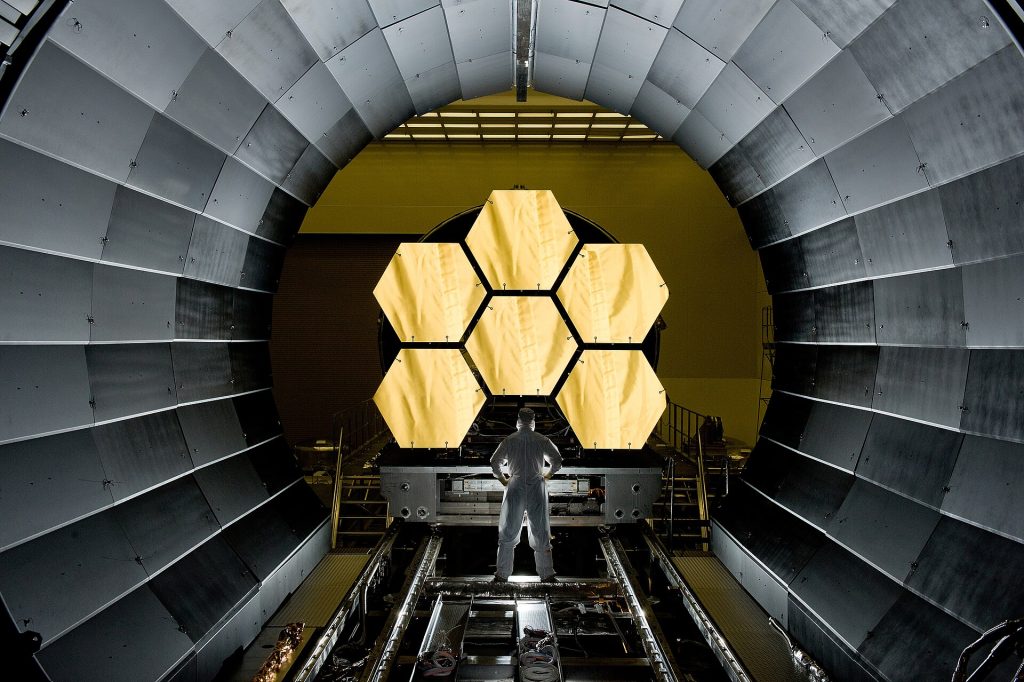
That ruled out a low Earth orbit like Hubble's. Infrared heat from Earth, and the constant swing between full sun and full shade, would swamp the signals from the edge of the visible universe. Webb instead sits in a special orbit near the Sun-Earth Lagrange point L2, approximately 1.5 million km from Earth on the far side from the Sun, where gravitational forces and its orbital motion balance. A large multi-layer heat shield protects it from the Sun, and cryogenic cooling equipment brings it to its target temperature.
Its first deep field image, taken with a near-infrared camera, covered an area of sky about the size of a grain of sand held at arm's length. About 600 such images would fit in the area of a thumbnail at arm's length. The composite combined different wavelengths with a total exposure time of 12.5 hours, and showed thousands of galaxies, including the faintest objects observed in the infrared at the time.
Rubin: the whole southern sky
Surveying the entire sky with Webb-sized images, but with much shorter exposures, would need over 25 million images, and one image a minute would take over 47 years. Rubin is designed to image the entire southern night sky in just a few days, from the ground, looking through the atmosphere from about 2,672 m in the Kwimbo region of northern Chile.
Its 3.2-gigapixel camera compares with 42 megapixels on Webb, which is 76 times larger, and takes an image every 30 seconds. The main sensor panel is made of 189 CCD detectors of 16 megapixels each, cooled to -100° C to reduce noise. The sensor is monochromatic, and six filters build up the colour images. The primary mirror is 8.4 m across, and the first corrector lens, at 1.5 m in diameter, is the largest of its type ever built. Because there is only a 5-second gap between images, the telescope does not actively compensate for atmospheric effects.
What continuous imaging is for
Repeated imaging lets astronomers see the universe in motion. Supernovae, gamma-ray bursts and gravitational wave counterparts are short-lived, and over a 10-year survey, now possibly 12 years, Rubin can catch them within minutes or hours and keep a record from before and after. It is also expected to be the most effective tool for finding and tracking potentially hazardous asteroids.
The observatory carries the name of Vera Rubin, the first person to work out that the outer edges of galaxies move faster than their mass should allow, which pointed to hidden mass now known as dark matter. By tracking the movements of stars and galaxies, Rubin should help map where that dark matter might be, building a four-dimensional map of three space dimensions plus time. The catalogue is expected to cover 6 million solar system objects and approximately 37 billion sky objects, including 20 billion galaxies and 17 billion stars.
Handling the data
Rubin generates about 30 terabytes a day, too much for humans to process by hand. If an object changes in brightness or position relative to an archived image, an alert is created for inspection, within 60 seconds of the observation. Aircraft, satellites and constellations like Starlink are detected and removed automatically so they are not labelled as near-Earth asteroids or meteorites; a 30-pixel area around each is cut out, and the gap can be filled from other images.
Rubin also captures secret military objects in orbit. A classified US government facility in California removes any known secret spacecraft for 3 days before unredacted versions are released to the public.
Access
Webb researchers must put in requests, sometimes years ahead, and only the most worthy are acted on. Rubin spends 90% of its time on the main survey and 10% on special projects, and most researchers will work from its data archive. Webb will continue with detailed images from the beginning of the universe, research into exoplanet atmospheres, and looking through intergalactic dust in the infrared.
Questions this video answers
Why does Webb orbit near the Sun-Earth L2 point?
Its camera sensors must be as cold as possible, at just 7 degrees Kelvin above absolute zero. Infrared heat from Earth and the heating and cooling of a low Earth orbit would swamp the faint infrared signals.
How far is Sun-Earth L2?
Approximately 1.5 million km (a million miles) from Earth, on the far side of Earth from the Sun.
Where is the Vera Rubin Observatory?
In the Kwimbo region of northern Chile, at an altitude of about 2,672 m.
How big is Rubin's camera compared with Webb's?
Rubin's camera has 3.2 gigapixels against 42 megapixels for Webb, which the video says is 76 times larger. Rubin takes an image every 30 seconds.
What did Rubin find in its first hours of observing?
Within just 10 hours of observing the night sky, it had already found more than 2,000 new asteroids, including a few near-Earth objects.
How is access to the two telescopes different?
Researchers must request Webb time, sometimes years in advance. Rubin spends 90% of its time on the main survey and 10% on special projects, and most researchers will use its data archive.
Explore related missions
Connected by the topic: Earth-Sun L2