Webb Space Telescope: 344 Failure Points and the Deepest Images
The short version
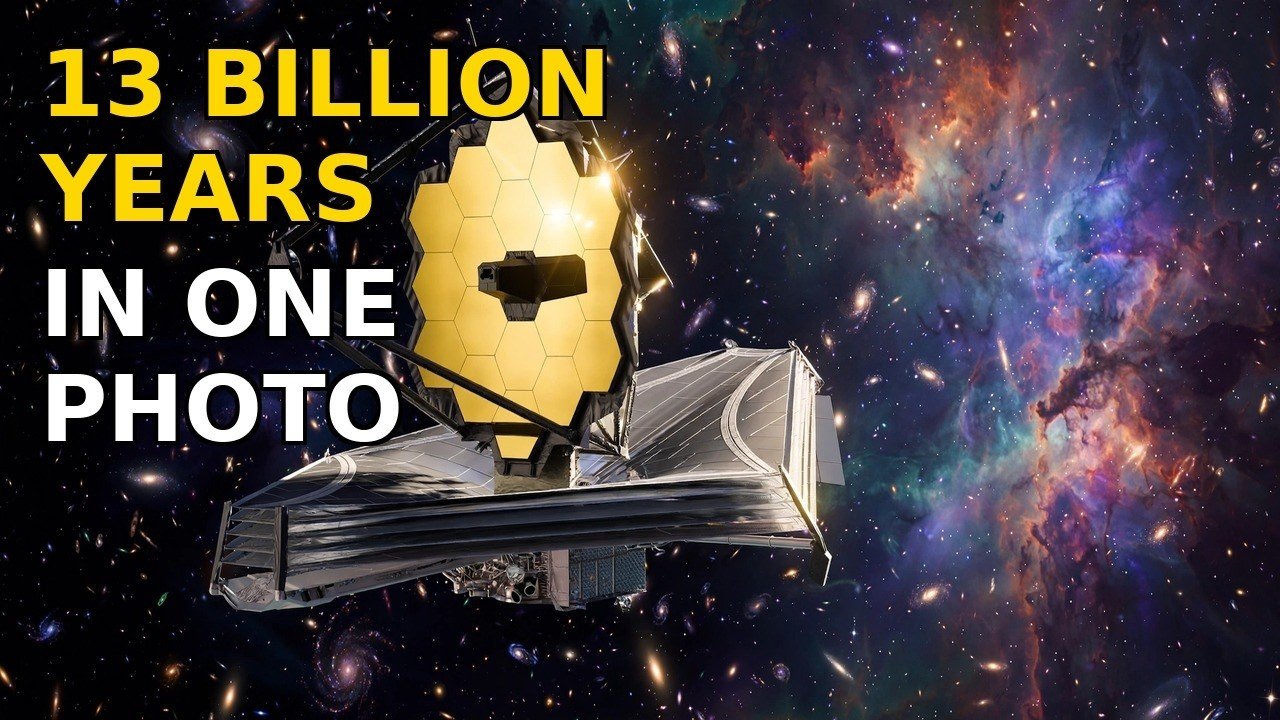
A documentary on the James Webb Space Telescope, from its troubled development to its Ariane 5 launch on Christmas Day 2021 and the 29 days of deployment with 344 single-point failures. It follows the mirror alignment, the first deep field of SMACS 0723 released in July 2022, and later findings on early galaxies and exoplanet atmospheres. NASA footage is used throughout, and the unfolding is shown with NASA's animation.
Full written account
On July 11, 2022, the president of the United States held up a single image in a White House room: a patch of sky the size of a grain of sand held at arm's length, crowded with thousands of galaxies, some shining from more than 13 billion years ago. The telescope that took it, the James Webb Space Telescope, had 344 single-point failures that could each have ended the mission, and it was parked 1.5 million kilometers from Earth, out of reach of any repair.
A project in crisis
The idea began in 1996, when astronomers asked what the first stars looked like. Their light has been stretched into infrared by the expanding universe, which Hubble could not see. The first estimate was 500 million dollars and a 2007 launch. Webb missed that date by 14 years, and the cost passed 10 billion dollars. In 2011 Congress came within a vote of cancelling it. Project science leader John Mather, a Nobel Prize winner, kept defending it. In 2018 program director Gregory Robinson took over and rebuilt the schedule, testing every deployment on the ground.
Mirror and sunshield
The mirror is 6.5 meters across, nearly three times the width of Hubble's. It is cut into 18 hexagonal beryllium segments and folded for launch. Each carries a gold coat about 100 nanometers thick, and all 18 together use less gold than a single golf ball. The mirror could only be tested folded on Earth.
To keep infrared light from being swamped by heat, Webb must stay colder than minus 220° C. Its tennis-court-sized sunshield has five layers of Kapton, each thinner than a sheet of paper. The sunny side reaches around 85° C, a difference of more than 300° across the layers. Unfolding it took 400 pulleys, 400 cables and eight motors.
Launch and deployment
The Ariane 5 lifted off from French Guiana at 12:20 UTC on Christmas Day 2021, after delays from weather, a loose clamp and a communications glitch. The telescope separated from its carrier within 27 minutes.
- Day 3: the sunshield booms extended and the five layers separated cleanly.
- Day 10: the secondary mirror swung out and latched.
- Day 12: the two wings of the primary mirror unfolded and locked.
- January 24, 2022: Webb fired its thrusters and entered orbit around L2.
None of the 344 single-point failures happened.
Alignment and first images
Aligning the segments began with the star HD 84406 in Ursa Major. At first Webb saw it 18 times; over weeks of adjustments the copies merged into one point. By June the instruments were calibrated, and Webb was pointed at the cluster SMACS 0723 in Volans for 12.5 hours. The cluster's gravity acts as a lens, magnifying older galaxies behind it, some from barely 600 million years after the Big Bang. The first full image set, released on July 12, 2022, also showed the Cosmic Cliffs in the Carina Nebula, Stephan's Quintet and the Southern Ring Nebula.
Findings since
In 2024 astronomers announced JADES GS-z14-0, seen 290 million years after the Big Bang. It was bright and massive, not small and dim as models predicted. Webb's spectrum of the gas giant WASP-96b showed water vapor. For K2-18b, astronomers reported a possible hint of dimethyl sulfide, a claim that is fiercely debated, and NASA has urged caution. Webb is expected to work for at least 20 years.
Questions this video answers
When did the James Webb Space Telescope launch?
It launched on Christmas Day, December 25, 2021, on an Ariane 5 rocket at 12:20 UTC from French Guiana.
How many single-point failures did Webb face?
There were 344 single-point failures during deployment, any of which could have ended the mission. None of them occurred.
Where is Webb located?
It orbits a point called L2, 1.5 million kilometers from Earth, where the gravity of the Sun and Earth balance. It arrived on January 24, 2022.
How big is Webb's mirror?
It is 6.5 meters across and made of 18 hexagonal beryllium segments, each coated with a layer of gold about 100 nanometers thick.
What was the first deep field image?
It showed the galaxy cluster SMACS 0723 in the constellation Volans after a 12.5-hour exposure. It was shown on July 11, 2022, and the full first image set was released on July 12.
Has Webb found life on another planet?
No. Astronomers reported a possible hint of dimethyl sulfide on K2-18b, but the claim is fiercely debated and NASA has urged caution.
Explore related missions
Connected by the topic: Ariane 5