Webb Telescope Launch and Deployment Sequence on Ariane 5
The short version
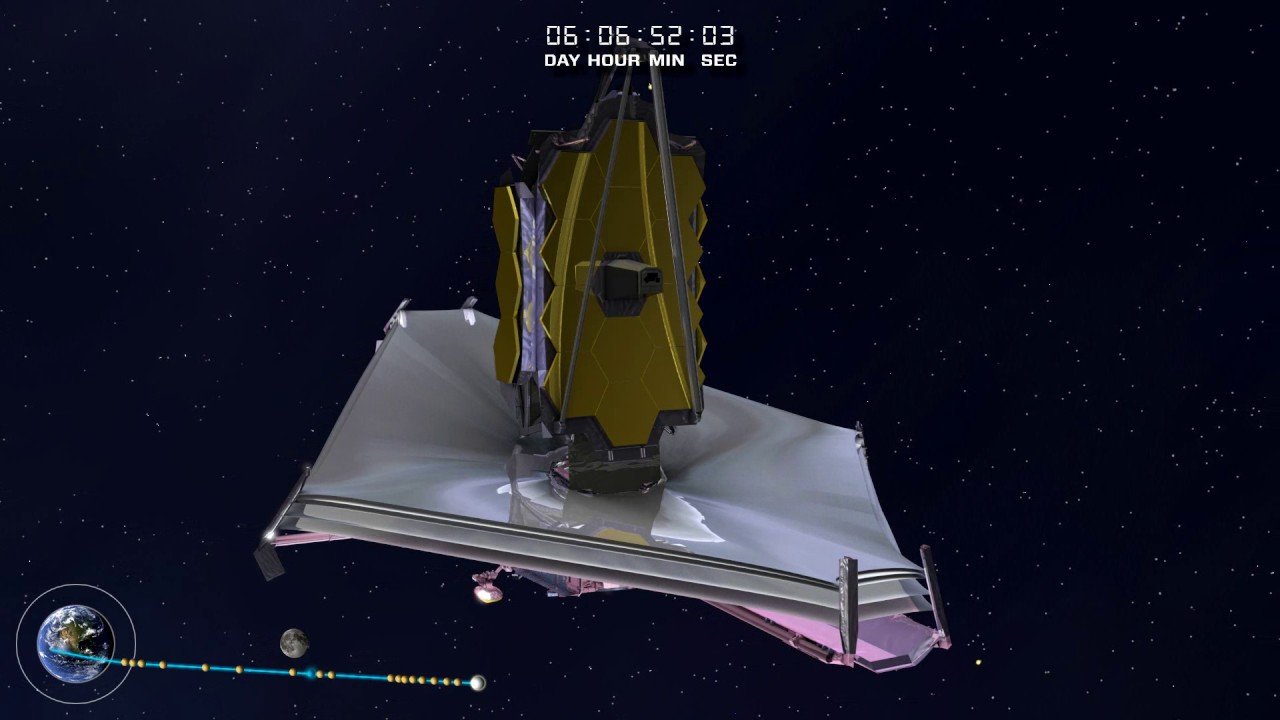
An animation from Northrop Grumman depicts the planned launch of the James Webb Space Telescope on an Ariane 5 and its deployment on the way to Sun-Earth L2, 1 million miles from Earth. It covers the sunshield, mirror and radiator deployments, a trajectory correction 29 days after launch, and commissioning about 160 days after launch.
Full written account
The James Webb Space Telescope, described as NASA's number one science priority, is shown in an animation riding an Ariane 5 rocket toward an orbit 1 million miles from Earth. The sequence, produced by Northrop Grumman, follows the launch and the deployment of what it calls the largest telescope in space, built by thousands of team members in the United States, Canada and Europe.
Launch and ascent
Before liftoff, the team conducts final checks on the health and status of the Ariane 5 and its payload. Seconds before launch, the liquid-fueled engine comes to full power, followed by ignition of two solid rockets. Webb ascends nearly vertically through the heavy lower atmosphere. At maximum acceleration the solid rocket motors are jettisoned into the Atlantic Ocean, and the payload fairing is jettisoned once protection is no longer needed in the upper atmosphere.
The first stage then expends its fuel, shuts down and separates. Between first stage separation and second stage ignition, the telescope follows a slightly downward trajectory over the Atlantic. The upper stage ignites and the ascent to L2 resumes. Because the exposed telescope is delicate and must be protected from the sun's heat, a series of oscillations is performed to avoid overheating. Near the end of powered flight the roll program stops and the launcher takes the attitude for separation.
Cruise to L2
After separation, Webb continues to L2 under its own power. The solar array is its first deployment, and once complete it satisfies all of Webb's electrical power needs. Thrusters sit only on the sunlit side to preserve the cleanliness of the mirrors, and the trajectory is designed without a retrofire that would point the telescope at the sun. Any course corrections must come early to use the limited fuel efficiently. Webb then passes the orbit of the Moon.
Transformation into an observatory
The first transformation is the deployment of the sunshield pallets, followed by the tower that separates the telescope and instruments from the spacecraft and sunshield. The aft flap deploys next; it helps balance the pressure of sunlight around the center of mass and manage momentum buildup and fuel consumption. The membrane launch restraints are released, the protective covers roll back, and the mid-booms extend so the sunshield takes its hexagonal, tennis court-sized shape.
Each sunshield membrane, thinner than a human hair, is then tensioned. Deployed, the shield lets the telescope cool to 385 degrees F below zero, cold enough to liquefy air, while the layer closest to the sun is almost 190 degrees F above zero.
After tensioning, the secondary mirror deploys and latches in place. The aft deployable radiator releases so instruments can radiate waste heat into space, which matters so heat does not overwhelm faint infrared signals. The wings of the primary mirror then deploy and latch, completing the major deployments.
Halo orbit and commissioning
A trajectory correction applied 29 days after launch puts Webb into its halo orbit around Sun-Earth L2, where its orbit is synchronized with Earth's. There it is free from the thermal influence of Earth in all eclipses, and the sun, Earth and Moon are hidden by the sunshield. Once the mirrors and detectors are cold enough, wavefront sensing and control begins, aligning each movable mirror. Commissioning is completed about 160 days after launch, when the science mission is ready to begin.
Questions this video answers
What rocket launches the James Webb Space Telescope in this animation?
An Ariane 5 rocket, lifting off from the Kourou area spaceport as described in the animation (the transcript names the site only as the "Gana Space Center").
Where does Webb operate?
Sun-Earth L2, about 1 million miles from Earth, in a halo orbit.
When is the halo orbit correction applied?
A trajectory correction applied 29 days after launch puts Webb into its halo orbit.
When is commissioning completed?
About 160 days after launch, according to the animation.
How cold does the sunshield let the telescope get?
The telescope cools to 385 degrees F below zero, while the layer closest to the sun is almost 190 degrees F above zero.
Explore related missions
Connected by the topic: Ariane 5