Webb’s Christmas Day Launch on Ariane 5: Countdown to Separation
The short version
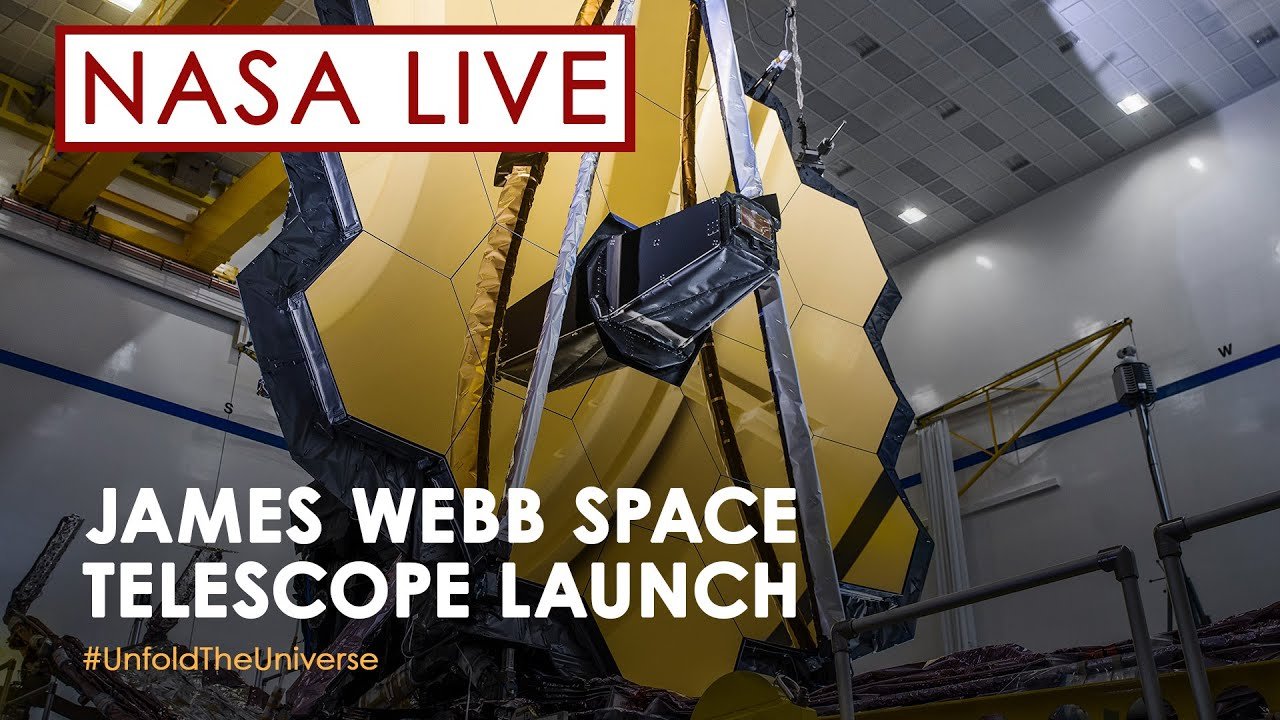
Official NASA and ESA broadcast of the James Webb Space Telescope launch on an Ariane 5 from French Guiana on 25 December 2021. It covers the countdown, the science goals, the telescope's design and the ascent through to separation and solar array deployment. Commentators reported nominal performance throughout and a power-positive telescope after separation.
Full written account
The James Webb Space Telescope left Europe's Spaceport in Kourou, French Guiana, on an Ariane 5 at 12:20 UTC (7:20 a.m. EST) on 25 December 2021, and its upper stage burned for about 16 minutes on only 15 tons of propellant to put it on its way. The rocket's first stage, loaded that morning with 175 tons of propellant (150 tons of liquid oxygen and 25 tons of liquid hydrogen), carried the largest payload ever accommodated on an Ariane 5. The telescope filled the fairing with gaps as small as 10 centimeters in a 5-meter diameter. The launch was uncrewed, and NASA, ESA and the Canadian Space Agency are the partners behind the mission.
A tight fit and a gentle ride
ESA's Daniel de Chambure described the changes made to the launcher for Webb. A specific integration procedure ensured there was no contact between the telescope and the fairing during separation. The venting system was improved to balance the pressure inside and outside the fairing, because of the fear of a depressurization shock that could damage the delicate layers of the sunshield. The roll control of the launcher was tuned so that Webb always faced the Sun with only one side, and the upper stage performed oscillating movements, described as a barbecue mode (also called a sawtooth maneuver), swinging 30 degrees to one side and then 30 degrees to the other to avoid overheating. After separation, the upper stage would perform a specific end-of-flight maneuver to put it into a libration orbit around the Sun to avoid collision in the long term.
Why Kourou
Raphael Chevrier of Arianespace explained that French Guiana lies close to the equator, where the rotation of the Earth gives a launch roughly 1,000 miles per hour of free speed. That boost saves Webb fuel and increases its operational life at its destination about one and a half million kilometers away. Launches go out over the sea, and the site has no hurricanes or earthquakes. Cleanliness mattered too: one speck of dust could alter the observatory's vision, so the facilities were kept pristine from Webb's arrival to its sealing inside the rocket.
Webb crossed the Panama Canal on a specialized cargo ship in a 16-day voyage from Los Angeles, after traveling the LA 405 freeway, which had to be closed. It then rolled out to Launch Pad three two days before launch. Arianespace CEO Stefan Israel said this was the 112th Ariane 5, after 111 successful deliveries.
The countdown
The countdown was described as flawless, though the weather had been dicey in the days before. Webb switched from external to internal battery power about nine minutes before launch, and ground power was cut about a minute before launch. The synchronized sequence began at seven minutes before liftoff. At minus six seconds the cryogenic arms disconnected from the upper stage, and the main Vulcain engine ignited first so that it could be checked before the solid boosters were lit about seven seconds later. The vehicle weighed 770 tons.
Flight to orbit
The milestones, as called out by range operations manager Jean-Luc Voyer and described in the commentary:
- About 1 minute 5 seconds: maximum dynamic pressure, Max Q.
- 2 minutes 15 seconds: the solid rocket boosters separated at an altitude of 44 miles, with the vehicle traveling almost 5,000 miles per hour.
- About a minute later: fairing jettison, which exposed Webb to the environment of flight for the first time.
- About 8 minutes 47 seconds: main stage separation and upper stage ignition, a moment Chevrier called a challenge because it means switching on a cryogenic engine in space.
- 24 minutes 51 seconds: upper stage cutoff, followed by a coast of a little more than two minutes to let oscillations dampen.
- 27 minutes 7 seconds: Webb separated, gently pushed off by springs, at an altitude of about 864 statute miles and about 21,000 miles per hour.
The yellow trajectory line stayed overlaid on the green pre-launch line throughout. Separation speed was slightly below 10 kilometers per second, so that the telescope would not be placed on an escape orbit and there would be time for commissioning. The upper stage camera showed Webb moving away, the last view humanity would have of it.
The solar array deployed slightly earlier than planned. Mission operations manager Carl Starr's team at the Space Telescope Science Institute in Baltimore confirmed Webb was power positive. NASA Administrator Bill Nelson called the launch flawless, noting that 344 things still had to work perfectly, and ESA Director General Josef Aschbacher called it a Christmas gift to humanity.
What Webb must do next
The first science images were expected about six months after launch. Webb needs about 29 days to reach the second Lagrange point (L2), where it orbits in a halo-like path about a million miles from Earth. It launched with 18 mirror segments that each produce a separate point of light, and mirrors must be moved slightly, using the NIRCam camera, until the 18 points become one sharp point.
The sunshield has five tennis-court-size layers of Kapton. The 178 non-explosive actuators on the observatory include 107 membrane release devices, and all 107 on the sunshield must work. The telescope operates at around or below 50 kelvin (minus 370 degrees Fahrenheit), while the MIRI instrument is also cooled by a cryocooler to about minus 450 degrees Fahrenheit. The mirror segments carry a layer of gold a few hundred atoms thick.
The science goals include studying exoplanet atmospheres for water, methane and carbon dioxide through transits, observing the first galaxies, and seeing through dust to forming stars. The TRAPPIST-1 system, whose seven planets fit inside Mercury's orbit, is a target. Webb is also to look at Europa and Titan.
Questions this video answers
When did the James Webb Space Telescope launch?
It lifted off at 7:20 a.m. EST (12:20 UTC) on 25 December 2021.
What rocket launched Webb and from where?
An Ariane 5 rocket launched it from Europe's Spaceport in French Guiana.
How long after launch did Webb separate from the rocket?
Separation from the upper stage came about 27 minutes and 7 seconds after launch, at an altitude of about 864 statute miles.
Where is Webb going?
It is headed to the Sun-Earth L2 Lagrange point, about a million miles from Earth, and the trip takes about 29 days.
When will the first science images arrive?
Commentators said the first scientific images for the public would take about six months.
Explore related missions
Connected by the topic: Ariane 5