Apollo 13: How the Lunar Module Became a Lifeboat After the Blast
The short version
A long-form documentary-style retelling of Apollo 13 built from the mission voice recordings and the Review Board report. It covers the history of oxygen tank 2, the explosion on the way to the Moon, and how Houston and the crew turned the lunar module into a lifeboat and worked the return problem. The transcript provided covers events up to the crew's rest period after the PC+2 burn.
Full written account
How does a spacecraft 205,000 miles from Earth survive when its power and oxygen vanish in minutes? The answer for Apollo 13, launched on April 11, 1970 with Jim Lovell, Jack Swigert and Fred Haise aboard, began with a tank that was damaged years earlier on the ground. The tank failed on the third day of the flight, about 204,839 miles (329,656 km) from Earth, and the crew then used the lunar module Aquarius as a lifeboat.
A tank with a history
The service module's fuel cells made the mission's electricity from cryogenic hydrogen and oxygen. There were three fuel cells, each with 31 connected cells, and the oxygen tanks sat in the service module. The tank in this story, oxygen tank 2, was contracted in 1966 and shipped to North American on May 3, 1967.
In October 1968 its shelf was removed from the service module assigned to Apollo 10. One bolt was still in place, the shelf caught on it, and it fell about 2 inches. Engineers calculated the forces were so low that serious damage was unlikely, and the shelf was reinstalled in the service module for Apollo 13 in January 1969.
Pre-launch tests showed tank 2 could be filled but would not empty normally. Technicians boiled off the oxygen with the heater and fans, and the temperature gauge never read above 80°F (26.6°C), though it had no numbers beyond 80. A fill test on March 30, 12 days before launch, showed the same behaviour. The drop might have damaged the fill and drain fitting.
The thermostatic switches meant to cut heater power at 80°F were rated for the wrong voltage. The spacecraft ran on 28 volts DC, but the pad systems had been changed to 65 volts DC, and the change never reached the switch maker, a subcontractor to Beach. The switches welded shut instead, and the temperature in the tank rose above 900°F (a little over 500°C), leaving the Teflon insulation on the wiring cracked and brittle.
Launch and a crew change
About 100,000 people watched the launch. During the climb the S-II's center engine shut down early, a result of the pogo effect, a vibration like a bouncing pogo stick. Controllers confirmed the other engines were go, and the rocket burned longer to compensate.
Eight days before launch, Ken Mattingly was grounded and replaced by Swigert. Backup lunar module pilot Charlie Duke had contracted German measles, and blood tests showed only Lovell and Haise were immune.
On the third day, oxygen tank 2's quantity gauge went off-scale high. Flight controllers took it for a sensor failure and asked the crew to stir the cryogenic tanks more often. Flight director Gene Kranz noted it as no sweat in the log. That evening the crew gave a television tour of Aquarius, which none of the major US networks carried.
The bang
When Swigert flipped the stir switch, power flowed through the damaged wiring. The video's account is that the Teflon ignited and ruptured the tank with a force of about seven pounds of TNT, enough to shear off a side panel of the service module. Two of three fuel cells were knocked out. The crew heard a dull bang, Haise felt a slight shudder, and Lovell, floating freely, felt nothing.
The call came down: "Houston, we've had a problem." Swigert reported a main bus undervolt. Controllers first suspected instrumentation, since the faulty sensor had already misled them. The venting oxygen acted like a thruster, pushing the stack off course while the RCS thrusters fought it, and controllers warned the spacecraft was getting close to gimbal lock.
About 15 minutes after the explosion Lovell saw gas venting out the window. Flight controller Sy Liebergot had the crew close the reactant valves on fuel cell 3, a step that ended any lunar landing, since mission rules barred landing with two fuel cells. Swigert then shut down fuel cell 1. Oxygen tank 1 kept falling: from 300 to 200 PSI in 10 minutes, with 100 PSI the cutoff for the remaining fuel cell.
Becoming a lifeboat
Using the lunar module's descent engine to get home had been proposed in 1963 and the crew had a procedure for it. There was no plan for a command module that could not provide life support. Aquarius was built for two people for two or three days, with batteries rather than fuel cells, and its power-up checklist ran 59 pages.
At one hour and 41 minutes after the explosion Houston gave the crew a firm deadline: about 15 minutes of power left in the command module. Haise and Lovell brought Aquarius up, using a coarse alignment with gimbal angles from the command module. While Swigert was powering down the Odyssey, a mix-up left the stack briefly without attitude control; Kranz later called it a significant operational error. Swigert repowered the Odyssey's RCS. At 2 hours and 45 minutes after the explosion, Odyssey was fully powered down. Swigert said it felt like a tomb.
Choosing the way home
A direct abort was no longer possible because the spacecraft had crossed into the Moon's sphere of influence. Three burns after passing the Moon were considered:
- A burn one hour after pericynthion of 4,728 ft/s, jettisoning the service module, for splashdown at about 118 hours.
- A burn of 845 ft/s, splashing down in the mid-Pacific around 142 hours.
- A burn using the engine's full capacity, with the service module attached, for the Atlantic at about 133 hours.
The fastest option risked leaving no fuel for a midcourse correction and exposing the Odyssey's heat shield to cold, sunlight and possible micrometeoroid strikes. The slowest return was judged safest. NASA also wanted a Pacific splashdown so the plutonium cask could go into the Tonga Trench.
First came a 31-second burn to reach a free return trajectory, after which they were headed for the Indian Ocean.
Carbon dioxide and a lost star field
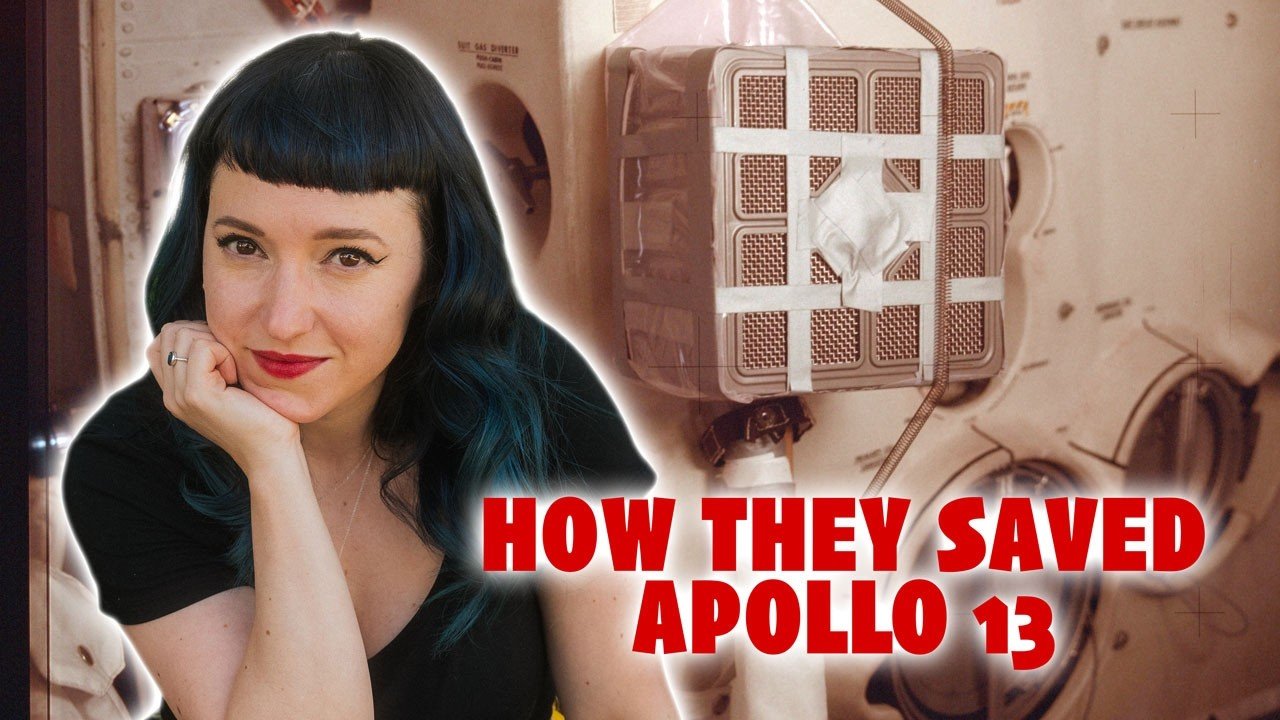
Haise recognised early that the lithium hydroxide canisters in the Odyssey would not fit Aquarius, a square peg in a round hole. The CO2 gauge's upper tolerable limit was 16 mm Hg, and doctors wanted to stay below 15. A Houston team improvised an adapter from a liquid-cooled garment bag, a suit hose and a flight-plan card, which looked like a mailbox. It was tested in a pressurized LEM cabin with CO2 injected at the astronauts' measured rate, up to 9.6 per hour.
Debris and sunlight glinting off it made stars impossible to sight for aligning the platform. Charlie Duke read up a procedure that used the Sun instead. The alignment check passed, and mission control cheered. Gold team flight director Jerry Griffin was so nervous he could barely write legibly in his log.
Around the Moon
Apollo 13 passed behind the Moon at 77 hours and 9 minutes, 21 hours and 14 minutes after the explosion. Lovell was one of 12 people to have seen the far side. Houston reported the S-IVB had hit the Moon and shaken the Apollo 12 seismometer. The PC+2 burn ran at 40% thrust for 21 seconds, then at 100% for 3 minutes 58 seconds. Swigert had been sitting on the ascent engine cover, which shifted the center of mass and made the descent engine gimbal to compensate.
Houston's consumables figures: 1,498 amp hours remaining in the LEM, 215 pounds of water, and 16 lithium hydroxide canisters lasting 12 hours each, enough for 192 hours.
Questions this video answers
What caused the Apollo 13 explosion?
The video explains that thermostatic switches in oxygen tank 2 were rated for the wrong voltage and welded shut, letting the heaters overheat the tank and damage the Teflon wire insulation. When the fans were switched on, the insulation ignited and the tank ruptured.
Why was Ken Mattingly replaced?
Backup pilot Charlie Duke had German measles, and Mattingly's blood test results were inconclusive, so Jack Swigert replaced him 8 days before launch.
Why not take the fastest route home?
The PC+1 burn would have required jettisoning the service module, exposing the heat shield and leaving no fuel for a midcourse correction, so the slowest return was judged safest.
How was the carbon dioxide problem solved?
Engineers in Houston built an adapter from bags, tape and a flight-plan card so the command module's square lithium hydroxide canisters could work in the lunar module's round ports.