Sophie Adenot Back in Europe After 237 Days on the ISS
The short version
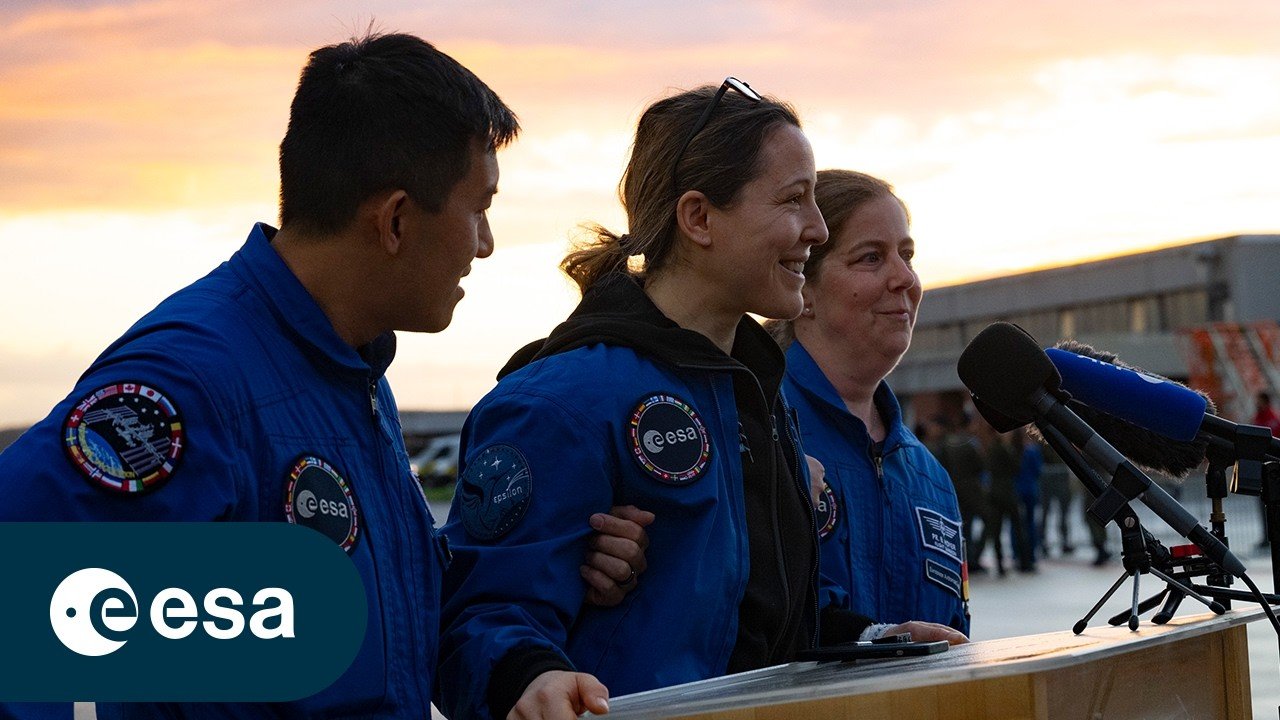
ESA astronaut Sophie Adenot arrived at Cologne Airport two days after splashing down off California with her Crew-12 crewmates, ending 237 days aboard the ISS for her epsilon mission. In a speech she thanked her crewmates, ground teams, partners and medical teams, and described the readaptation symptoms she was experiencing. She will spend two to three weeks at :envihab before continuing rehabilitation with the EAC training team.
Full written account
ESA astronaut Sophie Adenot arrived at ESA's European Astronaut Centre in Cologne, Germany, at 04:21 GMT/06:21 CEST on 10 October, two days after splashing down off the coast of California with her Crew-12 crewmates. She had spent 237 days, nearly eight months, aboard the International Space Station for her epsilon mission. Standing was still a struggle, and she told those gathered on the apron that it felt "more like being held" than standing.
The journey to Cologne
From Ellington Field in Houston, Adenot boarded a French Air and Space Force Airbus A330 MRTT Phénix bound for Cologne. Family, friends, colleagues, journalists and representatives of ESA Member States welcomed her. She said the return to Europe had been delayed until her health stabilized, because she could not make the transatlantic flight until she was more stable.
Readaptation
Adenot said launch was "a piece of cake" while coming back to Earth was not. She described two main issues. The first is orthostatic intolerance: the heart has to adjust its pumping to gravity so that enough blood reaches the brain and she does not faint on standing. The second is the vestibular system, which was used to zero inputs in orbit; she said every small head movement now feels like somersaults, and compared it to a drunk sailor on a crazy boat. She said doctors were not surprised by any of her symptoms.
She will spend the next two to three weeks adjusting to gravity and undergoing data collections at :envihab, a German Aerospace Center (DLR) facility next to the European Astronaut Centre. DLR teams provide operational, medical and scientific expertise for astronauts' return and recovery. She will then continue rehabilitation and follow-up with the EAC training team.
Thanks and reflections
She thanked her crewmates from Expedition 74, Expedition 75 and Crew-12, saying they became a family, along with ground teams, international partners and medical teams. She said teamwork means recognizing who is strong and who is weak and helping the weaker.
From the cupola, she said, she searched for borders and division and saw none, only a precious planet shared as home. She saw auroras, glowing cities at night, oceans and mountains. She explained that the dots around her epsilon patch represent the ordinary steps taken by everyone. She said she does not know what the future holds, and that her first goal is to stand on her own feet.
Questions this video answers
When and where did Sophie Adenot arrive in Europe?
She landed at ESA's European Astronaut Centre in Cologne, Germany, at 04:21 GMT/06:21 CEST on 10 October.
How did she travel to Cologne?
She flew from Ellington Field in Houston on a French Air and Space Force Airbus A330 MRTT Phénix.
How long was she in space?
She spent 237 days, nearly eight months, aboard the International Space Station for her epsilon mission.
What happens next for her?
She will spend two to three weeks adjusting to Earth's gravity and undergoing data collections at :envihab, a DLR facility next to EAC.
What symptoms did she mention?
She described orthostatic intolerance, where the heart must adjust to gravity, and a vestibular system that left her feeling like everything spins.
Explore related missions
Connected by the topic: International Space Station