Apollo 13: Home Safe, Survival After the Oxygen Tank Explosion
The short version
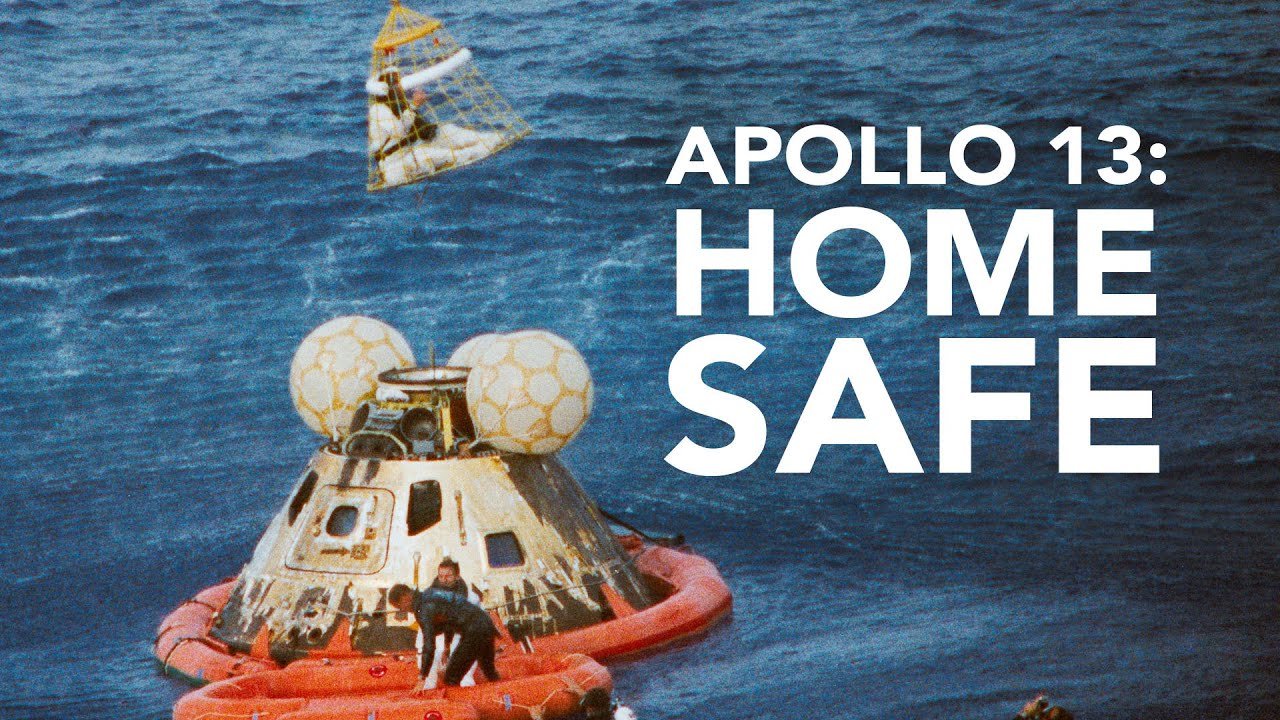
NASA's documentary on Apollo 13 draws on interviews with astronauts Jim Lovell and Fred Haise and flight directors Gene Kranz and Glynn Lunney. It follows the oxygen tank explosion, the use of the lunar module as a lifeboat, the burns to get home, the cold and carbon dioxide problems, and the crew's splashdown.
Full written account
Apollo 13 was a lunar mission that turned into a fight for survival. According to Flight Director Gene Kranz and others interviewed by NASA, the problem was life-threatening, and the question was no longer where to land on the Moon but how to get home.
The explosion
The crew was Jim Lovell as commander, Jack Swigert as command module pilot and Fred Haise as lunar module pilot. Swigert replaced Ken Mattingly two and a half days before launch because of a measles threat, something Haise says had never happened before or since on a mission.
Near the end of a shift, Mission Control asked the crew to stir the cryogenic tanks to equalize pressures feeding life support and the fuel cells. Then came a loud bang that Haise compared to a sledgehammer hitting a barrel, and metal in the tunnel area crinkled. In the command module he saw two of three fuel cells lost, then oxygen escaping from the window. He explained that the explosion occurred in the first tank and also ruptured the second.
In Mission Control, two meters showed oxygen tank two at the bottom of the scale. Because they were fed by different sensors, the controller knew the tank was lost and that it meant an abort, without opening the mission rules.
The lifeboat
The command module was dying quickly and the battery had to be saved for entry. Controllers had about 15 minutes of power left to transfer the guidance system from the command module to the lunar module, which would serve as a lifeboat. The crew was in the lunar module before the ground realized it.
The spacecraft then had to be put back on a free return course. Controlling it by computer display alone, to save power, was something Lovell had never tried.
Getting home
A burn with the lunar module descent engine at about 79 hours shortened the trip. The nominal return was 155 hours, and Haise's back-of-the-envelope calculation gave about one hour of spare consumables.
The command module temperature fell to about 38 degrees, walls and windows were wet, and a potable water line froze. The carbon dioxide canister filled quickly. Lovell and Haise built two adapters from command module canisters, and within an hour the partial pressure of CO2 fell from about 15 millimeters to two tenths.
The trajectory was shallowing, so another burn was needed with no platform powered up. Using the terminator of the Earth and the Sun position, an idea from Apollo 8 preparations, the crew made a manual burn at 105 hours. Swigert timed it, Haise handled pitch, Lovell handled roll.
Entry
Ground teams wrote a procedure in about three and a half days to power up a command module that had never been designed to be shut down. Swigert pushed in circuit breakers in groups, stopping to check for burning wire. The Apollo 1 fire led to rewiring, which Lovell credits with making the vehicles virtually waterproof.
The service module was jettisoned at 138 hours, 2 minutes, 8 seconds, and Lovell saw a panel blown off. The lunar module was then pushed away with tunnel pressure. Entry was automated, all three parachutes came out and the crew landed on the water in a calm recovery. The president declared the mission successful.
Questions this video answers
Who was on the Apollo 13 crew?
Jim Lovell was commander, Jack Swigert was command module pilot, and Fred Haise was the lunar module pilot. Swigert replaced Ken Mattingly two and a half days before launch because of a measles threat.
What happened to the spacecraft?
An oxygen tank in the service module exploded and also ruptured the second tank. Two of three fuel cells were lost and the crew used the lunar module as a lifeboat.
Why was the command module so cold?
With power shut down, the command module temperature slowly dropped to about 38 degrees before re-entry, and one potable water line froze.
How was the carbon dioxide problem solved?
Lovell and Haise built devices adapting command module lithium hydroxide canisters for the lunar module, based on a procedure read up from the ground.