Crew-12 Leaves the ISS: Dragon Freedom Undocking Step by Step
The short version
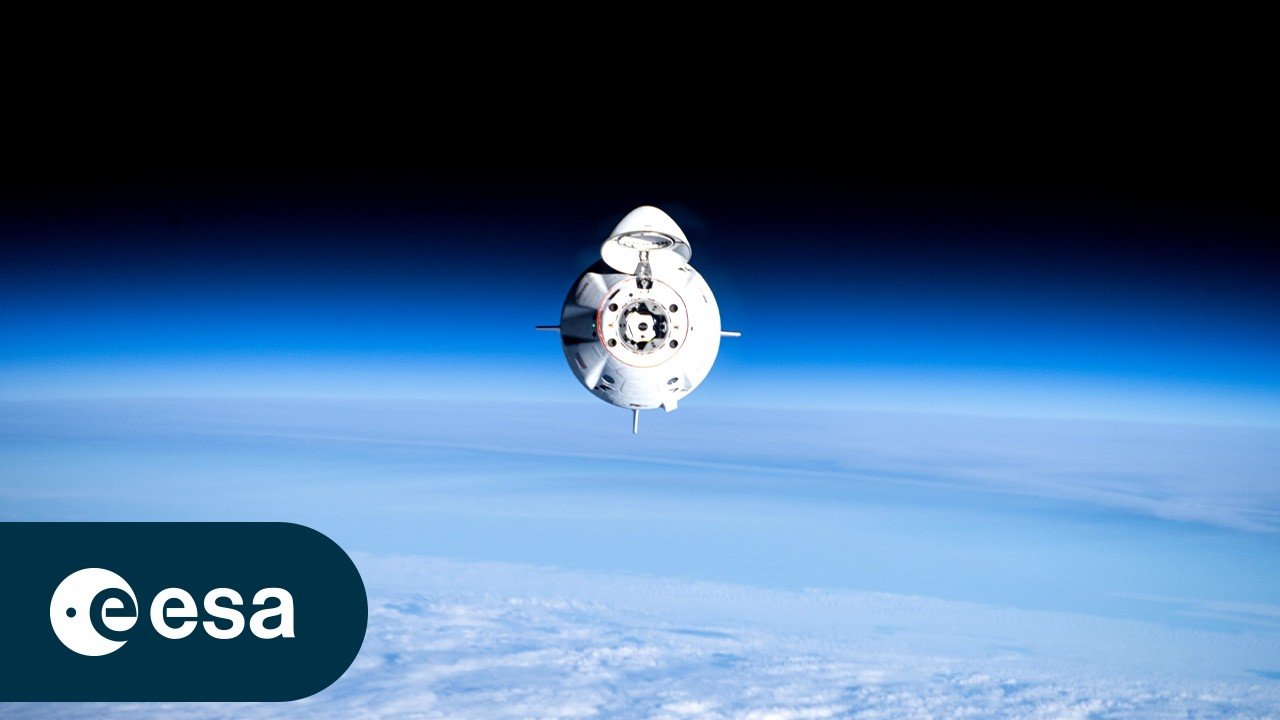
ESA's broadcast follows the Crew-12 Dragon Freedom spacecraft undocking from the International Space Station on 7 October 2026 with Jessica Meir, Jack Hathaway, Sophie Adenot and Andrey Fedyaev. It covers the hatch closing, the roughly five-minute undocking sequence, departure burns and the exit from the keep-out sphere and approach ellipsoid. Splashdown off California was targeted for the next day.
Full written account
How does a Dragon capsule carrying four people leave the International Space Station without anyone touching a control? On 7 October 2026, Crew-12 undocked aboard the Dragon Freedom spacecraft at 8:05 a.m. Eastern (5:05 a.m. Pacific), while the station was traveling 262 statute miles over northern Cuba. NASA astronauts Jessica Meir and Jack Hathaway, ESA astronaut Sophie Adenot and Roscosmos cosmonaut Andrey Fedyaev were headed home after 235 days aboard the station.
A departure designed to be autonomous
Dragon's departure and de-orbit are designed to be fully autonomous, requiring no action from the crew. Departure is typically faster and easier than arrival because the spacecraft does not stop at waypoints, as it does when approaching the station. The crew's flight home was expected to last about 27 and a half hours, with splashdown targeted off the coast of California on Thursday, 8 October at approximately 8:34 a.m. Pacific (11:34 a.m. Eastern).
The hatches had been closed at 6:05 a.m. Eastern, followed by depressurization of the vestibule to vacuum. NASA astronaut Anil Menon helped the crew prepare for hatch closing. During undocking, Canadian Space Agency astronaut Joshua Kutryk monitored operations from the Cupola, though the prime monitoring role fell to the crew inside Dragon. All four were suited, and the crew wears suits during docking and undocking in case of off-nominal situations such as a cabin depressurization; the suits also keep them cool.
The five-minute undock sequence
Crew-13 had arrived on 1 October, after a trip of about seven and a half hours, and spent almost a week in handover with the departing crew. Before the undock, joint NASA and SpaceX teams polled "go" and the crew confirmed four visors down. The undock command was issued about five minutes before separation. The sequence retracted the umbilicals, then opened 12 hooks, in two sets of six. Once the second set was opening, the controller noted that Dragon was committed to undock.
Unlike Soyuz vehicles, which rely on springs to push away from the docking port, Dragon uses two short firings of its Draco thrusters: the first breaks any stiction between Dragon and the docking port, and the second slowly backs the spacecraft away. The call came: "All hooks are open. Separation confirmed."
Burns and invisible boundaries
Departure burn zero lasted 16 seconds. Departure burn one, expected to last 22 seconds, followed at about 8:10 a.m. Eastern, after which the crew got a go to doff their suits. Four departure burns in total move Dragon away from the station, and a later phasing burn lowers its orbit and lines it up with the landing location.
Two invisible boundaries govern the area around the station:
- The keep-out sphere, a 200-meter-radius boundary. Before entering it, a spacecraft must be configured so it would not cross the boundary for at least four orbits even if it lost all maneuvering. Dragon exited it at about 8:11 a.m. Eastern.
- The approach ellipsoid, measuring 4 km by 2 km by 2 km. Vehicles outside it must be on a 24-hour safe free drift trajectory, meaning they would not cross into it for at least 24 hours even if they lost all maneuvering.
The approach ellipsoid exit was expected around 8:24 a.m. Eastern. Once confirmed, with Dragon on a safe free drift trajectory, the shared "big loop" communications channel linking Houston, Hawthorne, the station crew and the Dragon crew was taken down, and SpaceX took over communication with the crew through splashdown. Before the exit, Dragon was about 715 meters from the station and later almost 1,000 meters away.
The crew and the mission
Meir, the commander, has spent 442 days in space over two flights, the 10th most by a NASA astronaut. She did four spacewalks on this mission totaling 27 hours 38 minutes, and seven in her career totaling 49 hours 22 minutes. Hathaway, the pilot, was on his first flight; a US Naval Academy graduate, he has more than 2,500 flight hours in 30 types of aircraft and has flown 39 combat missions. Adenot, a French mission specialist on her first trip to space, did three spacewalks totaling 19 hours 42 minutes, and at splashdown would have 237 days in space, the seventh most by an ESA astronaut. Fedyaev, on his second mission, became the first Russian cosmonaut to fly twice in Dragon, with 423 total days in space.
Over the mission the crew completed 3,792 orbits of Earth by the time of landing, traveling more than 100 million statute miles. They spent over 1,000 hours on more than 250 research investigations. Examples included Veg-06, on how space flight affects the relationship between plants and nitrogen-fixing microbes, and IV Gen Mini, a compact system to make saline from drinkable water, given that commercial IV fluids have a shelf life of only about 16 months.
The crew also took part in four spacewalks in the months before departure. During spacewalk 96 in August, they installed hardware to modify the station's 3B power channel for a future ISS Roll-Out Solar Array (IROSA), due for delivery later in the month on SpaceX's 35th commercial resupply mission.
Questions this video answers
When did Crew-12 undock from the ISS?
Dragon Freedom undocked from the International Space Station at 8:05 a.m. Eastern (5:05 a.m. Pacific) on 7 October 2026, as the station was traveling about 262 statute miles over northern Cuba.
Who was aboard Dragon Freedom?
Jessica Meir (commander), Jack Hathaway (pilot), ESA astronaut Sophie Adenot and Roscosmos cosmonaut Andrey Fedyaev.
How long was the trip home?
The flight home was expected to last about 27 and a half hours, with splashdown off the coast of California targeted for about 8:34 a.m. Pacific (11:34 a.m. Eastern) on 8 October.
How long was Crew-12 in space?
Crew-12 was to have spent 235 days aboard the station and 237 days in space once they complete the return.
What is the approach ellipsoid?
The approach ellipsoid is an invisible boundary of about 4 km by 2 km by 2 km around the station. Vehicles outside it must be on a 24-hour safe free drift trajectory.